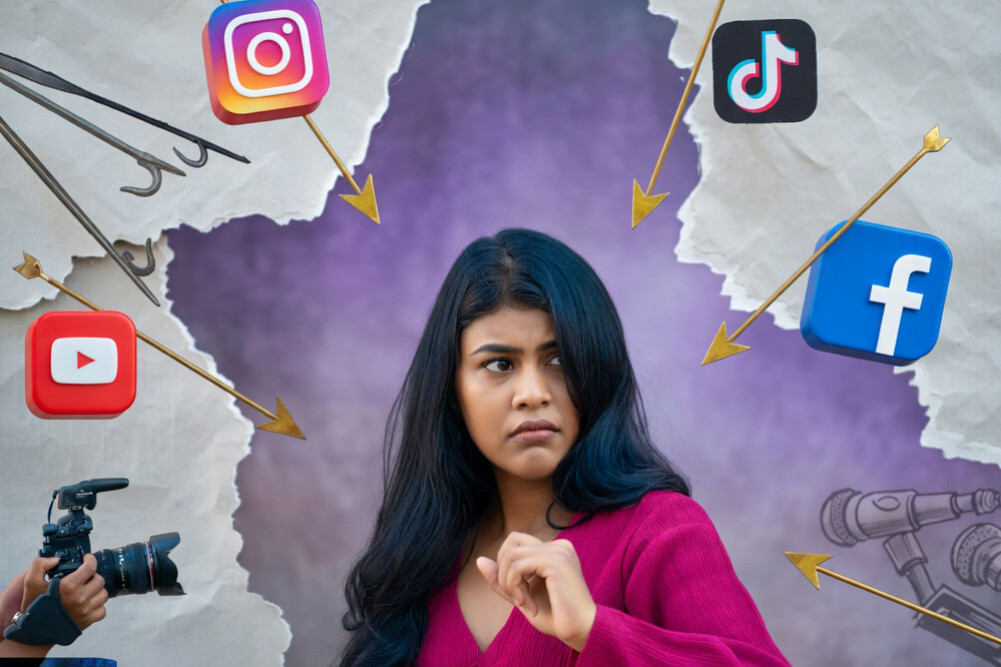
The development of a tendency to avoid speaking out due to fear is a great threat to democracy and a free society.
We use Google Cloud Translation Services. Google requires we provide the following disclaimer relating to use of this service:
This service may contain translations powered by Google. Google disclaims all warranties related to the translations, expressed or implied, including any warranties of accuracy, reliability, and any implied warranties of merchantability, fitness for a particular purpose, and noninfringement.
After the police arrested UML Chairman KP Sharma Oli on Saturday morning, the UML organized a protest program in the afternoon. Amisha Parajuli participated in it. During that, she answered a journalist's question and called Oli's arrest wrong. Her other statements were logical from her side. No one had insulted her personally with her statement. But because she is a UML supporter, because she spoke in favor of Oli, and because she opposed the arrest, she is now forced to face violence on social media. After trolls and vulgar jokes started making her laugh, she has had to turn off the comment feature on her TikTok.
She is not the first person to face violence on social media for expressing her opinions. Many people like her who vote on public issues have had to face personal comments, trivial abuse, and threats from strangers and unrelated people on social media. And, women are more likely to face such violence. It has been reported that Parajuli herself has been threatened with rape.
Like Parajuli, Renuka Dahal, who said before the election, "If Balen wins from Jhapa, I will cut off my ear, go to the teaching hospital and get it stitched, and I will also give this earring to Balen," also faced violence and harassment on social media and public places. People used 'AI' to create a photo of her with another person and posted it on social media. Some even managed to create a photo of her cutting off her ear using 'AI'.
People can also be seen taking her photo and video in public places and uploading it on social media by mentioning her name. She is still facing questions like, "Isn't Didi cutting off her ear?" Not only her, but her children are also being bullied. That is why she has had to request through her social media, "No matter what I say to her, don't tell anything to my family."
A few months ago, another young woman who posted a photo of herself holding the flag of one of the old parties on social media also faced trivial abuse. The comment box of the photo was full of very vulgar comments. The word ‘sloppy’ was the most used.
There is a common trend in the above-mentioned context. First, the commenters often use obscene, vulgar and rape-threatening language. Second, most of the commenters are young people. Third, if you look at the profiles of those commenting in this way, you will understand that they are supporters of a new party.
Obscene, vulgar and rape-threatening comments and the involvement of young people in them expose the criminal nature of our society. This is a very scary sign. Because, threatening to rape someone when you don’t like their opinion shows how unsafe this society is for girls. If the society was civilized, even if you don’t like someone’s argument, you would politely argue against it. Facts would have found a place. Either there would have been agreement, or you would have carried your own ideas. Here, rape threats are openly made. Serious treatment of this disease in society is inevitable.
Second, most of the people who make such comments seem to be supporters of the Rashtriya Swayamsevak Sangh (RSS). This is not surprising, because one can support the party one likes. However, this party has become big now. It will surely earn the trust of the people through its work. Its time has begun for that. However, when supporters of this same party hate, threaten, and call supporters of other parties 'scum', it does not benefit the party itself. Because being big means being tolerant, being responsible, being a guardian in a way that even the minority feels safe. Not being arrogant, not prohibiting. The leadership of the RSSS should appeal to its supporters about this. People who are in the minority or do not support it are also safe and should be assured that they can freely express their opinions.
The RSSS should understand now that if different opinions cannot be protected in a democracy, it will be counterproductive in the future. Because, people with criminal character may be supporters of some party today, but over time, they will damage the very institution they support. It is good to remember how the extremist activists and supporters of various parties in the past brought the same party to disaster.
Another aspect of this context is related to the right given by the Constitution itself to express one's views. The fundamental right of the Constitution (right to freedom) is that every citizen has the right to freedom of thought and expression. There is the freedom to assemble peacefully without weapons. Therefore, everyone should be able to experience this freedom.
There is no reason for Parajuli, Dahal, or a young woman holding a photo of a party flag in her hand who expresses her opinion without harming others, without damaging public structures, and without going against social values and customs to face violence. Those who commit violence against them should be punished.
The issue of which party or idea to favor is a personal concern of the individual. Nepal has a multi-party democracy. Where it is natural to have different parties, beliefs, and ideas. People are free to campaign for the party they believe in, to participate in programs organized by the party. They are free to cast their votes.
On the other hand, one may or may not agree with someone's opinion. That is a matter of personal freedom. But questioning someone's morality and character, threatening rape, and mocking them for having different opinions, beliefs, and political views is not suitable for a civilized citizen and a free society.
If expressing opinions is prohibited in society, then 'self-censorship' increases in people. Before writing or speaking, people may ask themselves questions like 'Will something happen to me', 'Will I have to face violence because of the opinions I hold', or 'Will my family members suffer'. At that time, freedom of expression shrinks. The development of a tendency not to speak out due to fear is a great danger to democracy and a free society. This may result in people not speaking out even when very wrong things are happening in society tomorrow. Therefore, people who love violence and have criminal attitudes should be punished now. It may be too late.