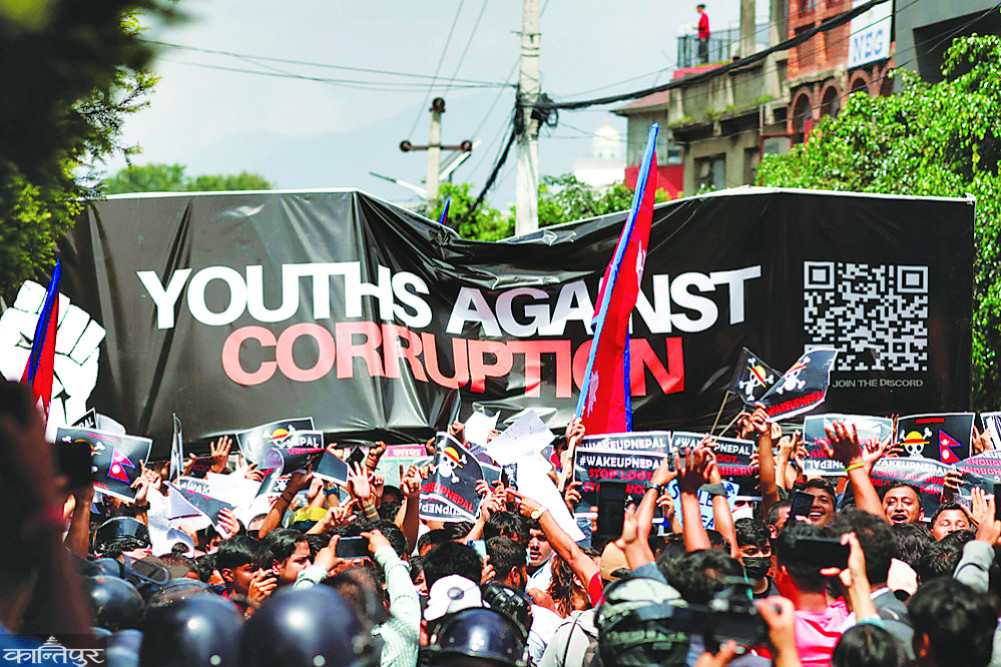
The rise of the Rashtriya Swayamsevak Sangh (RSS) has sparked a new hope for good governance and inclusive justice, as the Nepali people staged a historic uprising against decades of misrule, corruption, and a drought of opportunity.
We use Google Cloud Translation Services. Google requires we provide the following disclaimer relating to use of this service:
This service may contain translations powered by Google. Google disclaims all warranties related to the translations, expressed or implied, including any warranties of accuracy, reliability, and any implied warranties of merchantability, fitness for a particular purpose, and noninfringement.
The results of the House of Representatives elections held on 21 Falgun have completely shattered the established norms and traditional power structures of Nepali politics. The National Independent Party (NISP) has won a total of 182 seats, including 125 directly and 57 proportionally. Thus, it has received a clear and powerful mandate to assume state power as the largest party.
This victory is not just the emergence of a political party, but rather a ‘silent rebellion’ expressed by the Nepali people against the prevailing injustice and misrule for decades. The famous satirist Mark Twain had said that politicians and diapers should be changed from time to time. This time, Nepali citizens have given a historic vote to change the ‘diaper’ of the government for years, embodying Twain’s words.
The foundation of this change is particularly linked to the rebellion of Gen-G who took to the streets on 23 and 24 Bhadra. Which was not inspired by any party interest. That was the anger generated by the drought of decades of opportunity, whose main and strongest demand was good governance. Therefore, as glorious as this burden of public opinion is for the new government, the challenge of making the good governance agenda raised by the Bhadau uprising meaningful is equally difficult. Good governance and prosperity must be the first and essential condition in the journey ahead.
The more intense the debate on good governance in Nepal, the more frightening the picture of unrest has been. Therefore, now we want to see not only a government formed, but a country formed. The ‘Corruption Perception Index’ (CPI) 2025 report released by Transparency International has shown that Nepal is still ranked 108th in the list of countries with the highest levels of corruption. Due to corruption and policy deviations prevalent in every branch of public administration, the common people were not able to perceive the existence of a state.
The current election results have made it clear that citizens now want to see the mechanism that protects the ‘big fish’ and the setting of middlemen completely dismantled. The new government should strictly implement the zero tolerance policy to establish good governance not just as a popular slogan, but as a system.
Full adoption of technology in government service delivery and the moral courage to bring anyone involved in corruption to justice will be the real solution after this election. Another major problem of the country is unemployment and the exodus of energetic manpower, which is making the future of the country uncertain. According to the data of the Department of Foreign Employment, an average of 2,000 to 2,500 Nepali youth are leaving the international airport for work every day.
This lark is not a desire, but rather a compulsion of the state's inability to create opportunities at home. Now, the Rashtriya Swayamsevak Sangh (RSS) government should focus on the 'startup' ecosystem, industrial revolution and commercialization of agriculture instead of getting involved in distribution-oriented programs and cheap popularity. The government should arrange for the right to guaranteed employment through the constitution.
As long as the country's economy depends solely on remittances, sustainable development is not possible. We are now looking for not just assurances, but a direct experience of a decent and secure labor market where we can sweat on our own soil. Another key issue, the question of social justice, is also not limited to constitutional documents and quotas of inclusion.
As world-renowned jurist Amartya Sen said in his theory of justice, ‘Justice is not just the formal observance of rules, but also the development of the real freedom and capabilities of man.’ According to Sen’s ‘capability approach’, real justice is possible only when the state provides every citizen with an equal legal basis and opportunity to improve their standard of living.
In the context of Nepal, social justice is not just about counting the voices of Dalits, tribals, women and marginalized communities in numbers, but also about making them decisive in policymaking and resource allocation. It is primarily about working for the empowerment of the most vulnerable communities. The new leadership must now establish a system where merit can be used instead of nepotism and favoritism, where the backward classes can feel that the state is ‘mine too’.
Because the state does not belong to any particular community only, but to every citizen, and the rights of all need to be ensured. This historic referendum on 21 Falgun is the last chance given by the citizens to political parties. This new force has reached the pinnacle of victory on the basis of the political awareness and keen appetite for good governance that was aroused among the citizens by the repeated movements and especially the uprisings of 23 and 24 Bhadra.
If this government, like the past, does not break the web of corruption, does not stop the flow of youth migration, and reduces the issue of good governance to speeches and manifestos only, then the country is certain to be pushed towards a deeper constitutional and political disaster. The elections are over, a major party has also been formed, but the real test now is in the delivery. We need not just another government, but a clear and credible national solution built on the foundation of good governance. Good governance is the first and indispensable condition for prosperity now.