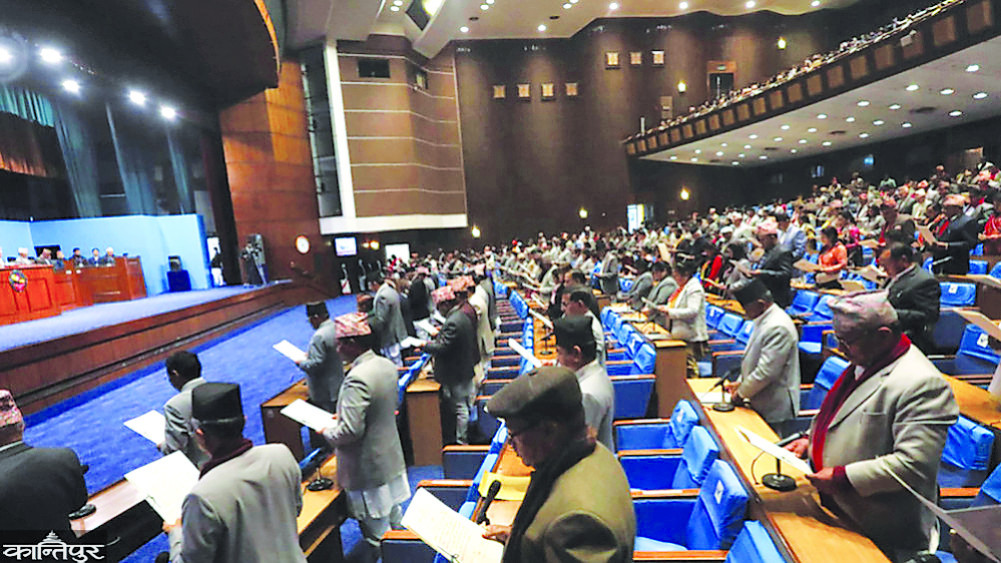
What are the parties' views on burning political agendas? Parties need to mention a clear vision and a concrete roadmap for solutions in their manifestos. If there is no clear vision on such agendas, the manifestos will be incomplete.
We use Google Cloud Translation Services. Google requires we provide the following disclaimer relating to use of this service:
This service may contain translations powered by Google. Google disclaims all warranties related to the translations, expressed or implied, including any warranties of accuracy, reliability, and any implied warranties of merchantability, fitness for a particular purpose, and noninfringement.
(Candidates for the 21 Falgun elections are reaching out to the public with their manifestos. They are presenting their agenda. At this time, Kantipur is launching a special series 'Kantipur Bimarsha: Manifesto' to present the people's agenda to parties and candidates. You too can write a manifesto for this series, focusing on a specific area. We will give space to manifestos that are based on facts, figures, and logic.)
As the election date of 21 Falgun approaches, a fresh debate has begun on the agendas and manifestos of political parties. It is natural for such a debate to occur on the eve of the upcoming election at a time when Nepali politics is going through a very sensitive phase. When reviewing the past, parties would issue ritualistic manifestos for formality, but after the election, those manifestos have been neglected. Therefore, parties have been sharply and harshly satirized by comparing the manifestos to the well-known proverb of Nepali society, ‘tying up a cat in a ritual’. A manifesto is a vision with clear policies, plans, and programs that any party will deliver over a five-year period. But party manifestos are either rituals or like bundles of dreams. Manifestos contain more dreams than resolutions, more illusions than visions, and more propaganda than policies and plans.
At a time when the global wave of populism is having a significant impact on Nepal, the populist trend of deifying the leader rather than the manifesto and vision and trading illusions among the people in the name of popularity seems to be dominant in the upcoming elections. Now, debates and accusations are going on based on misleading statements, not on the agenda, not on the face and vision, but on the basis of false statements. On the other hand, due to the lack of implementation, it seems that the people are also losing importance to the manifesto. No party has yet made the main political agenda of the election public. But what is needed today is to go to the people with a clear vision and concrete proposals on the existing burning political, constitutional, economic, social, commercial, and cultural agendas. Since the columnist is a student of political science, the article focuses on the main political agenda that must be included in the manifesto.
The need of the day is to develop the democratic system established through the sacrificial struggle of the people and the historical people's movement into a more advanced, liberal and inclusive system and establish a prosperous, just and equitable society. What kind of constitution, what kind of amendment?
The constitution made through the historic Constituent Assembly is democratic, republican, liberal, pluralist, federal, progressive, inclusive, secular, and rights-friendly. This constitution has truly made the people sovereign and has developed Nepal as a nation-state. The constitution of Nepal is considered one of the best constitutions in the world in terms of democratic, liberal and rights-friendly principles. However, some political parties as well as women, Madhesi, indigenous people, Dalits, minorities and marginalized communities have some disagreements and complaints about the constitution. Therefore, they have been raising their voices to address their demands by amending the constitution. After the Gen-G rebellion, some Gen-G communities have also been making such demands. Since the constitution is a dynamic and changing document, it is a natural democratic process to amend, revise and update it according to the feelings of the people from time to time. Therefore, it is necessary to develop it as a common and prosperous document that the entire people will take ownership and ownership of through its liberal and progressive amendments, while assimilating the democratic principles of the constitution.
The important question today is how this democratic system can be transformed into a functional, result-oriented and accountable system. Citizen supremacy, citizen rights, separation of powers, independent judiciary, periodic elections, freedom of the press and expression, rule of law, human rights are the basic universal principles of democracy. These principles are the prerequisites of any democratic system. Developing the democratic system established through the sacrificial struggle of the people and the historical people's movement into a more advanced, liberal and inclusive system and establishing a prosperous, just and equitable society is the need of the day. Therefore, at a time when the question of not being able to deliver as expected is being raised, it is inevitable to transform this democracy into a democracy that delivers.
What electoral system, what amendment?
The electoral system is another controversial and complex agenda. The constitution issued in 2072 followed a mixed electoral system with direct and proportional representation. However, when analyzed against the backdrop of no single party getting a majority from the union to the provinces in the two elections held in 2074 and 2079, the reality has been confirmed that the possibility of a single majority in the future has diminished. There is a cycle of political instability with frequent changes of government from the union to the provinces, unholy alliances and hateful games between parties for power and power, and a vicious cycle of producing Prime Ministers, Ministers and Chief Ministers. Due to this, widespread discontent has arisen among the people, questions have been raised not only about the electoral system, but also about the constitution. Therefore, concluding that the electoral system is a source of instability, there has been a strong voice from political parties to the people to amend the constitution and follow a system that guarantees a stable government.
But no electoral system is and cannot be an absolute source of stability or instability. It also depends on the people's opinion, balance of power, and the policies, strategies and culture of the parties. But apart from the theoretical proposal and political opinion to review the electoral system, no concrete proposal has been made public by any party so far. Informal proposals such as making the House of Representatives directly elected and the National Assembly proportional, increasing the threshold by reducing the number of proportional representation, and reducing the number of federal and provincial ministries and MPs have been debated. But another reality is that the history of political stability not being achieved even when one party achieved a majority is alive. In the 2048 and 2056 elections, the Congress had a clear majority. But not only was there no stable government, but both times the parliament was dissolved and the game of instability started. Similarly, in 2074 BS, the then NCP had a majority. But due to internal disputes and power struggles, the House of Representatives was dissolved twice each, while the NCP itself was divided. Therefore, even though both the Congress and the UML got a majority, they failed to maintain stability.
In a multi-religious, multi-ethnic, multicultural, and multilingual country like Nepal, a mixed system is appropriate. The proportional system, as portrayed by some parties, is not a problem. If an alternative to the proportional system, which is considered the basic pillar of the constitution, is sought, another complex dispute may arise. Therefore, the current solution is to review the proportional system and balance both by providing political stability and proportional representation. Addressing the anomalies seen during the exercise, the scope of the proportional and inclusive system should be broadened, not narrowed, in accordance with the values and beliefs of the constitution. Therefore, it is necessary to ensure more representation not only in proportional representation, but also in the direct elections of women, Madhesi, indigenous people, Dalits, minorities and marginalized communities in the House of Representatives and Provincial Assemblies and make amendments and revisions.
Suppose federalism is abolished. Will the problem be solved? In the opinion of the columnist, it is not. The alternative to federalism is a more advanced, liberal and people-oriented federalism. But the alternative to federalism is not and cannot be a unitary and centralized system. What kind of federalism, what kind of amendment?
Nepal, which has been a laboratory for political movements, constitutions and governance systems for a long time, has been engaged in controversial debates about the need and justification of federalism since its announcement. Although it was announced in 2065, federalism was implemented only after the constitution was promulgated in 2072. But federalism has become so controversial and unpopular that it seems that even negative commentary is being made about the democratic republic and the constitution because of federalism. Federalism has been criticized and widely commented on in public discourse, social media and digital media, calling it an 'unwanted baby' and a system imposed by foreigners. In the context of Nepal, federalism is a process of restructuring a unitary and centralized state. But what public opinion has been created is that 'there is no justification for the federal system and provinces in the current situation.' That delivery has to be done, otherwise it will be abolished. There is no third option.’
Suppose federalism is abolished. Will the problem be solved? In the opinion of the columnist, it is not. The alternative to federalism is a more advanced, liberal and people-oriented federalism. But the alternative to federalism is not and cannot be a unitary and centralized system. It is inevitable to devolve power to the lower-level governments and the people through the federal system. If federalism is abolished, not only will it create unwanted political complications, it may even lead to unimaginable political conflicts. But even in the status quo, federalism has no future. It should be transformed into a system with more rights and resources, people-oriented, functional and effective, by assimilating the spirit of the Constitution and the principle of federalism. The provincial government should be reformed and strengthened. To make federalism successful and the provincial structure effective, the constitutionally granted rights must be unconditionally vested. This is both the letter and spirit of the constitution, and this is also the appropriate model for Nepal. It is a democratic and people-oriented system that not only empowers the people in political, economic, and natural resources, but also ensures social, cultural, and linguistic rights and identity. The fundamental principle and main objective of federalism is to make the government accountable by ensuring the direct participation of the people in all levels of government. In federalism, the sovereignty and rights of the state are clearly mentioned in the constitution and distributed to all levels of government. While the governments of the respective levels are autonomous in exercising individual rights, coordination and cooperation should be required between all levels on matters of common rights. Therefore, federalism, inspired by the concepts of self-governance and common governance, is a system of coordination, coexistence, and cooperation between governments at all levels.
The federal system is considered more suitable than the unitary system in terms of addressing the religious, social, cultural, linguistic, geographical, and ethnic plurality and diversity existing in society. Federalism has embraced liberal values that ensure identity, access, representation, and dignity for all. Federalism is considered superior to unitaryism in terms of people's participation, rights over natural resources, and cultural-linguistic identity. In the context of Nepal, no government or party has made a sincere effort to fully implement federalism. Due to the new provincial structure, the provincial assembly was not effective and the provincial government was also unable to deliver. The party and the provincial government had the opportunity to confirm the legitimacy of the province by delivering according to public sentiment, but they lost it. When analyzed based on the people's opinions and reactions, it seems that the people do not have trust, ownership, and belonging to the province. Therefore, the process of federalization has become longer, more complex, and more controversial than expected.
Britain is considered the mother of parliamentary democracy. Parliamentary democracy is also called the Westminster system because the Parliament building is located in Westminster, England. The parliamentary system is an indirect democracy and a representative system, while the presidential system is a direct and participatory system. What form of governance, what system of governance?
After the Gen-G movement was successful and an interim government was formed, the debate about the form of governance has resumed. Now, some Gen-G communities and some parties have been raising their voices in favor of a directly elected executive, calling the parliamentary system a failure. There was extensive discussion, debate, and controversy about the form of governance in the first and second Constituent Assembly. But after the direct presidential system could not be agreed upon, a compromise was finally reached on a reformed parliamentary system and a mixed electoral system. Did the failure of the parliamentary system create a situation for the adoption of a directly elected executive system? The question has been raised.
Britain is considered the mother of parliamentary democracy. Parliamentary democracy is also called the Westminster system because the Parliament building is located in Westminster, England. The parliamentary system is an indirect democracy and a representative system, while the presidential system is a direct and participatory system. In a parliamentary system, the people elect the MPs and the Parliament elects the Prime Minister. In a parliamentary system, the Prime Minister is accountable to the people through Parliament. Only in this system, which embodies the values and norms of parliamentary supremacy, is the Parliament truly sovereign.
Parties, groups, and individuals in favor of the directly elected executive system have been making some arguments, debates, and proposals. The system of electing the Prime Minister from the parliament is the main source of political instability and crisis. Instead of such a failed and unstable system, it is necessary to adopt a directly elected executive system for political stability. This is the only solution to the current crisis in Nepali politics and the right time to make such a decision is now. Only a directly elected executive system runs the state in a way that is responsive to the people and also guarantees development, good governance and delivery. The people are also found to be meaningfully attracted to such debates, proposals and conclusions.
However, when analyzed based on national and international experiments and results, the parliamentary system is the most suitable for Nepal. The existing problems, distortions and inconsistencies of the parliamentary system should be resolved by amending the constitution and this system itself should be made more sophisticated, responsible and effective. To escape the cycle of political instability, adopting another authoritarian and totalitarian system in the name of political stability is like the Nepali proverb of ‘a fish that escapes from the frying pan falls into the sea’. Therefore, it is necessary to improve and revise the governance system as well as the form of governance.
It is the need of the day to constitutionally guarantee that such institutions, which are considered the pillars of the democratic system, will function independently and autonomously, free from unwanted partisan interference. How to end partisanship?
In a democratic system, the state and state institutions should be democratized. But in Nepal, the democratic system itself has become infamous and unpopular due to unwanted politicization and distorted partisanship in the name of democratization. In the past, partisanship, interference, and division have been carried out in the judiciary, constitutional bodies, academic and educational institutions, civil administration, and security agencies. Therefore, serious questions have been raised about the institutional credibility and credibility of such constitutional, judicial, academic, autonomous, and sensitive institutions. There is hardly a model of such distorted partisanship in the name of democracy in any other democratic country in the world. What greater misfortune could there be for Nepal's democracy than this?
It is the need of the day to constitutionally guarantee that such institutions, which are considered the pillars of the democratic system, will function independently and autonomously, free from unwanted partisan interference. To ensure separation of powers, rule of law, institutional autonomy and just rights of citizens, it is imperative to free these institutions from political influence, pressure and bargaining. These institutions should be stronger, more capable, autonomous and impartial. Parties should accept the harsh reality that appointments to such institutions based on party recommendations and loyalty seriously undermine institutional credibility, performance and accountability. If parties are committed to democratic values and the existence, sanctity and credibility of democratic and constitutional institutions, then it is necessary to make public a clear roadmap for concrete policy and structural reforms to end such distorted and unwanted partisanship.
Conclusion
A system that cannot deliver as per the wishes of the people and for which the people do not have trust and ownership, in the eyes of the people, that system is neither justified nor necessary. What is the view of the parties on such burning political agendas? Parties need to mention a clear vision and a concrete roadmap for solutions in their manifestos. If such agendas do not have a clear vision, the manifestos will be incomplete. Based on the views and proposals mentioned in the manifesto, there should be a wide debate in the media, social media, forums, tea shops, as well as in every home. The public should also read the manifesto and form a view on such agendas and vote on the basis of that. If such a process is followed, there will be an informed debate and the people will also make appropriate and prudent decisions. Otherwise, the manifestos to be made public in the near future will also be a bundle of rituals and dreams, and populism that cultivates illusions, like the ones in the past. There is neither a need nor a justification for such manifestos. @GejaWagle