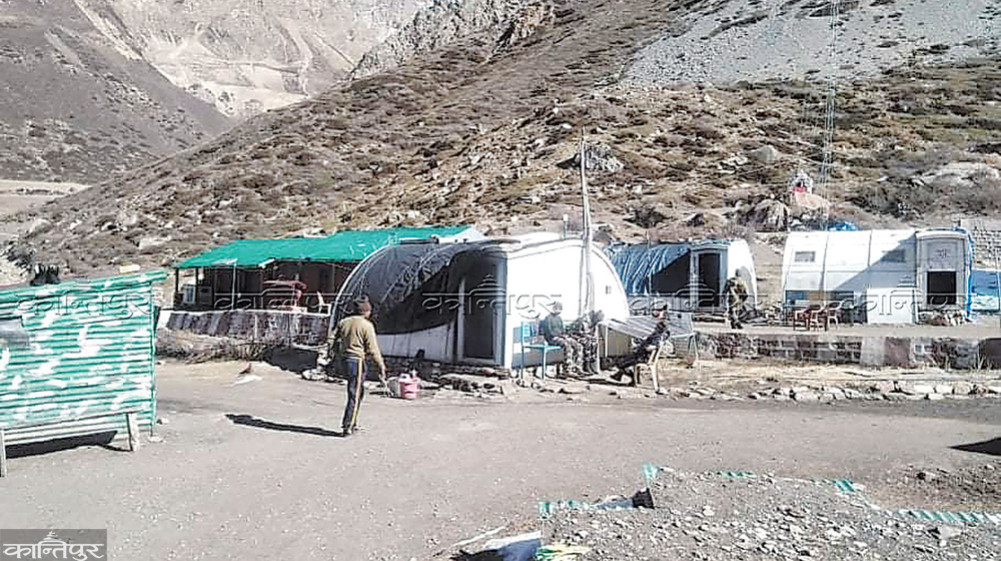
Between two good neighbours, there should not be strife on the border. It continues to blur the relationship between the two countries. From which both sides are suffering. Therefore, the issue that Nepal is asking to be resolved through discussion, it is also appropriate to resolve it and move on.
We use Google Cloud Translation Services. Google requires we provide the following disclaimer relating to use of this service:
This service may contain translations powered by Google. Google disclaims all warranties related to the translations, expressed or implied, including any warranties of accuracy, reliability, and any implied warranties of merchantability, fitness for a particular purpose, and noninfringement.
India and China have once again attacked neighboring Nepali lands. During the visit of Chinese Foreign Minister Wang Yi to India, the two countries agreed to reopen border trade through the Lipulek Pass in Nepali territory. In 2015, when Narendra Modi visited China for the first time as the Indian Prime Minister, his counterpart Li Keqiang had "agreed to do business through Lipulek Pass", and Nepal retaliated through a diplomatic note.
There has been an attempt to destroy the sensitivity of that land again without reaching a concrete discussion and conclusion about it. Historical facts and treaty agreements make it clear that Limpiyadhura and Kalapani areas along with Lipulekh belong to Nepal and were occupied by India. The Indian side has been trying everything from digging roads to printing maps to claim the land it has occupied as its own. Even China has agreed to give legitimacy to his internal efforts. This behavior of India and China on Nepalese land is unacceptable.
The Sugauli Treaty signed between the then British India and the Government of Nepal on March 4, 1916 is the official document that defines the border between Nepal and India. Even though Nepal lost a lot of land through the treaty, it was accepted. The treaty demarcated the western boundary with India. It is clear that the territory east of the Mahakali belongs to Nepal as it is said that the Nepali side will give up all rights in the western part of Kali river. And various maps, documents and river theories confirm that the source of Mahakali is Limpiyadhura.
For a long time, both Nepal and India have accepted that it is Nepal's land both from the point of view of documents and behavior. After the Sugauli Treaty, the supplementary treaty of the Sugauli Treaty on December 8, 1816, the agreement to return Banke, Bardia, Kailali and Kanchanpur to Nepal on November 1, 1860, the mapping of the Duduwa region of Dang on January 7, 1875, and the western border of Nepal are continuous up to Limpiyadhura.
There are many evidences to confirm that the Nepalese state has representation and authority in the western lands including Limpiyadhura. Diss. The evidence that the citizens of Limpiyadhura region surrendered their crops in 1995, the voter list of the 2015 general election and the 2018 census make it clear that the region belongs to Nepal. Not only the land, the government also has the details of the Nepali citizens in that area at that time.
These references confirm that the Nepalese state considers that region and its citizens as their own and that the citizens there also consider Nepal as their country. India also seems to consider the area up to Limpiyadhura as Nepal's land in its and Nepal's maps published for a long time. The map issued by the Survey of India in 1819, the map including Kumaon and Garhwal issued in 1827, the map of the Western Provinces of Hindustan issued in 1830, and the updated map of Kumaon State issued in 1894 also show Limpiyadhura as the mouth of the Kali River.
The Indian movement started after the 1962 India-China war. At that time, the Indian army started to set up a camp in the Kalapani area. After that, the land belonged to Nepal on the map/document but practically it came under Indian possession. But due to the fact that the map and the treaty made it clear that Kalapani is part of Nepal's territory, India is promoting a tributary river in the Kalapani region as the Kali River and claiming that only the territory before that belongs to Nepal.
Nepal's liquid politics and the attention of the political and intellectual community for democracy, the issue could not be prioritized by many. Diss. The map published by Nepal in 2032 did not include areas including Limpiyadhura. However, it is an established fact that that area belongs to Nepal but was occupied by India.
After the India-China agreement of 2015, this issue has come up again. In which China was also included along with India. Going forward, in November 2019, India released its new map including Nepalese territory including Limpiyadhura. In March 2020, he completed the construction of the road connecting Nepali land Lipulek with China and inaugurated it. At that time, Nepal issued its disagreement. In response to the
, Nepal also released its new map in May 2020. It also unanimously amended the constitution of Nepal to update its Nissan seal according to the new map. Where the area up to Limpiyadhura is covered. Aware of the dispute between Nepal and India, when China released a new map in 2023, Lipulek, Kalapani and Limpiyadhura were shown on the Indian side. It showed China's insensitivity.
Despite all these, Nepal is clear in its claims. And India has at least accepted that area as a contested role. Therefore, India and China should take care of Nepal's concerns before making any agreement on connecting that region. But they have agreed to their interests without even informing Nepal. In this way, while India has a bitter relationship with China, the land occupied by India has become amicable and both have moved towards using it together. Such activity is not the mark of a good neighbor.
The border between two good neighbors doesn't stay tight. It continues to blur the relationship between the two countries. From which both sides are suffering. Therefore, the issue that Nepal is asking to be resolved through discussion, it is also appropriate to resolve it and move on. Such problems and disagreements are resolved through diplomatic dialogue. Now it is necessary to have such a dialogue in the near future and find a lasting solution. A solution can be found by making the
public. Within a few weeks, Prime Minister KP Sharma Oli is going to China and India. He should put his questions in the high-level meeting and discussion that will be held in that order as well. Since Nepal updated its map in 2020 when Oli was the prime minister, he should strongly express his opposition to the current India-China agreement and the use of force by it on Nepal and take the initiative to find a solution through constructive dialogue.