Kantipur has studied the indictment in this case, viewed the video evidence presented in court. The events depicted in the documents and interviews go far beyond the limits of a simple murder conspiracy.
We use Google Cloud Translation Services. Google requires we provide the following disclaimer relating to use of this service:
This service may contain translations powered by Google. Google disclaims all warranties related to the translations, expressed or implied, including any warranties of accuracy, reliability, and any implied warranties of merchantability, fitness for a particular purpose, and noninfringement.
An email arrived in the Commission for the Investigation of Abuse of Authority's email on 15 Asho 2082, stating that Chief Commissioner Prem Kumar Rai had been given 10 days to fulfill his last wish.
It also included a warning that 10 commission officials would be killed if he did not resign within the specified time. The email was signed at the end, 'Prakash Pathak, Chairman, EGN.'
EGN stands for Extremist Group of Nepal.
According to investigators, the name its founder initially thought of was not offensive. But the most surprising aspect of the investigation was not the name of the organization, but the destination the investigation took him to.
The police followed a chain of email metadata, WhatsApp accounts and financial transactions that stretched across Nepal, India, the United Arab Emirates (UAE) and the Philippines, eventually reaching Pradeep Adhikari. Adhikari is the former Director General of the Civil Aviation Authority of Nepal and is considered one of the country's most influential and long-standing administrative power centers.
The government prosecutor's office filed a fifth criminal case in the Kathmandu District Court on April 18, accusing the official of being involved in organized crime, illegal hundi transactions, and a conspiracy to force Prem Kumar Rai to resign or have him killed.
Kantipur has studied the charge sheet in the case, viewed video evidence presented by investigators in court, and spoken to Rai himself, two investigators, a senior police superintendent, and lawyers for the accused.
The events depicted in the documents and interviews go far beyond the limits of a simple murder conspiracy.
The details also reveal a kind of pressure being exerted on the constitutional body investigating corruption. Where threats, planned propaganda, illegal cross-border financial transactions, and tantric and religious rituals targeting high-ranking anti-corruption officials are all implicated.
According to the details revealed in the investigation, some of the activities of this gang of threats include financial support from contractors related to one of the largest Chinese-funded infrastructure projects in Nepal. Adhikari, 46, has denied all the allegations against him.
Adhikari's lawyer Subhash Acharya, speaking to Kantipur, claimed that Adhikari was framed. Adhikari spent more than a decade as the most powerful and almost untouchable official in Nepal's administrative machinery. Civil aviation employees used to call him the 'permanent government' in informal conversations. Governments would form and fall. Prime Ministers would alternate between KP Sharma Oli, Pushpa Kamal Dahal and Sher Bahadur Deuba.
But Adhikari remained resilient, adapting to every political change. He maintained his influence on infrastructure contracts worth billions of rupees by maintaining relations with whoever came to power. Among them were all three of Nepal's 'national pride' international airport projects.
'Employees like Adhikari are produced by the political leadership,' Khemraj Regmi, former president of Transparency International Nepal and retired secretary to the government of Nepal, told Kantipur. 'Politicians plant, nurture and use such people for their own interests.'
But after the Genji movement of 23 Bhadra 2082, Adhikari no longer had the old security cover. The political turmoil weakened the networks of protection and access around Adhikari. The Commission for the Investigation of Abuse of Authority (Akhtiyar), which was encouraged by this, began reopening files related to various projects, including the Pokhara International Airport. It began re-examining documents related to the procurement process, unnaturally inflated contract amounts, foreign financial transactions and subcontracts worth billions of rupees.
Investigation officers of the Commission for the Investigation of Abuse of Authority arrested Adhikari on 27 Mangsir 2082 on charges of involvement in irregularities in the construction of a heliport in Nalinchowk, Bhaktapur. A few days later, the CIAA filed a case in the corruption case at Pokhara International Airport, demanding the recovery of 3.5 billion rupees from 56 defendants, including Adhikari. After that, more cases were registered. The Director General of Civil Aviation was ‘grounded’ by the CIAA
Former Tourism Minister Sudan Kirati, speaking to Kantipur, claimed that Adhikari had once tried to remove him from the ministry.
Prem Kumar Rai, the chief commissioner of the Commission for the Investigation of Abuse of Authority, also received similar calls from his superiors, calling him a ‘good person’. ‘I kept getting pressure from politicians and other influential people to say that Adhikari was a good person,’ Rai told Kantipur. ‘When our investigation team took the statement of one of his associates, we started receiving death threats.’ At that time, the Commission was investigating irregularities in the construction of a heliport in Nalinchowk. Prakash Pathak, who sent threatening emails to Rai, also started getting involved at this juncture. Pathak studied dentistry, but never became a dentist. Instead, he wandered around in various fields, including student politics, operating a consultancy that sent people for foreign employment, and unsuccessful business ventures, including film production. At one time, he was even involved in the ‘visit visa’ business and frequently traveled to India and Southeast Asian countries.
According to the police, while abroad, he obtained an Indian Aadhar card and PAN card, opened Indian bank accounts and conducted business through informal financial networks. According to the charge sheet, Pathak initially contacted Adhikari not as an accomplice but with a warning of action for committing corrupt acts. EGN had initially believed that Adhikari, who is embroiled in several corruption investigations, would pay the ransom as they said.
But Adhikari did not give them the money, but instead started using it for his own interests. After tempting Prakash Pathak, the targets began to be not the officials, but high-ranking officials including CIAA Chief Commissioner Rai.
According to the charge sheet, Adhikari forced CIAA Chief Commissioner Rai to resign by offering him Rs 80 to 100 million. Then Pathak sent a threatening email to the Commission for the Investigation of Abuse of Authority. He also circulated threatening videos online.
In his statement to the police in the presence of the government prosecutor, Pathak said that Adhikari immediately gave Rs 20 million through some people. 'Believing in the officer's proposal, I sent two emails to the Commission for the Investigation of Abuse of Authority,' Pathak told the police.
Kathmandu Police Chief SSP Ramesh Thapa also said that it was confirmed during the investigation that Adhikari used a group including Pathak to threaten the investigation officers of the authority. 'Our investigation shows that Adhikari had committed to spending Rs 100 million for that purpose,' he said. 'We submitted an investigation report to the government prosecutor's office with the basis and evidence to confirm this.' A case has also been registered in the court on that basis.’ As the investigation progressed, he said, religious and tantrik networks were also contacted to threaten the officials of the authority. According to the charge sheet, the officials’ close associates had contacted religious and tantrik networks in India. Kantipur has viewed the video material included as evidence. In one of the videos, some people dressed in red and black clothes are sitting around a statue that looks like a horse in a dark room lit by oil lamps. The statue is repeatedly stabbed with a sharp weapon like a khukuri. A voice is heard in the background, ‘Bhasm... Bhasm... Bhasm....’ Kantipur has viewed the video material included as evidence. In one of the videos, some people dressed in red and black clothes are seen surrounding a mannequin that looks like a horse in a dark room lit by oil lamps.
A voice message sent after that says, ‘The work is done. Now he dies.’
The person who sent the message has been identified by the police as Saraya Kinnera, a tantrik seeker from the Kamakhya area of Guwahati, India. The investigators say that at the center of this relationship is construction businessman Navinraj Basnet from Bhaktapur. Basnet had previously worked on the construction contract for the taxiway and apron of Gautam Buddha International Airport, Bhairahawa, a national pride project built under the supervision of Adhikari.
A photo obtained by Kantipur shows Adhikari and Basnet jointly welcoming a tantrik named ‘Jai Jagadambe’ at the Tribhuvan International Airport.
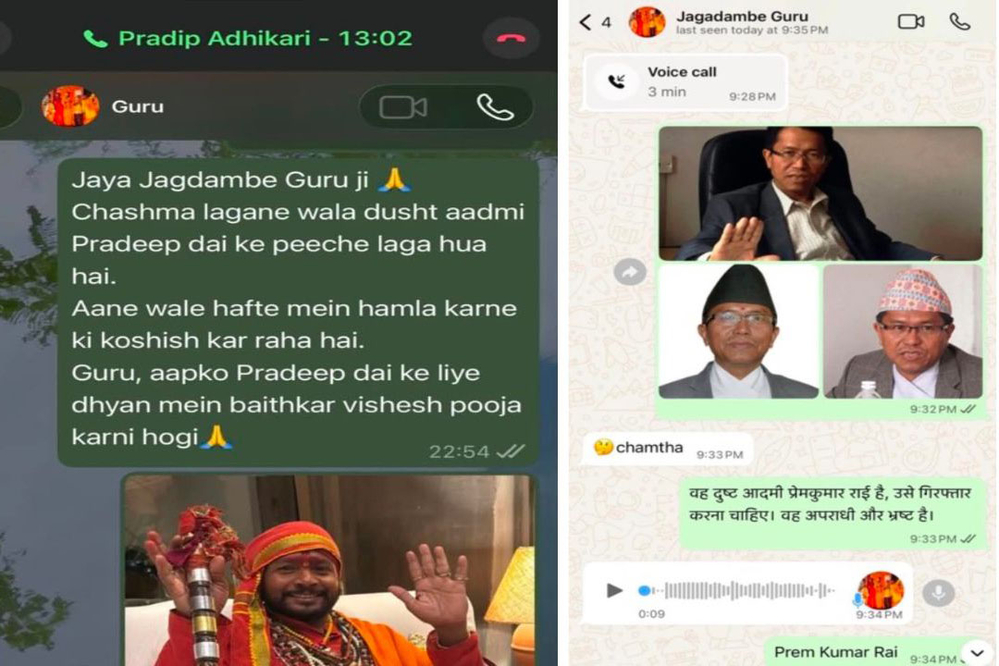
According to investigators, Basnet sent a photo of Rai to the tantrik, saying that Rai was ‘giving Adhikari pain’. Another person had requested a special ritual called ‘Chhamata’ to be performed. The charge sheet describes this ritual as intended to harm the target person.
A WhatsApp message sent by Basnet to the tantrik said, ‘This man wearing glasses is preparing to attack Pradeep next week.’ Guruji, a special puja had to be performed for Pradeep's safety.'
Naveen, speaking to Kantipur, claimed that he was unnecessarily dragged into the controversy. He said, 'I was acquainted with him as I work as a construction businessman, but I am not involved in any other conspiracy.'
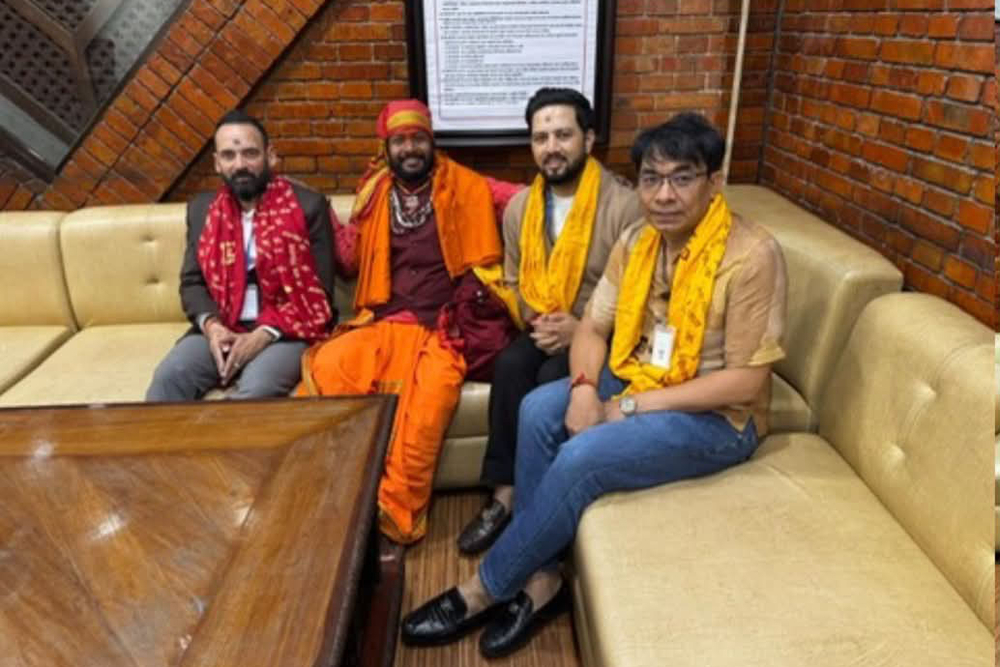
A tantrik named Kinnera, in his statement to investigators, said that he had warned Adhikari that he had many enemies around him.
In his statement, Adhikari claimed that these rituals were not intended to harm Rai. He said that he had sent the photos of people including two authority commissioners, a media entrepreneur and a former tourism minister to the tantrik for 'protection' and 'positive energy'. But the investigators have a different explanation.
In his statement to investigators, a tantrik named Kinnera said that he had warned the officer that he had many enemies around him. ‘I had predicted that he would be arrested soon,’ he said. According to him, the officer had given him gold for his protection. Kinnera expressed no hesitation in talking about his work. ‘I earn money by performing tantra and mantras,’ he said, ‘that is my profession.’ ‘When the officer started feeling uncomfortable with someone, he would send the person’s picture to the tantrik, so that he could harm him,’ said an investigator.
According to investigators, the money given to Pathak was routed to him through three countries. Pathak also admitted in his statement that he received the money sent by the officer through an informal hundi network that extended to Nepal, Dubai and the Philippines. On November 27, 2025, Pathak went to a Starbucks outlet in Bulacan, Philippines, carrying a code used to match hundi transactions. At around 12:15 pm, he approached a table where five Chinese nationals were sitting and handed over a paper with *123# written on it. In return, he claims to have received 8 million Philippine pesos, or about 20 million Nepalese rupees in cash. According to Pathak, the people at the table were affiliated with a group of contractors related to Pokhara International Airport, including people associated with China CAMC Engineering Company Limited. He also mentioned the names of the company's directors Liu Shengcheng and Wang Bo in his statement. The CIAA had named the same company, along with Wang Bo and project manager Yang Zhigang, as defendants in the Pokhara International Airport corruption case. In the case, the CIAA had concluded that each of the 56 defendants should be recovered Rs 8.36 billion, which is considered one of the largest corruption cases in Nepal's history. When asked for a response on the matter, the company did not respond to Kantipur.
'Adhikari and the directors of China CAMC Engineering Company Limited were jointly involved in sending me money through hundi,' Pathak alleged. Pathak was arrested in the Philippines and returned to Nepal on 28 Magh 2082.
Banker Zenu Thapa also came into the news during the investigation. The police are looking at her as someone who may have helped manage or hide suspicious financial assets. Similarly, 26-year-old Arjun Shahi is also under investigation. Shahi, who publicly criticized Adhikari after the Genji movement, was also seen in the Sheetal Niwas premises along with the movement leaders.
But after the investigating officers found the WhatsApp conversation between Shahi and Adhikari, suspicion also focused on him. The investigators had also investigated from the angle that his public opposition to Adhikari was not a cover. However, it was mentioned in the charge sheet that the charges would be filed later, saying that it could not be confirmed from the evidence immediately available.
Adhikari has been in custody at Dillibazaar Jail since 21 Mangsir 2082 till now. According to his lawyer, the hearing date has not been set yet as the process of taking statements is ongoing.
‘Adhikari feels that he has been framed,’ says his lawyer, ‘in his view, these cases against him are part of a state-led vendetta.’