If the government does not implement the report, the commission may keep a record of human rights violators, questions may be raised in various UN forums, and the career development and foreign travel of employees may be affected.
We use Google Cloud Translation Services. Google requires we provide the following disclaimer relating to use of this service:
This service may contain translations powered by Google. Google disclaims all warranties related to the translations, expressed or implied, including any warranties of accuracy, reliability, and any implied warranties of merchantability, fitness for a particular purpose, and noninfringement.
After the National Human Rights Commission (NHRC) investigated the incidents of the Gen-G movement and recommended the government to take action and further investigate human rights violations, interest has increased on how this will be implemented and what its impact will be. There is a debate going on from society to social media regarding the implementation of the recommendation.
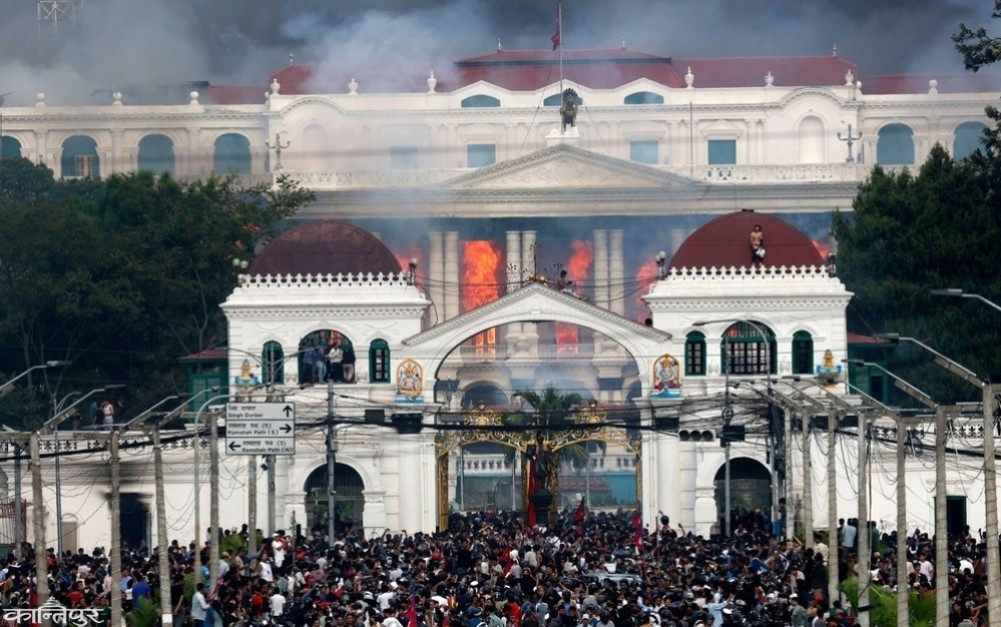
The commission submitted the recommendation section of the report to the government on Wednesday and also made it public. Exercising its authority under Article 249 of the Constitution, the commission has recommended action against the then Prime Minister, Home Minister, Communications Minister and heads of security agencies. The commission has said that they are responsible for the violent incidents of 23 Bhadra and has asked for action.
The commission has named 52 people, including 17 MPs of the Rashtriya Swayamsevak Sangh (RSS) involved in the 24 Bhadra incident, and has recommended for investigation. It has also recommended that the government investigate and take action against two groups, including 'TOB'. The commission formed a 6-member committee on 24 Bhadra and started the investigation and investigation.
Former member of the Human Rights Commission, Sudip Pathak, said that the commission's report is important both legally and constitutionally, inside and outside the country. 'The Office of the United Nations High Commissioner for Human Rights also recognizes this,' he said, 'Since Nepal has a constitutional commission, the government is obliged to implement its recommendations.'
According to Pathak, there is a process in which the commission sends the report to the Prime Minister's Office and the Prime Minister sends it to the Attorney General's Office for study. 'The Attorney General's Office can make recommendations to the government on who to take action against or not, whether an investigation should be conducted,' he said. 'On the other hand, if the government is not satisfied with the commission's report, it can be discussed with the commission.'
Pathak says that since the commission has investigated and prepared a report in the context of serious human rights violations, it cannot be left alone. He argues that ignoring it will raise questions on the government. ‘In the context of human rights, the image of the government in the national and international world is tarnished,’ he said, ‘In a situation that has changed due to the Gen-G movement, elections and the formation of a new government, the report of the commission cannot be ignored.’ As Pathak, a former member of the commission, said, according to previous precedents, constitutional provisions and international practice, the report of the commission is important not only nationally but also internationally. Questions may be raised about the report of the commission and its implementation in various forums of the United Nations, from the Universal Periodic Review (UPR) of the human rights situation. The Government of Nepal will have to respond in such forums.
The report of the commission will also be studied by the Human Rights Council in Geneva. Other international organizations related to human rights may also study the report and raise questions. Those organizations are constantly monitoring whether the government has taken action as per the recommendations of the commission. The international image of a person identified by the commission as a human rights violator may become negative. If one’s own country does not take action according to the law, there is a possibility of being arrested in other countries during a foreign trip.
Former Supreme Court Justice Balram KC said that if the government delays implementing the commission's recommendations, it could have serious consequences. According to him, in such a situation, international legal jurisdiction could be attracted. He informed that this issue has also been explained in the case filed by advocate Madhav Basnet.
If the commission's recommendations are not implemented, those in service will be affected the most, said KC. 'Employees' career development, participation in various training and seminars, and foreign travel may be affected,' he said. 'Politically active people may also be affected.'
Similarly, security officers on the list of human rights violators may be barred from participating in UN peacekeeping missions. Based on the recommendations of various human rights organizations, the security forces have been undergoing the 'vetting' process (ban on foreign travel).
There is a provision in the constitution that the commission can record human rights violators if the recommendations are not implemented. The Commission was granted this right by granting constitutional status from the Interim Constitution of 2063. It has been further clarified by the National Human Rights Commission Act of 2068. According to Article 249, Clause (2)(h) of the Constitution of 2072, the Commission has the right to make public the names of officials, individuals or bodies that do not follow or implement the recommendations of the Commission and keep a record of them as human rights violators as per the law.
According to Section 7 of the Act, the Commission must give the concerned person a 15-day opportunity to clear himself before keeping such a record. Thereafter, the concerned body must also consider the record as a basis for appointment, promotion or career development in public positions.
People who are listed as human rights violators by the country's constitutional body are almost certain to be subject to 'vetting'. The process of banning people involved in crimes against humanity including torture, murder, illegal detention, rape and inhumane treatment from traveling abroad, participating in training and international programs is called 'vetting'.
If the government wishes, it can send the Commission's report to the Attorney General's Office for implementation and further investigation. The Attorney General can appoint an investigation officer and proceed with the investigation through a government lawyer, and then a case can be filed in a regular court. But the government can also proceed with the process by making a separate law and forming a special court as per the recommendation of the commission. In such a case, the officers specified by the act will investigate, a case will be filed in a special court, and an appeal against it will go to the court specified by the act. The practice of appealing the decision of the special court to the Supreme Court has also been in the past.
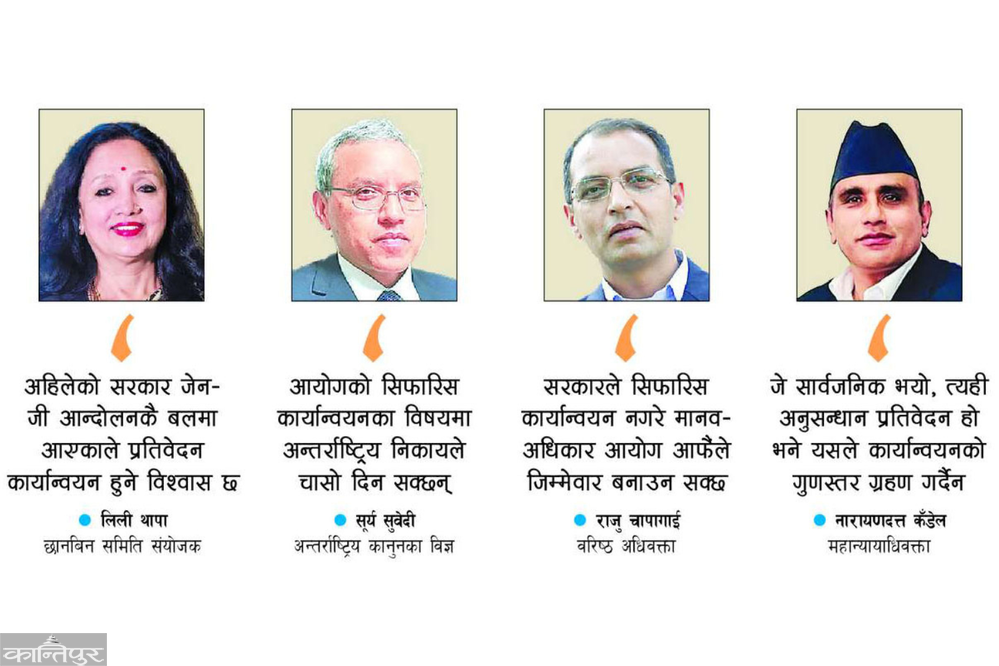
Senior Advocate Raju Chapagain says that the government has both the option of proceeding with the investigation as per the existing law or proceeding with the process by making a new law as per the recommendation of the commission. “The government is responsible for implementing the recommendations made by the Human Rights Commission. It can implement the new law or the existing law on any basis,” he said.
Senior Advocate Chapagain said that if the government does not implement the recommendations, the commission itself can put them on the negative list and hold the officials who do not implement them responsible. ‘If the government does not implement it, the commission can also bring human rights violators to justice,’ he said.
International law expert Surya Subedi says that the international community, especially the UN human rights bodies, may be interested in the recommendations of the Human Rights Commission. ‘They can raise the issue of how and when the recommendations of the Human Rights Commission will be implemented with the Nepal government,’ he said.
National Human Rights Commission member Mihir Thakur said that the commission did not envisage that the recommendation to prosecute human rights violations would not be implemented. Stating that the commission’s recommendations cover issues ranging from making laws to forming courts, he said that if the government does not implement it, they will move forward according to the constitution and law. ‘According to Section 17 of the Commission Act, 2068, we will wait for three months, if it is not implemented, we will move forward according to the constitution and law. But we are confident that the recommendations will be implemented,’ he said, ‘There is a way to move forward in the process according to Article 249, Clause 2(h) of the Constitution and Section 7 of the Commission Act.’
Lily Thapa, coordinator of the Gen-G Movement Incident Study Committee, said that she is confident that the commission's report will be implemented as the current government came to power on the strength of the Gen-G movement. 'There is a suspicion that this report will not be implemented as the reports submitted by the commission after studying the human rights violations in the Madhesh movement, Gaur incident, etc. in the past have been shelved, but since the foundation of this government is the Gen-G movement, it is binding on the government,' she said. 'If this government does not implement it, the commission can keep it on record as per Article 249 of the Constitution. Questions may also arise internationally.'
Attorney General Narayan Dutt Kandel, however, responded that the recommendation of the report made public by the commission is 'like a complaint to be filed against an angry person'. 'The government has not officially understood the report. Since it has not been officially received and is only public, it does not appear to be an investigation report. "What is made public is the same research report, so it does not meet the quality of implementation," he said.
Controversy over recommendation for retrospective law
The recommendation section of the commission has recommended making retrospective law based on the judgment in the case related to transitional justice filed by advocate Madhav Basnet. In that case, the full bench comprising the then judges Kalyan Shrestha, Girish Chandra Lal and Sushila Karki had explained the issue of retrospective law in detail.
In paragraphs 36 and 37 of the judgment, it is stated, "Since serious violations of human rights and crimes against humanity are crimes of a serious nature, if the existing law is insufficient to bring the persons involved in such crimes to justice, impunity should be ended by making a new law."
The judgment also states that international legal principles have been developed that global jurisdiction applies to serious violations of human rights and crimes against humanity and that, if necessary, they can be brought to justice by making retrospective laws. But some criminal law experts have said that the recommendation to enact retrospective laws for the Gen-G movement on this basis may be controversial.
According to senior advocate Krishna Prasad Sapkota, while such an interpretation is possible in special cases of crimes against humanity or serious human rights violations, the practice of enacting retrospective laws in general cases can be dangerous. ‘The practice of declaring an act that was not a crime at first and punishing it later can set a wrong precedent,’ he said.
Advocate Subash Acharya has also commented that the commission’s recommendation is against established principles of criminal law. ‘No person can be brought under the criminal ambit, punished or declared a criminal by enacting retrospective laws,’ he said. ‘This is also prohibited by the Constitution of Nepal and the International Covenant on Civil and Political Rights (ICCPR), to which Nepal is a party.’ According to him, the practice of enacting retrospective laws is considered to be against universally accepted principles of criminal justice.