Nepal's content creators earned Rs 3.53 billion from digital platforms in the last fiscal year, and this figure is expected to increase further in the current fiscal year.
We use Google Cloud Translation Services. Google requires we provide the following disclaimer relating to use of this service:
This service may contain translations powered by Google. Google disclaims all warranties related to the translations, expressed or implied, including any warranties of accuracy, reliability, and any implied warranties of merchantability, fitness for a particular purpose, and noninfringement.
Prime Minister Balendra Shah, in his recently made public asset details, mentioned that the source of income of Rs 14.6 million in cash is ‘Facebook, YouTube, TikTok, Spotify and iTunes’. His claim that 4.6 million Facebook followers, 1.3 million YouTube subscribers and 465,000 TikTok followers are the basis of the said assets attracted the attention of many.
This has revealed a fact, can ‘followers’ of social media really be considered assets? According to Nepal Rastra Bank spokesperson Guru Prasad Poudel, the existing law recognizes this. ‘There is a provision in the Rastra Bank system to receive remittances for audio-visual and similar services,’ Poudel told Kantipur, ‘The matter mentioned by the Prime Minister falls under this category. Therefore, it can be considered a source of income legally.’
After the country's chief executive himself showed social media followers as assets, it has established the reality that 'creator economy' and 'influencer marketing' have found a place in the official documents of the state in Nepal.
The Prime Minister's bank balance is just a representative example. Thousands of Nepali youth are now earning a good income in foreign currency from the comfort of their own rooms. If we look at the data of Nepal Rastra Bank, in the fiscal year 2081/82, Nepal earned Rs 3.53 billion from digital platforms including YouTube, Facebook and TikTok. This figure has reached Rs 2.9 billion in the first eight months of the current fiscal year, while only Rs 2.24 billion was earned during the same period last year.
The largest share (67 percent) of the amount earned in this way belongs to Google, which owns YouTube. Facebook and its related meta platform account for 12.21 percent, while film and animation production accounts for 6.33 percent. The remaining 14.10 percent comes from TikTok, Distrokid, and others.
According to Poudel, spokesperson for the National Bank, this data does not show the full picture of the creators' actual earnings. 'Brand deals' directly between creators and companies, remittances, or other general income are not included in this. 'Only the amount received under the monetization heading is shown in this,' he said. Earlier, such income was kept under the 'Miscellaneous' heading. However, only recently, the National Bank has started keeping it separate in accordance with the International Monetary Fund (IMF) standards.
'Is there really so much income from social media?' The direct answer to this lies with those who are interested in this field. Dipesh Tripathi has been making 'explainer' videos on contemporary, historical and social issues on his YouTube channel 'The Nepali Comment' since 2022. He earns between Rs 300,000 and Rs 400,000 per month from this channel, which has 442,000 subscribers. His monthly expenses, including research and the salary of his team of 10, are around Rs 350,000, which is raised from YouTube advertisements. The money coming from brand sponsorships is his net profit.
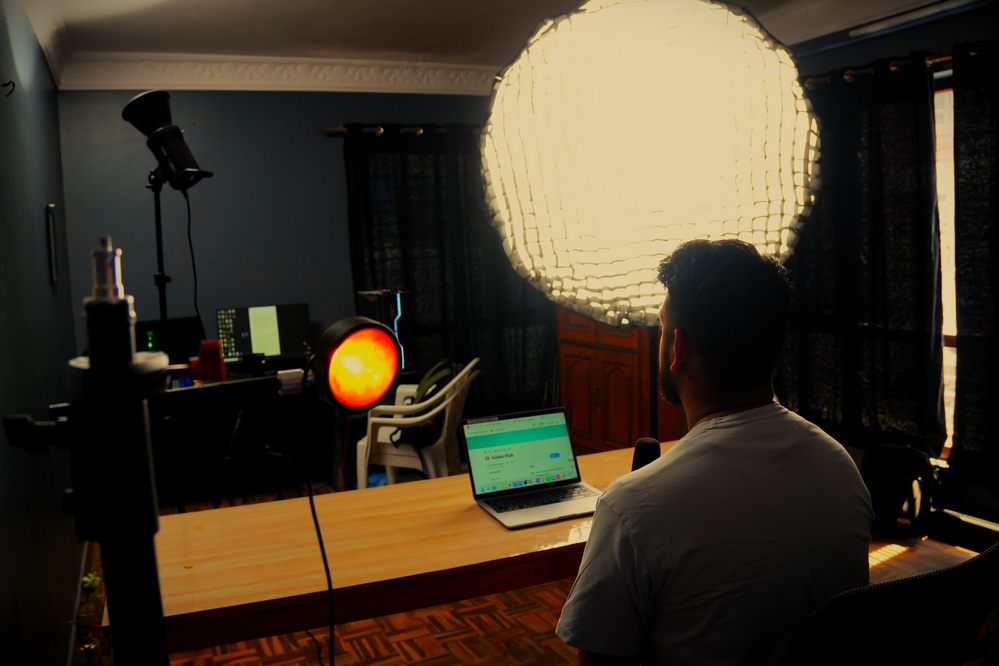
'If we were only going to make money, we would have created sensational content that would go viral,' says Tripathi, 'but we don't do that. We want our content to be useful and spark positive debate in society. That's why we have our own scope and we are happy with that.'
Another established creator who earns a good income from content creation is Elina Gurung. Known online as 'Alina Don', she has been making videos for over a decade. Working in the mental health sector by profession, she is not doing it 'full time' but is doing it in parallel. 'Although it has been 10-11 years since I started, it is only in the last eight years that I have started earning,' she says, 'I do not give it full time, I only work on things that I like. But still the income is good. If I do this full-time, I can earn more with pleasure than a senior employee in the corporate sector.'
This digital economy is not limited to Kathmandu. Saroj Karki from Biratnagar has given full-time employment to seven people through a YouTube channel called 'Project Kura'. She makes videos on contemporary issues from the channel, which has 320,000 subscribers. 'It is difficult to survive on YouTube monetization alone,' he says, 'We need brand sponsorship as well as monetization.' He earns an average of $3,000 to $4,000 (about Rs. 400,000 to 500,000) per month from this platform.
Istu Karki, who has 66,900 followers on Instagram and 719,000 followers on Facebook, is a full-time content creator. She is satisfied with the income she receives from monetization and brand collaborations. 'I am satisfied with the income I have to meet my needs,' Istu told Kantipur, 'But if I have to earn a lot, build a big palace and live a luxurious life, then this alone will not be possible.'
Not only full-time, but also a large number of students and youth who work part-time to earn pocket money are also working. Subhana Budhathoki earns up to Rs 50,000 per month by creating content on Instagram and TikTok. 'I have been creating content for about 3 years.' She says, 'I am currently associated with a consultancy and am also doing brand deals part-time. The income from this is satisfactory.'
As creators say, how do Nepalis make money? To understand this, you need to know how money moves on digital platforms. There are mainly two ways of income. First, 'platform monetization' YouTube gives about 60 percent of the money raised from advertisements played on videos to the creator and keeps the rest. Second, ‘influencer marketing’ brands pay creators directly for their promotion, the entire amount of which goes into the creator’s pocket.
The first way determines how much money is earned by ‘cost per thousand views’ (CPM). Monayak Karki, owner of influencer management company ‘Uptrendly’, explains this, ‘Your content determines the CPM.’ While entertainment videos like Dohori earn less money, banking or AI-related content earns many times more.’ Geography also plays a big role, he says. According to him, if a viewer in Jumla earns 50 rupees, a viewer in New York or London will increase the CPM dramatically, because in those markets there is competition between advertisers to attract attention, even if they pay a lot.
Every platform has its own nature. YouTube is particularly popular for its in-depth content. People go there to learn, research, or read in-depth reviews. Good videos can rack up views for months or even years. Content related to technology, education, automobiles, real estate, and tourism do well here. Instagram, with about 3.6 million Nepali users, is especially popular with urban, literate, and 18- to 35-year-olds. Reels have increased organic reach, and content on fashion, beauty, lifestyle, and restaurants sells the most here.
Facebook, Nepal's largest network with 13.5 million registered users, covers every class and geography of the country. Since last September, Meta officially started 'content monetization' in Nepal, a new way of earning money based on views has opened up for page operators. On the other hand, the principle of TikTok is different. Here, the number of followers does not matter much. If the content is good, even a person with 2,000 followers can go viral overnight. TikTok has become very attractive for brands looking for a big impact on a limited budget.
Earlier, Nepali brands had only newspapers, radio or television as their options to reach customers. However, times have changed now. This change has come much faster than the traditional media business expected. Large advertising budgets are now turning towards 'influencer marketing'.
The taxes paid by social media platforms also prove this. According to the data of the Large Taxpayers Office, 48.995 million rupees were collected as electronic service tax in the fiscal year 2080/81. This amount increased to 63.542 million rupees in the fiscal year 2081/82.
Foreign technology companies like Google, Meta, TikTok, Netflix and Adobe have been paying such taxes for providing digital services in Nepal. According to the office, in the fiscal year 2079/80, Rs 56.9 million was collected from these companies as digital services tax. At that time, 19 foreign technology companies were registered for tax purposes. Till now, 22 large foreign technology companies have been registered in the tax system in Nepal.
Companies that once relied on banner advertising are now trying to sell their products through faces (influencers) that the common people can relate to and trust. E-commerce platforms like Daraz prioritize influencer campaigns over traditional advertising during big sales like Dashain and 11.11. Ncell even organized the ‘League of Creators’ last May to provide mentorship and training to creators in digital storytelling, where more than 1,300 people applied and 50 were selected.
The 2024 ‘Sprout Social’ report also confirms this. According to the report, about 49 percent of consumers buy goods based on influencer posts on a daily or weekly basis. Similarly, 30 percent said that their trust in influencers has increased in the last six months. This influence rate is as high as 87 percent among ‘Gen-G’. Although there is no similar comparative data in the context of Nepal, the global trend reflects the impact that the influencer ecosystem is having on businesses every day.
This impact is clearly visible at our local level. Suraj Bajracharya, who runs ‘Newaj Sandwich’ in Pimbhal, Patan, is a direct witness to this. He said that after a content creator made a video of his shop in April last year, his daily sales of around 100 sandwiches increased to 300. ‘Whatever that brother ate in the video, customers started coming and looking for it,’ he told Kantipur. Hemraj Rai, the creator of the shop’s video, was happy to hear that his video had increased the shop’s business. ‘Digital content helps viewers choose the right option to get good service,’ he said. ‘When a business progresses like this because of the videos we make, we get the encouragement to do even better.’ Most cases related to social media are still registered under the Electronic Transactions Act, 2063. This is Nepal's first major law on cybercrime. Section 47 of this act is considered the most widely used provision. The section provides for action to be taken against anyone who publishes or broadcasts content that affects public morality, social harmony or someone's reputation using a computer, internet or electronic means. Section 47 of the Cyber Law: Government weapon to silence citizens' voices
Many cases have been registered against journalists, YouTubers, TikTok users and social media users under this section in recent years. Digital rights activists have criticized the words 'public morality', 'harmony' and 'indecent' used in this section as being very vague. According to them, such vague language increases the risk of misuse of the law.
The National Cyber Security Policy, 2080 also indirectly covers social media and digital platforms. यस नीतिले साइबर अपराध नियन्त्रण, डिजिटल पूर्वाधार सुरक्षा, दुष्प्रचार नियन्त्रण र राष्ट्रिय साइबर सुरक्षा संरचना विकासजस्ता विषयलाई प्राथमिकतामा राखेको छ । सरकारले डिजिटल सुरक्षाको आवश्यकता औंल्याए पनि आलोचकहरूले ‘दुष्प्रचार नियन्त्रण’को नाममा राज्यले अनलाइन निगरानी बढाउन सक्ने आशंका व्यक्त गर्दै आएका छन् ।