Even though the police use gunfire to take control of drug dealers/users, there has been no decrease in the number of arrests and prosecutions in the last three years, but rather the graph is increasing every year.
We use Google Cloud Translation Services. Google requires we provide the following disclaimer relating to use of this service:
This service may contain translations powered by Google. Google disclaims all warranties related to the translations, expressed or implied, including any warranties of accuracy, reliability, and any implied warranties of merchantability, fitness for a particular purpose, and noninfringement.
At midnight on 24 Chaitra, Pingalasthan, Kathmandu. A team of the Narcotics Control Bureau fired two rounds of bullets to arrest Indian citizen Anil Kumar Paswan. Paswan, who was shot below the knee, is admitted to the Trauma Center of Bir Hospital. About five hours ago, another similar incident took place in Rohini-4 Kotahawa, Rupandehi—there, police fired shots to arrest Vishal Yadav of Rohini Rural Municipality-2, Khuruhuriya. The police bullet hit his left leg.
This is not a coincidence. In the last three years, the Bureau team has fired at 17 places alone while arresting drug dealers—6 places in the fiscal year 080/81, two places in 081/82, and 7 places so far in 082/83. Among those injured and arrested are 11 Indian citizens. According to the police, legal proceedings have been initiated in all of them under the Narcotics Trafficking Act, 033. The investigation has just begun in the case of Paswan and Yadav.
The official police response is the same in every case: the suspect attacked first, shots were fired in self-defense. Regarding the incident in Pingalasthan, SSP Krishna Koirala, the head of the bureau, said, “Paswan had to open fire after punching the police.”
In Rupandehi, DSP Krishna Kumar Chand claimed that after the motorcycle riders threw stones, they first fired in the air and only after they tried to escape, more shots were fired. “After a drug dealer was arrested, we were looking for the main person through him,” SSP Koirala said. “At the same time, when the police team reached Pingalasthan, he tried to attack the police. Then, the shooting took place.”
The incidents do not seem natural. The way society is now heading towards anarchy, it is a matter of study whether it is the police trying to intimidate or not: Former DIG Hemanta Malla Thakuri But former bureau chief DIG Hemanta Malla Thakuri is not ready to see these incidents as the police have described them. ‘Looking at the incidents, it does not seem natural.’ He said. The roots of this police practice go back to 2074. On 23 Shrawan 2074, Praveen Khatri, who was accused of being involved in drug trafficking, was killed in a police encounter in Kusunti, Lalitpur. When the police reached his house, he tried to escape by jumping from the roof. In the process, he was shot and collapsed. Doctors declared him dead on arrival at the hospital. Later, the police revealed that he himself was a drug user and was even kept in a correctional center.
In Khatri's case, the then member of the commission, Mohana Ansari, says that the shooting appeared to have occurred despite the fact that he was in a position to be arrested at the time. 'It seems that an investigation was conducted at that time and action was recommended. It has been many years since I left the commission,' she says. 'However, the implementation of the issues for which action was recommended depends on the government.'
'In the past, separate committees have been formed to investigate such incidents, and action has been recommended in some cases. When Kumar Poudel was killed, we clearly said that it was a murder. Other issues are also gradually becoming public: Human Rights Commission spokesperson Dr. Tikaram Pokharel
Human Rights Commission spokesperson Dr. Tikaram Pokharel says that he is not aware of any complaints filed in recent incidents. ‘In the past, a separate committee has been formed to investigate this matter, and action has been recommended in some cases,’ he said, ‘When Kumar Poudel was killed, we clearly said that it was a murder, and other issues are gradually becoming public.’ At that time, the police had adopted a similar aggressive policy in controlling gangsterism – Dinesh Adhikari ‘Chari’, Kumar Shrestha ‘Ghainte’, Manoj Pun and other gangsters were killed in encounters, while some were spared. ‘Those actions had drastically reduced gangsterism in the valley,’ says an investigation officer, ‘now the drug trade has reached the same level of gangsterism as it was at that time. And, the message that the police are becoming ruthless has gone out to the dealers.’
This belief that the policy at that time worked is the basis of current practice. The list of incidents based on that is long.
27 Jestha 082, Tokha-3, Kathmandu. Police fired 4 rounds of airstrikes and 3 rounds of live ammunition behind Grande Hospital. Both Sadiq Alam, 38, and Mohammad Manjar Alam, 22, were shot in the left leg. According to the police, Sadiq had previously been arrested with drugs on 5 Asoj 080 - he had returned to the business after spending 8 months in Nakkhu Jail. The court had already sentenced another member of his group, Hemant Bhagat, to 10 years in prison. He had escaped from prison by taking advantage of the 24 Bhadau movement. Nepal Police spokesperson Avinarayan Kafle says that everyone who escaped on 24 Bhadau is being searched for. 'The police are constantly searching for absconding accused, and more priority has been given to controlling those who escaped on 24 Bhadau,' he said.
22 Magh 081, Tulsibari, Jhapa. The Bureau team fired 6 rounds, one of which hit Indian citizen Anjar Alam. 30 grams of brown heroin was recovered from him. His brother Yusuf was also arrested along with him.
30th Shrawan 081, Nepalgunj, Banke. A man from Uttar Pradesh, India, had just reached a hotel to deliver drugs when the police arrived. According to the police, when they tried to arrest him, he tried to attack them with a knife and an iron bar. During the shooting, he was hit in the right leg. Another accused arrested with him was only 14 years and 6 months old.
10th Shrawan 082, Bhadrapur, Jhapa. 36-year-old Mohammad Islam was found in a suspicious condition, and was shot below the knee after attacking the police and trying to escape.
According to the investigation officers of the bureau, opium and marijuana are being smuggled from Nepal to India, while drugs including pharmaceuticals are being misused to enter Nepal through the open Nepal-India border. According to a senior officer of the Nepal Police, Nepal has always requested the Indian side to help in drug control.
However, they say that this continues without sufficient support from the Indian side. ‘For India, this is like a business being done on the Nepal side. Although the high-ranking police personnel are ready to help, the necessary support has not been received from the field level,’ he says, ‘We have been raising this issue repeatedly.’
According to the police officers, in some cases, Nepali businessmen have reached India and imported drugs in various ways, while Indian citizens also tend to bring them themselves. The bureau’s past investigations show that drugs are sometimes smuggled by hiding them in speakers and sometimes in the tank of a bike. There is even a background of ambulances being used in marijuana smuggling.
However, questions have also been raised within the police about whether this policy of firing bullets in drug control works.
Former chief of the bureau, DIG Hemanta Malla Thakuri, considers the occurrence of similar incidents in two places on the same day to be a subject worth studying. He questions whether such incidents are coincidences or policy directives. But former SSP Basanta Kunwar, director of Narconon Nepal, raises a direct question about the trend of such incidents. ‘Government statistics say that there are 134,000 drug users in the country now,’ he said, ‘the real number is at least 1 million.’ If one dealer sells to 10 people, there are more than 1,000 dealers - how many will be shot?'
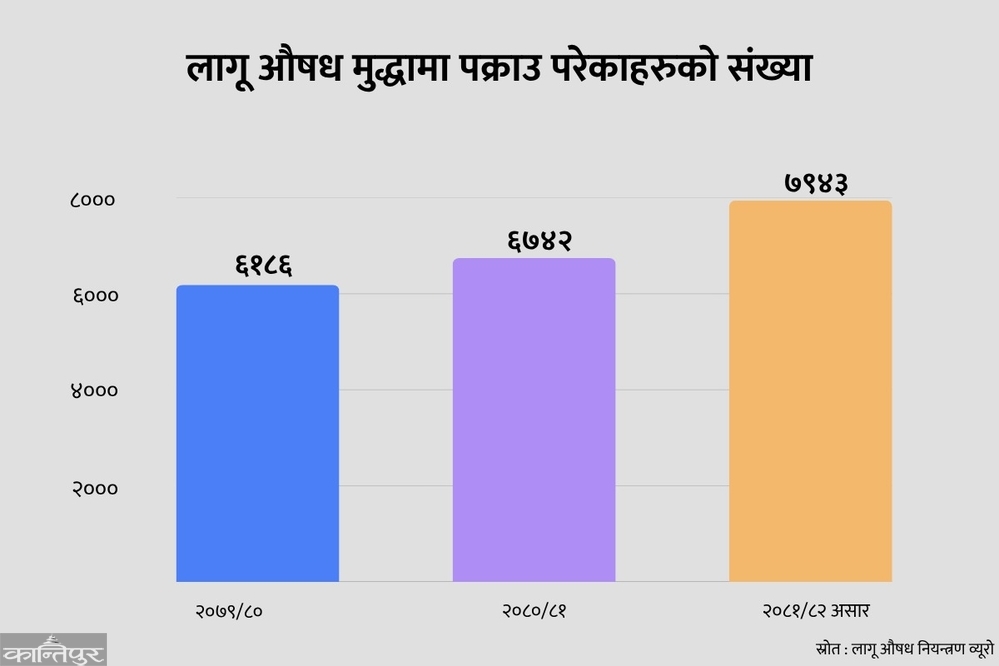
As Kunwar said, even though the police have tried to control drug dealers/users by shooting, there has been no decrease in the number of drug users arrested and prosecuted every year for the last three years. On the contrary, the graph of this trend seems to be increasing every year.
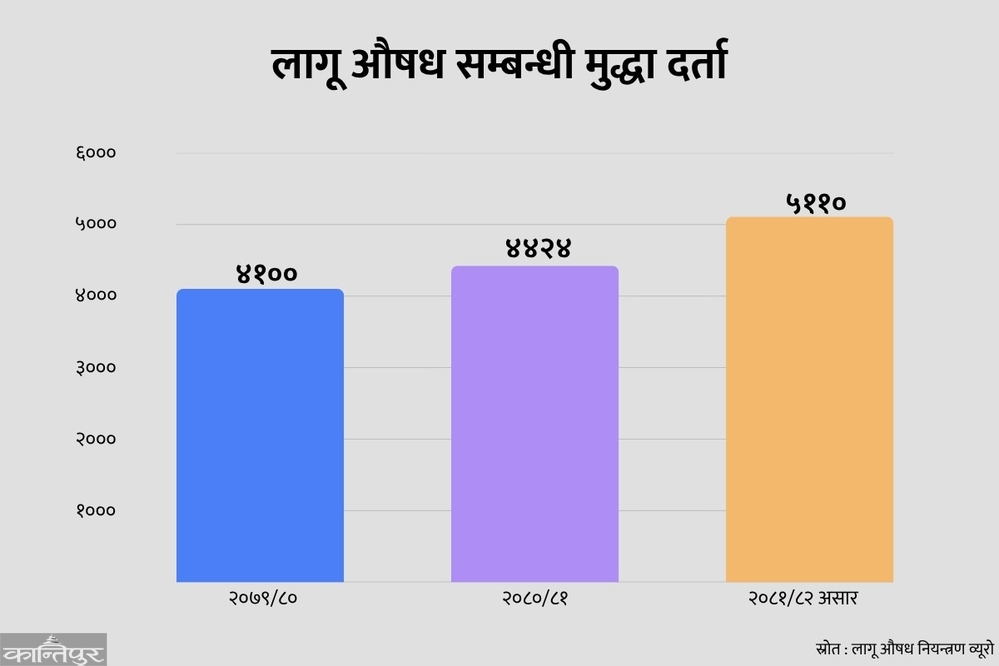
In the fiscal year 2079/80, the police had filed 4,100 cases for drug-related offenses. In those incidents, 6,186 people, including Nepalese, Indian and other nationals, were arrested. The maximum amount of marijuana (20,671 kg), hashish (630 kg), heroin (15 kg), opium (37 kg), and cocaine (14 kg). The rest were pharmaceutical drugs.
In 2079/80, 4,100 cases were registered for drug-related offenses, while 4,424 cases were registered in the fiscal year 2080/81 and 5,110 cases were registered in the fiscal year 2081/82.
In the fiscal year 080/81, the number of cases registered and arrested increased further. 4,424 cases were registered from police units across the country, and 6,742 people were arrested. This year, the police seized 32,522 kg of marijuana, 508 of hashish, 24 kg 676 grams of heroin, 64 kg of opium, and 13 kg 877 grams of cocaine. In the fiscal year 081/82, the number of cases registered and arrested increased further. This year, 5,110 cases were registered, and 7,943 people were arrested. This year, the seizure of marijuana set a new record. The police seized 51,439 kg 84 grams of marijuana from across the country. 829 kg of hashish, 48 kg 465 grams of heroin, 185 kg 58 grams of opium and 20 thousand 928 grams of cocaine were seized.
This three-year data shows that the steps taken by the police have not reduced the drug trade, but rather the number of dealers is increasing every year. Former SSP Kunwar says that a solid plan for user identification, treatment and rehabilitation is needed before the bullet to control the drug trade. Police spokesperson Kafle says that the police are working to stop gangs importing drugs from the border and to spread public awareness at the local level.
It has been found that people involved in incidents ranging from rape and financial transactions to murder have also used drugs, which is why controlling drug trade has been given priority for overall crime control: Nepal Police Spokesperson Avinarayan Kafle
According to him, of all the serious crimes that are happening in society today, most of them are related to drugs. ‘People involved in incidents ranging from rape, financial transactions to murder have also been found to be using drugs, which is why it has been given priority for overall crime control,’ Kafle added. ‘In the context of controlling drug trafficking, the police are also running campaigns including marijuana and opium eradication.’ Regarding the incident of shooting while arresting the accused, he says that it cannot be seen as a change in policy regarding drug trafficking control. ‘Since drugs are involved in every crime, even the head of the organization has taken care to proactively mobilize,’ he said. ‘Indian businessmen were involved in both the incidents in Kathmandu and Rupandehi.’ This is also for overall crime control.’
Other police officers also say that the shooting incidents are purely coincidental. ‘The shooting only occurred after the police were attacked,’ says SSP Koirala.

