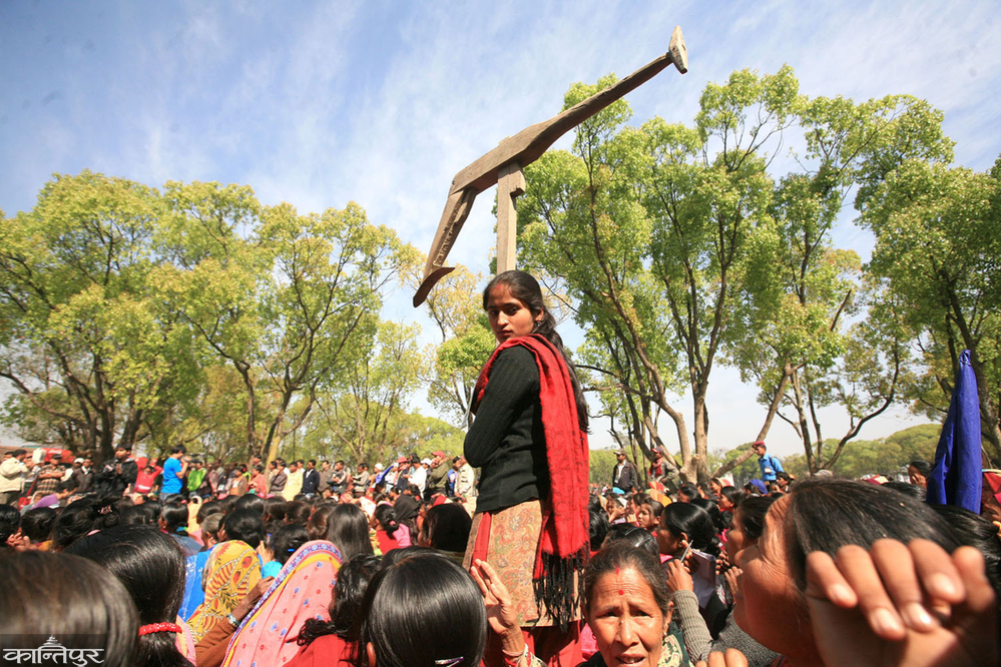
There are still farmers in Rasuwa and Nuwakot who are trapped by the Birta problem. In Rasuwa, 718 families own 2,389 ropanis and in Nuwakot, 1,558 families own 4,957 ropanis of land. The land they farm is still under Birta.
We use Google Cloud Translation Services. Google requires we provide the following disclaimer relating to use of this service:
This service may contain translations powered by Google. Google disclaims all warranties related to the translations, expressed or implied, including any warranties of accuracy, reliability, and any implied warranties of merchantability, fitness for a particular purpose, and noninfringement.
In Rasuwa and Nuwakot, hundreds of Birta-affected families who are still cultivating Birta land and deprived of land ownership have started the process of applying for land acquisition. On 24 Poush 2082, the government published a notice in the Gazette regarding the ninth amendment to the Birta Regulations, 2017. According to the amended provision, farmers of Birta land will be able to submit applications by Asad 2083, and the application will have to be finalized by Asad 2084.
The Department of Land Management and Records has also written to the District Land Revenue Office. The amendment to the Birta Regulations has paved the way for farmers who have been suffering for decades to get their rights. Khimananda Acharya, Director of the Land Administration Branch of the Department of Land Management and Records, says, "As soon as the Birta Abolition Regulations were amended and received by the department, a letter was sent to all Land Reforms and Land Revenue Offices on 7 Magh 2082 for necessary implementation." This problem does not exist in all districts. In districts where the problem of birta remains, the office will now take action.'
The government has given a deadline of Ashar to submit applications by revoking the law. During this period, farmers can go to the Land Revenue Office of the concerned district and submit applications. People who earn birta land can register such land in their name by submitting the evidence they have or know of within the deadline specified by the government, including the plot number of the land, the name of the four-kilala birtawal, surname, country, crop, and tax, and apply to the Land Revenue Office of the concerned district to obtain a land title deed.
After the amendment to the regulations, farmers will be able to submit applications with all documents, said Ganesh Bhatta, spokesperson for the Ministry of Land Management, Cooperatives and Poverty Alleviation. 'Farmers who are cultivating birta land must have a record of birta. After receiving the application, the concerned Land Revenue Office will investigate. If all the evidence is received and it is deemed appropriate, the farmers will receive a land title deed,' he said.
 The then King Prithvi Narayan Shah, who had accompanied him after conquering Nuwakot and was in power at that time, had taken the land that was being cultivated by the farmers as Birta on the king's orders. In the meantime, many changes and adjustments have taken place in Nepal, although the Birta problem that started at that time has not yet been resolved, so the farmers are facing injustice.
Bhawani Prasad Neupane, a Birta land victim who has been leading the land rights movement in Rasuwa for a long time, says, 'We are happy with the news that the Birta regulations have been amended to allow applications to be submitted for land registration, and we are hopeful that it will be implemented in a way that protects the rights of the farmers.'
Lyam Bahadur Darji, President of the National Land Rights Forum Nepal, says that justice will be served to the farmers only if an environment is created where land titles can be easily obtained in the name of the tillers who have shed blood and sweat on the same land for generations. He says, 'There should no longer be a game of registering land in the name of those who have money and access. We are fighting for the rights and entitlements of farmers, we will continue to fight until the farmers get their rights.’
There are still farmers in Rasuwa and Nuwakot who are trapped by the Birta problem. According to a study, 718 families in Rasuwa and 1,558 families in Nuwakot are still living and cultivating 2,389 ropanis of land, and 4,957 ropanis of land, which is still under Birta.
Land expert Jagat Deuja says, ‘No matter what Birta the farmer is tilling, the law and regulations have a clear provision to register the Birta land in the name of the farmer tilling it, so the local government and the concerned office need to play a role in resolving the problem.’
The Birta land problem that remains to be resolved in Rasuwa and Nuwakot is Birta land of the ‘K’ nature. After the struggle of the Land Rights Forum, in 2066, the then government, listening to the pain of the farmers, opened a one-year period for registering ‘B’ nature of Birta land, and 168 families of farmers from Rasuwa who had submitted applications in 2066 also received the land title deeds. The remaining farmers have not yet been able to get the land title deeds.
‘Despite the existence of a clear legal system, our application file was put on hold without being given the land title deeds,’ says Chitrakumari Neupane, leader of the Land Rights Forum Rasuwa, ‘We have struggled all our lives to get the land title deeds, it would have been better if they had not delayed it now.’
This regulation was amended after a long effort by the Birta-affected families. ‘Farmers should make good use of this opportunity,’ says land activist Sushma Neupane.
Farmers in the village say – After the multi-party system of 2046 came, we stopped paying the land title deeds. They say they have stopped paying taxes to the landowners after feeling cheated. The farmers, who have been protesting for a long time, are now demanding their land back from the state. They have been holding sit-ins, rallies, meeting ministers and prime ministers, and submitting memorandums.
 The landowners who were abolished in 2016 are still living in the Rasuwa-Nuwakot area. They cannot be sold or mortgaged. “There is a bigger problem – many farmers have been living on similar land for generations, and there is also a concern that they will be evicted,” says Binda Nepal, a land movement leader and landowner who is a victim of landownership in Nuwakot.
In 2016, the then Prime Minister BP Koirala had made a government-legal announcement that “the landowners should be permanently abolished and the land under the landowners should be paid rent like a rakkar.” However, the land dispute between farmers who till the land and the Birtawals who have never owned the land or seen 'their' land is just as fresh. When I reached the villages of Rasuwa-Nuwakot, while chatting with the farmers in the squares, they complained - if our people's representatives and leaders had played a role in eradicating Birta for us at that time, we would not have had to suffer from this problem until now.
The farmers are happy after receiving the news that the government has recently amended the law. They feel that the problem will be solved now. A new government has come to the country, the governance system has changed, and the elected government has made public an action plan to work in favor of the people, which has given more hope to the rural farmers.
It has been three hundred years since the ownership of the farmers who used to earn a living by mining Bhir, Pakha, Pakhero, Khoriya and Khosri was taken away. When the ‘Kantipur team’ visited the houses of farmers in Rasuwa-Nuwakot, they would cry and tell them about the pain of not getting the land titles for their homes and farmlands. ‘Farmers are suffering from injustice and pain. If farmers who have been cultivating their land are given land titles unconditionally, free of charge, and without any hassle, justice will be served to them,’ says Hemnath Khatiwada, a district member of the Land Problems Resolution Commission and a dispossessed farmer from Rasuwa. ‘Active facilitation by people’s representatives and party leaders is also necessary in this regard. We should take this as a common problem and find a solution.’
The dispossessed farmers of Rasuwa-Nuwakot have been agitating for a long time. They are not in a position to leave the land they have been living on since their ancestors. There is no other place to go. When we reached each village during the reporting period, the farmers had one demand – they don’t want anything else, the government should make arrangements to easily provide them with the land titles for the land they cultivate. Chudamani Prasad Gajurel, leader of the Land Rights Forum Nuwakot and a victim of birta, says, ‘We are happy that the government has amended the law. Now, all together, facilitation is equally necessary to ensure the rights of farmers. Now the land should be registered in the name of the farmer, not in the name of the birta owner.’
 After farmers repeatedly visited Singha Durbar, the then government had started to take forward this work that had been stalled for a long time before the Gen-G movement. After the Gen-G movement, the farmers had reached Singha Durbar to meet the then Minister for Land Management, Cooperatives and Poverty Alleviation, Prof. Dr. Kumar Ingham, with their demands. After the request of the farmers, the notification that the birta regulations have been amended has been published in the Nepal Gazette as promised by Minister Ingham.
It is an irony and a sad fact that it has been 66 years since the abolition of birta was legally declared and farmers have not been able to register birta land in their names, says the land activist. Kalpana Neupane, a land activist from Nuwakot and an expert member of the Land Problem Resolution Commission, said that despite repeated requests and protests, farmers have not been able to get justice. She says, ‘Even now, no one should hurt farmers under various pretexts.’
‘In cases where the land is being cultivated by the farmer, it should be registered in the name of the farmer. Not in the name of the paper landowner. While registering the land, the original proof of cultivation should be produced. If the paper landowners have submitted any application before, it should be rejected,' says Jagat Deuja, 'in a situation where the Constitution itself has abolished dual ownership and absenteeism, everyone should play a role in ensuring the rights of farmers.' Read
Other news