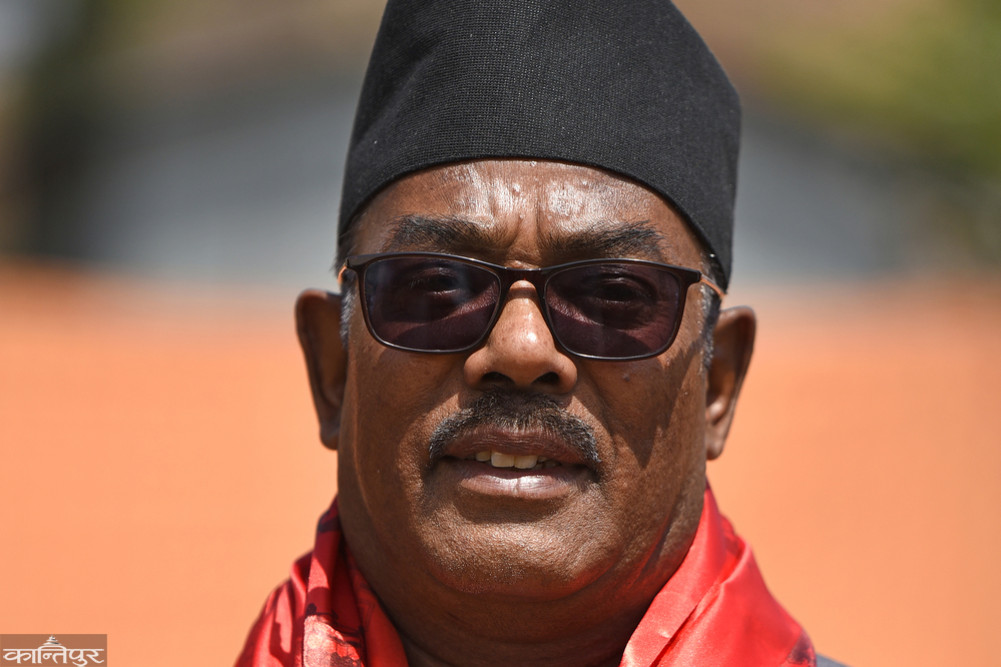
He has been associated with UML since 2049 BS and was previously a member of the Central Advisory Council. He will represent Kathmandu Valley from UML in Parliament.
We use Google Cloud Translation Services. Google requires we provide the following disclaimer relating to use of this service:
This service may contain translations powered by Google. Google disclaims all warranties related to the translations, expressed or implied, including any warranties of accuracy, reliability, and any implied warranties of merchantability, fitness for a particular purpose, and noninfringement.
Human rights leader Padmaratna Tuladhar started a movement in 2036 BS, saying that the state was suppressing Nepali language. Under his leadership, the Nepali language movement spread from Banepa, Palpa, Birgunj to Biratnagar.
Tuladhar's demand was to respect Nepali language, the mother tongue of the Newar community of Kathmandu, and to be employed in government jobs. That movement put pressure on the Panchayat rulers. Kulbhakta Shakya was also involved in the language movement.
At that time, he was studying at Pulchowk Engineering Campus. He was inclined towards leftist politics and joined the language movement as well as the student movement. Tuladhar himself was a leftist leader, who had also won as a public-party candidate in the National Panchayat. Shakya was also influenced by Tuladhar.
He has started his journey to parliament for the first time as a proportional representation MP from UML. Born in Lagantol, Kathmandu in 2017, Shakya has closely observed the political ups and downs of the Kathmandu Valley.
‘In 2035, I got involved in student politics while studying at the Engineering Campus, Pulchowk,’ he said. ‘I became close to him after the Nrivad Bhasha Movement started under the leadership of Padmaratna Tuladhar in 2036. Through that, I moved towards social campaigns.’
He had a close relationship with Tuladhar, the leader of the language movement that started during the Panchayat period, for about a decade.
‘Since I am an indigenous person from Kathmandu, I worked close to Padmaratna Tuladharji for about 10 years. I got the opportunity to learn many topics including politics and social campaigns from him,’ he said. ‘There are many social organizations of the Newar community.’ He worked in those organizations.'
Shakya, who played a role in getting other politicians to parliament in the past, has now become an MP himself.
'In the past, I was in the role of helping my political friends, getting some to the mayor, some to parliament. This time, the party itself put me forward as an MP. Now I will make good use of my experience,' he said.
Along with local politics, he is more interested in language, culture, and heritage. He believes that even though speakers of different languages do not face discrimination like in the Panchayat, there is still not enough work to protect them.
Joined by UML since 2049, he was previously a member of the Central Advisory Council. He will represent Kathmandu Valley from UML in parliament.
'This is my first trip to parliament. There are issues of indigenous and tribal people. My role is to raise issues of my own party,' he said, 'There are many native speakers in the parliament. If there is discrimination against native speakers, it is natural to raise the issue.'
He said that since Newari is the official language in the municipalities of the Kathmandu Valley, other issues will be given more priority in the coming days. 'Currently, there are working languages in Bagmati Province.
Nepali has been made the working language in Kathmandu, and Tamang has been made the working language in other municipalities,' he said, 'Now, it is not another movement for language preservation and protection, but culture must be preserved. Heritage must be preserved. I think we should move forward by embracing the essence of indigenous people.'