While no party has been able to secure a clear majority in the four elections of the Republic of Nepal, the Rashtriya Swayamsevak Sangh (RSS) is aiming for a two-thirds majority.
We use Google Cloud Translation Services. Google requires we provide the following disclaimer relating to use of this service:
This service may contain translations powered by Google. Google disclaims all warranties related to the translations, expressed or implied, including any warranties of accuracy, reliability, and any implied warranties of merchantability, fitness for a particular purpose, and noninfringement.
After the Gen-G rebellion of 23 and 24 Bhadra, Balendra Shah had the opportunity to become the Prime Minister. However, he did not step forward to become the Prime Minister in the electoral government. Instead, he 'approved' former Chief Justice Sushila Karki as the Prime Minister.
Whatever the real reason for Balendra not stepping forward to lead the country at that time, those close to him had explained that he would not come to lead the country for a short time but for a full five years. After defeating former Prime Minister and UML Chairman KP Sharma Oli by a wide margin from Jhapa-5, it seems almost certain that he will become the Prime Minister.
According to the results of the House of Representatives election 2082, Balendra, who defeated Oli by a margin of about 50,000 votes on Saturday, has secured 68,348 votes. Oli has secured only 18,734 votes. In the past, Oli had been setting a record for the candidate who got the most votes by contesting elections in this constituency. However, this time, after Balendra reached Jhapa to challenge him, Oli had become defensive. He had continuously campaigned. Oli continued his election campaign by making statements in his defense and going door-to-door. Balendra, on the other hand, campaigned silently.
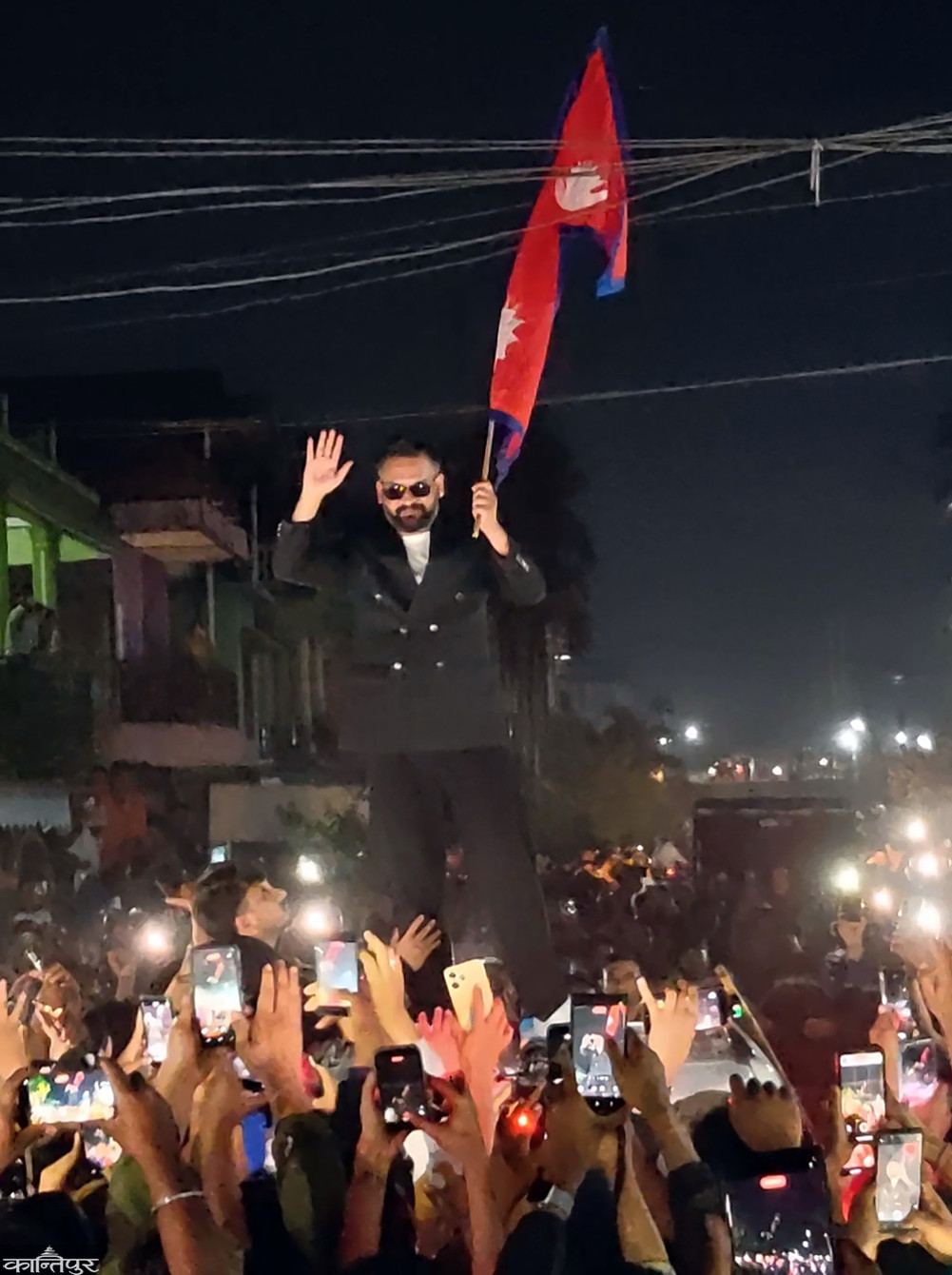
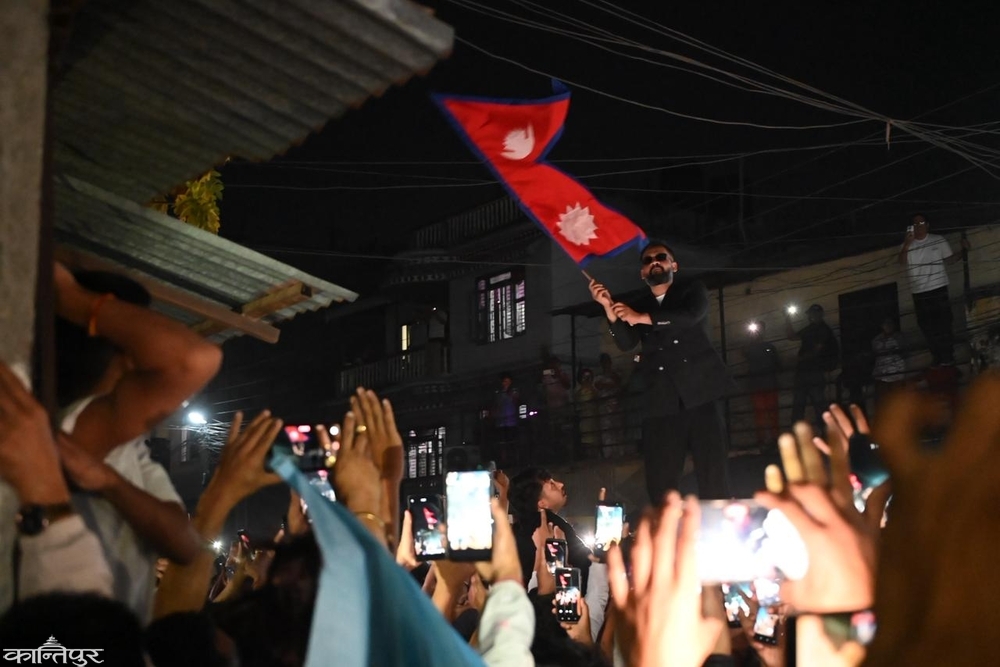
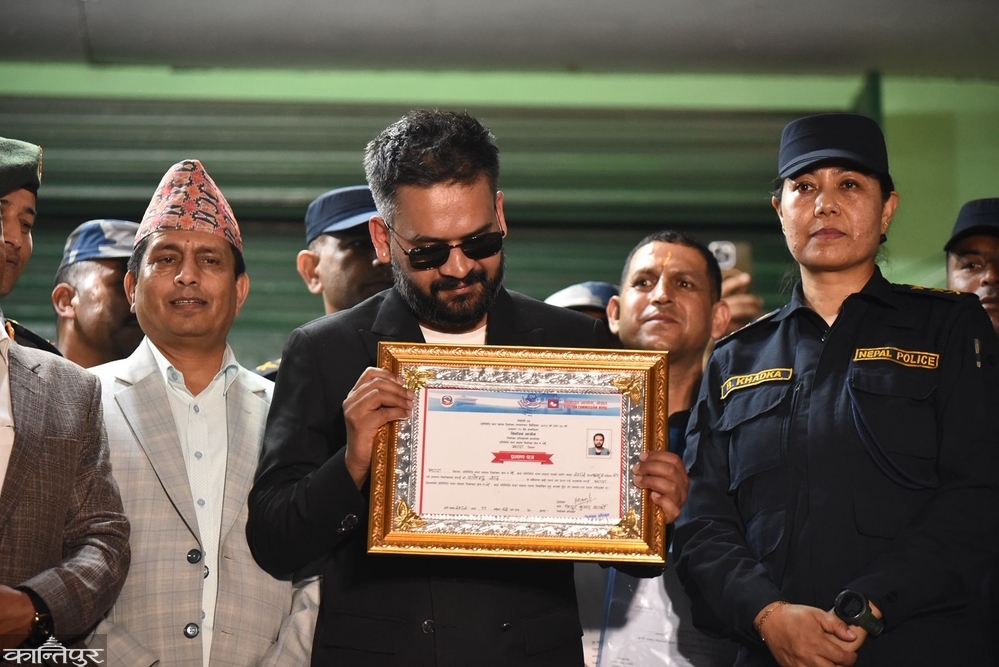
Balendra, who did not even give any interviews, also gave a short speech at the election meeting, not longer than 3 minutes. Balendra remained silent even after receiving the certificate of being elected as a member of the House of Representatives. The Rashtriya Swayamsevak Sangh (RSS) has issued an order not to celebrate the Abir Jatra and the victory festival. Balendra was welcomed by a crowd when he got out of the ‘sunroof’ vehicle with the certificate. Balendra silently came out and showed a banner that read, ‘Congratulations to you, you have won.’
Yujanraj Bhandari, a member of the Nepal Gen-G Front, says that they understand Balendra’s wide victory in Jhapa as voters’ approval of the Gen-G movement.
‘The voters have defeated the forces that reject the Gen-G movement and, on the contrary, call it terrorism through ballots,’ he told Kantipur. ‘The results across the country and Balendra’s landslide victory against the then Prime Minister Oli have confirmed the need for the Gen-G movement.’ Stating that the forces trying to devalue the Gen-G movement have been defeated, he added, ‘The voters have given a clear message that the government to be formed now should also adopt the agenda raised by the Gen-G movement and work to instill hope in the common citizen.’
Stating that this election has also revitalized democracy and the constitution, he said that the statement that no single party could bring a majority has also been proven wrong. Bhandari said, ‘It was seen that the problem lies in political culture more than the election process.’
After being defeated, Oli sent a photo of him gifting a tabla to Balendra on social media Facebook in 2079 BS. He had gifted Balendra, who had come to Balkot to meet him after he was elected mayor in 2079 BS, a gift he had at his house.
Making public the photo from that time, Oli addressed Balendra as 'Babu' and wished him a 'successful five-year term'. Referring to the same photo, some social media users wrote that the tabla given by Oli was played by Balen in his constituency.
A month ago, in an interview with Kantipur in Damak, Oli had claimed that RSPB President Ravi Lamichhane had sent Balendra to defeat him. However, Balendra's team had decided to contest against Oli after conducting internal 'research' in Jhapa-5 before registering nominations, estimating that he could win the election.
Oli had thought that Balendra would not take a 'risk' to fight against him. However, in the end, Balendra went to Jhapa-5, and UML President Oli had to focus there throughout the election period. According to the results across the country, the RSPB is moving towards two-thirds.
Oli represented Jhapa-5 in parliament six times in 2048, 2051, 2056, 2070, 2074 and 2079. In 2064, Maoist candidate Bishwadeep Lingden defeated him by a margin of about 1,200 votes. At that time, the people of Damak understood that development work did not progress when Oli lost, so UML leaders claimed that the people of Jhapa-5 would win him. Oli had spoken in Damak even on the eve of the silence period and asked not to doubt that he would win.
But by Saturday evening, the Rashtriya Swayamsevak Sangh (RSS) had made a 'clean sweep' not only in Jhapa-5, but also in the entire Jhapa district. Former Speaker Devraj Ghimire himself was defeated in Jhapa-2. Speaking to journalists on 21 Falgun, Oli's party, which had said, 'UML will bring the majority as much as possible, even if it does not get the majority, it will become the main party', has won only 5 seats and is leading in 7 seats.
Balen, who thus defeated Oli, did not suddenly enter politics just when he contested the mayoral election of Kathmandu Metropolitan City. It seems that he had political awareness since the Constituent Assembly elections.
After the dissolution of the first Constituent Assembly, he used to participate in the campaign to put pressure on the constitution-making process. When the state obstructed such a movement, he would openly protest, and even write songs on the same subject. Once, when the ruling UML Youth Association took out a motorcycle rally with loud horns, they did nothing to them and lathi-charged the youth who were raising their voices peacefully, he wrote a song expressing his dissatisfaction –
‘It was difficult for us to walk in the morning and evening.
Even seeking our rights was an accusation today.’
On 7 Magh 2071, the police lathi-charged the youth who had taken to the protest saying ‘I want to see Nepal laugh’. At that time,
Balen had expressed his anger on Facebook,
‘Apart from leaders, dons and businessmen, are there no other people? When will the police respect anyone other than these three?’
When the process of closing Nepal was going on with various agendas during the constitution-making, Ujjwal Thapa had launched the ‘Nepal is open, Nepal is being built’ campaign. Even then, he used to stand on the streets.
After joining the campaign on 29th December 2071, he said, ‘Now it is our turn to make the situation of those who are trying to close Nepal worse, Nepal is open, we will remain open.’ He also actively participated when the ‘For the Constitution’ campaign was launched to pressure for the constitution-making. He also used to protest through rap. Most of his songs contain political awareness.
Earlier, the interest of young people in politics was rarely seen. After Balendra was elected mayor in Kathmandu and after the Gen-G movement, the interest of the young generation in politics has increased dramatically. Former leader of the Bibeksheel Party, Milan Pandey, says, ‘Balendra Shah’s rise in politics and the Gen-G movement have awakened everyone.’
Balendra had agreed to join the Rashtriya Swayamsevak Sangh (RSS) by becoming the party’s candidate for Prime Minister. After the first dialogue did not go in a positive direction, he was preparing to pursue separate politics through the Desh Bikas Party.
However, later, RSP President Ravi Lamichhane spoke to him again. They agreed that one would lead the party and the other the government. After that agreement, the enthusiasm of the voters was seen in the RSP.
After the RSP's majority was clear, Balendra is almost certain to become the Prime Minister. However, Balendra's journey to power is not that easy. 'At a time when there is extreme despair in the society, he will have to do things that will instill hope in the people, and before that, he will have to create an environment that will not have internal strife like the one seen in the party that won the majority in the past,' says young political analyst Naveen Tiwari. 'Until now, Balendra's rise has been through questioning, writing statuses and creating a rebellious nature, but now he will have to answer for himself, and it will be worth watching how he plays that role.'
When he was elected mayor of Kathmandu, he was seen as ruthless towards street traders. Therefore, he says, there will also be questions about what kind of policy he will adopt towards the disadvantaged classes across the country. ‘The most important issue is to maintain balanced foreign relations, the kind of tension that is happening in the Middle East, that is where his test may begin,’ says political analyst Dr. Lokraj Baral, who is also a former ambassador, ‘The rest will have to implement the agenda that was raised in the past in the movement and that he himself raised.’ The Rashtriya Swayamsevak Sangh (RSS) released its manifesto on 7 February, including commitments such as creating jobs, eliminating the tax burden, making the country a middle-income country in 10 years, making the per capita income three thousand dollars, and starting the refund of savings of cooperatives within 100 days.
‘The party has also promised on the subject of cooperatives, how it will be implemented is a matter of challenge,’ says analyst Tiwari. According to leader Pandey, Balendra’s biggest challenge will be to balance the party’s internal balance and build a good team. ‘The challenge before him is to move with both speed and direction,’ says Pandey.