Security surveillance will also be carried out using drones, Home Minister Aryal says that some groups trying to spread violence and rumors have been brought under the purview of the law.
We use Google Cloud Translation Services. Google requires we provide the following disclaimer relating to use of this service:
This service may contain translations powered by Google. Google disclaims all warranties related to the translations, expressed or implied, including any warranties of accuracy, reliability, and any implied warranties of merchantability, fitness for a particular purpose, and noninfringement.
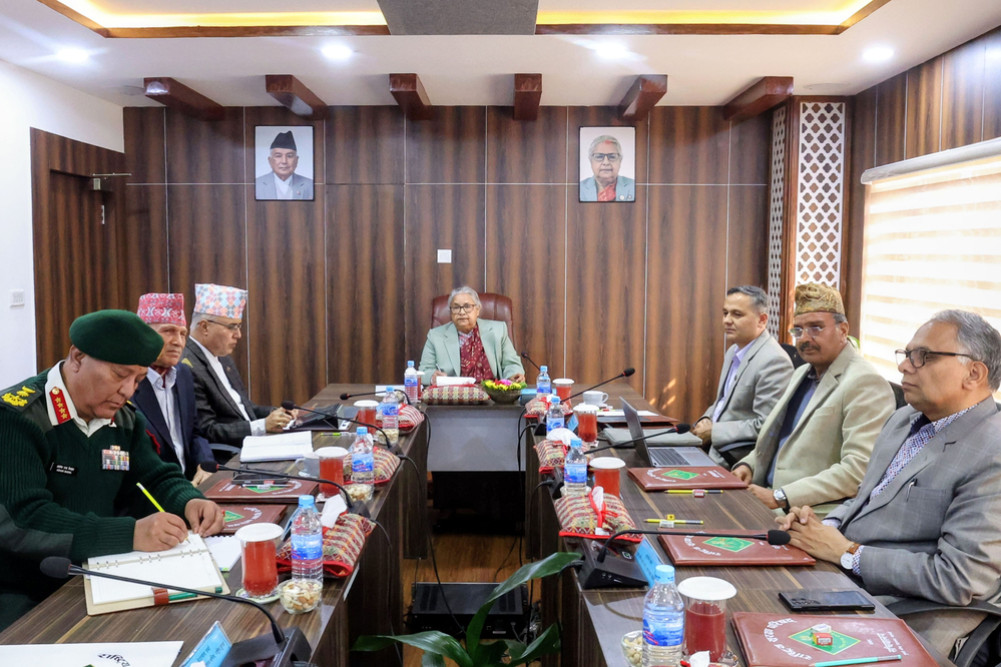
The National Security Council meeting held on Wednesday under the chairmanship of Prime Minister Sushila Karki on the eve of the House of Representatives elections concluded that there are no complex security challenges in the country for the elections. The meeting, attended by Finance Minister Rameshwor Khanal, Home Minister Om Prakash Aryal, Foreign Minister Balananda Sharma, Minister for Labor, Employment and Social Security Rajendra Singh Bhandari, Chief Secretary Suman Raj Aryal and Army Chief Ashok Sigdel, concluded that the security situation for the elections is good.
According to Council Member Secretary Kedarnath Sharma, who is also the Secretary to the Ministry of Defense, the meeting reviewed the security situation in the country and discussed the issue of conducting the elections in a fair, fearless, peaceful and error-free manner as all necessary preparations for the elections have been completed. ‘Discussions were held to mobilize the relevant security agencies in a more effective and coordinated manner to maintain peace and security during the elections,’ Sharma said.
In the meeting, Home Minister Aryal said that some groups trying to spread violence and rumors in the election have been brought under the purview of the law and that people can vote with confidence. He said that although some tried to engage in violent activities, they had talked to some in time and brought others under control, creating an environment for a peaceful election.
The government had initially analyzed that some groups, including the Rashtra, Nationality, Dharma and Culture Mahaabhiyan led by medical professional Durga Prasai, the Civil Defence Party registered by his ally Madhav Khatiwada, the NCP majority led by Dharmendra Bastola 'Kanchan', and Genji, could pose challenges for the election. Accordingly, the government had initially held talks with Prasai.
According to Home Minister Aryal, an attempt was made to send a message to Prasai that he should take the path of addressing his demands through political means. "At that time, we showed him the way, go to parliament, then we told him that even if you want a referendum after getting the numbers, you can go," he said, "later his activities were of a nature to subvert the nation, spread violence and rumors." Prasai was arrested by the police from his residence in Bhaktapur on February 17.
At least 35 people, including Prasai, and leaders of the majority NCP led by Dharmendra Bastola, are in police custody for allegedly trying to incite violence. According to Central Police Spokesperson Abinarayan Kafle, they were arrested from different districts on charges of anti-election activities and misusing social media to spread rumors. Kafle said that they were arrested for engaging in activities that adversely affect election security and misusing AI to spread rumors through social media and spreading false propaganda.
According to Home Minister Aryal, the provincial security committee has also been activated to ensure that the elections are held in a fear-free environment. ‘Coordination has been made reliable by activating the command post led by the provincial chief secretary,’ Aryal said. ‘That committee includes the army chief, the secretary of the Ministry of Internal Affairs and the heads of all security agencies.’
Although there is no immediate challenge, the council has decided to immediately coordinate with each other to deal with any challenges that may arise during the election.’ According to a member who participated in the meeting, discussions were also held on potential security challenges after the vote. ‘We discussed the issue of keeping the situation calm until the final results are announced after the counting of votes has started and preliminary results are coming in,’ the member said. ‘In that regard, no challenges have been seen at the moment.’
He said that Army Chief Sigdel had also made the preparations for the election to be held in a fearless manner in coordination with all security mechanisms in the briefing meeting. In addition to assisting in monitoring social media during the pre-election period, the Nepal Army worked on the security of ballot printing, transportation, and important infrastructure. During the election, the army will work in coordination with election officers, local administrations, and other security agencies, serving as the third ring after the Nepal Police and the Armed Police Force.
‘There will also be joint patrols by setting up various bases, and after the election, the army will again assist in transporting ballot boxes and securing the counting site,’ says Army Spokesperson Rajaram Basnet. ‘The army alone will deploy 79,000 security personnel during the election.’ According to him, the army has worked to create a safe environment by coordinating and collaborating with all agencies, including the Election Commission and other security agencies, to conduct the election safely. Basnet said that 800 bomb disposal teams have been mobilized across the country to prevent any untoward incident.
‘As soon as any news is received, they immediately go and dispose of it safely, while ensuring the safety of the citizens,’ said Assistant Lieutenant Colonel Basnet. So far, the army has disposed of 14 suspicious objects. However, officials say that all of them were bomb-like objects placed to intimidate.
According to officials, one temporary base each for the army and the armed forces has been set up in 165 constituencies to prevent any untoward activity. The army has been deployed through the same base in three parts - long distance, medium distance and short distance - for foot patrols, striking forces, mobile patrols, etc.
According to Nepal Police, CCTV and drones will also be used to monitor the elections peacefully.
‘Social media monitoring desks are working in every district police office, provincial police office, valley police office, cyber bureau and police headquarters to prevent violations of the election code of conduct and misuse of social media,’ said police spokesperson Kafle. ‘Therefore, there is a situation where you can vote with confidence.’
The Election Commission has designated 11,901 polling stations and 23,112 polling stations across the country. Of these, 4,114 polling stations have been placed on the highly sensitive list. Security personnel have been deployed based on sensitivity. According to the ministry, 4,442 polling stations across the country are on the sensitive and 2,845 general security challenge list.
In Kathmandu Valley, 278 polling stations are general, 237 polling stations are sensitive and 12 polling stations are on the highly sensitive list. In Koshi, 647 polling stations are included in the general, 237 sensitive and 12 highly sensitive list. In Madhesh, 159 are on the general, 755 sensitive and 1,246 highly sensitive list. In Bagmati (excluding the valley), 437 are general, 497 sensitive and 1,288 highly sensitive list.
In Gandaki, 392 are general, 577 sensitive and 328 highly sensitive, in Lumbini, 471 are general, 738 sensitive and 358 highly sensitive. In Karnali, 161 general, 422 sensitive and 358 highly sensitive polling stations are on the list, while in Sudurpaschim, 300 general, 394 sensitive and 481 polling stations are on the list.