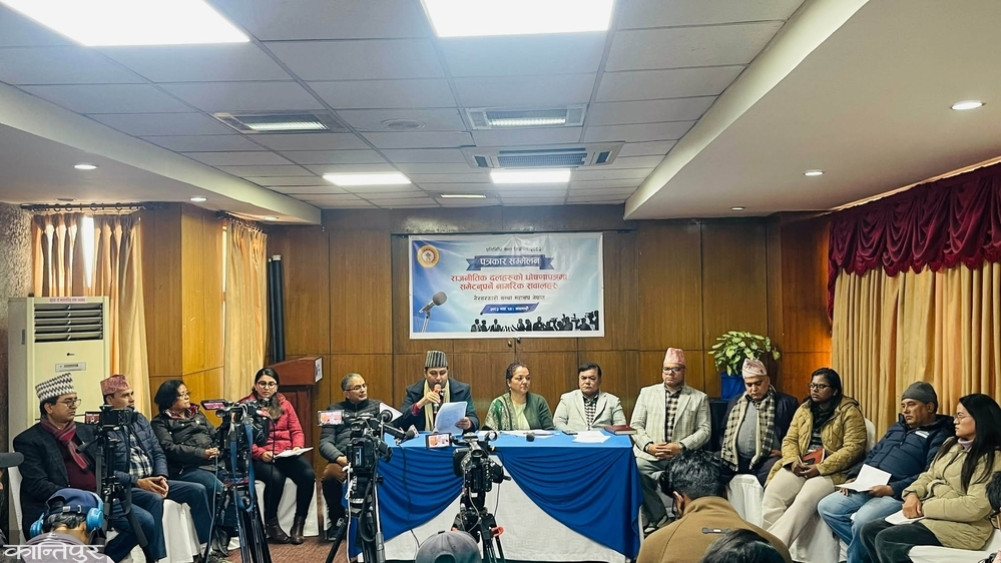
The 'Citizen Appeal Letter, 2082', jointly prepared by organizations, networks, campaigns, activists and various stakeholders active in civil society, has been made public to identify issues that should be included in the upcoming elections.
We use Google Cloud Translation Services. Google requires we provide the following disclaimer relating to use of this service:
This service may contain translations powered by Google. Google disclaims all warranties related to the translations, expressed or implied, including any warranties of accuracy, reliability, and any implied warranties of merchantability, fitness for a particular purpose, and noninfringement.
Parties are busy writing manifestos for the elections to be held on Falgun 21. Against this backdrop, 16 organizations have jointly prepared a 24-page long suggestion sheet for the parties.
In which they have shown interest in the manifestos issued by the parties and the content to be included in them. The suggestion letter includes the fact that the issues of daily concern of the citizens should be included in the manifestos of political parties.
At a press conference in Kathmandu on Wednesday, led by the Federation of Non-Governmental Organizations, they have made public 13-point suggestions for various issues that the parties should include in their manifestos. Arjun Bhattarai, Chairman of the Federation of Non-Governmental Organizations Nepal, said that the manifestos brought by the parties in the 2079 elections are being reviewed. He informed that the 'Citizen Appeal Letter, 2082', jointly prepared by organizations, networks, campaigns, activists and various stakeholders active in civil society, has been made public on what issues should be included in the upcoming elections.
Chairman Bhattarai said that the parties have been urged to include issues that are directly related to the lives, rights and future of the citizens in the manifestos in a clear, committed and implementable manner. He also informed that the suggestions for the manifestos to be submitted to the political parties were prepared after conducting study tours across the country.
The organizations that prepared the suggestions include the Federation of Non-Governmental Organizations Nepal, Federation of Nepali Journalists, Community Radio Broadcasters Association, Federation of Dalit NGOs, National Federation of Disabled People, Beyond Beijing Committee, Federation of Water and Irrigation Consumers, Federation of Community Electricity, Federation of Drinking Water and Sanitation Consumers, National Federation of Indigenous and National Women's Federation Nepal, Consumer Interest Protection Forum, Youth Organization Network, Federation of Sexual and Gender Minorities, Blind Association Nepal, and National Network of Women Human Rights Defenders.
In the backdrop of the citizen dissatisfaction and demands exposed by the Gen-G uprising held on Bhadra 23 and 24, the suggestion letter states that the upcoming election to the House of Representatives to be held on Falgun 21 is not just a regular election but a historic turning point in guiding the direction of democracy. 'The aspirations of fundamental rights, inclusive democracy, social justice, equality, good governance and prosperity guaranteed to citizens by the Constitution of Nepal promulgated in 2072 BS have not yet been fully implemented,' said Chairman Bhattarai.
The current reality of not making the expected progress in strengthening democratic institutions, ensuring civil liberties, accountability of state organs, and socio-economic transformation is raising serious questions about the quality of democracy, the citizens' appeal states. The appeal states that the upcoming elections are not just a formal process of transferring power, but a historic opportunity that should prove to be a decisive turning point in the direction of restoring and expanding civil rights, ensuring accountable governance, institutional development of social justice, and inclusive and sustainable prosperity. 'Issues such as strengthening democracy, administrative restructuring, ensuring civic space, protecting human rights, good governance and controlling corruption, effective implementation of federalism, economic growth, industrialization and commercialization of agriculture, environmental protection, climate justice, disaster risk management, and ending all forms of inequality and discrimination are no longer optional agendas of political manifestos, but mandatory obligations,' the letter states.