The journey is easy on the Banibnau black-paved road in the Muglin-Narayangadh section, but the risk of road accidents is high when the 19 bridges, small and big, on this 36-km road section are built to the right or left, above the road line.
We use Google Cloud Translation Services. Google requires we provide the following disclaimer relating to use of this service:
This service may contain translations powered by Google. Google disclaims all warranties related to the translations, expressed or implied, including any warranties of accuracy, reliability, and any implied warranties of merchantability, fitness for a particular purpose, and noninfringement.
Those who travel through the Narayangadh-Muglin road in Chitwan must have noticed one thing. That is, concrete bridges constructed in this section. The distance of the road connecting Muglin to Narayangadh is 36 km, but the number of small and big bridges constructed in that section is only 19.
On the Muglin Bazar-Narayangadh section, travel is easy on the Banibanau blacktop road, but for the new bridge built on the same section, one has to turn right or left. Again, you have to go up and down from a bridge that is higher than the road level.
Not only the old ones, but also the newly built bridges are like this. Where there are bridges that are more than 35 years old, new bridges have been constructed parallel to them. Road Division Office Bharatpur has the data that more than 11,000 small and big vehicles pass through this road every day.
District Traffic Police Office Chitwan chief Gayatri Sharma said that although accidents have decreased after the construction of the new bridge, there has been no reduction in overall accidents. "When the first bridge was narrow, there were more accidents," he said. According to the traffic police, 18 people died in accidents on this road section in 078/79, 11 in 79/80, 21 in 080/81 and 26 in 081/82. He said that the number of two-wheelers is more. "Before, there were more accidents with the narrow bridge," he said, "now it has decreased, the number of deaths due to accidents on the entire road section has increased." Later, in August 2018, it was upgraded and handed over to Road Division Office, Bharatpur, Chitwan. By this time, only four bridges were built while 15 bridges were not yet built.
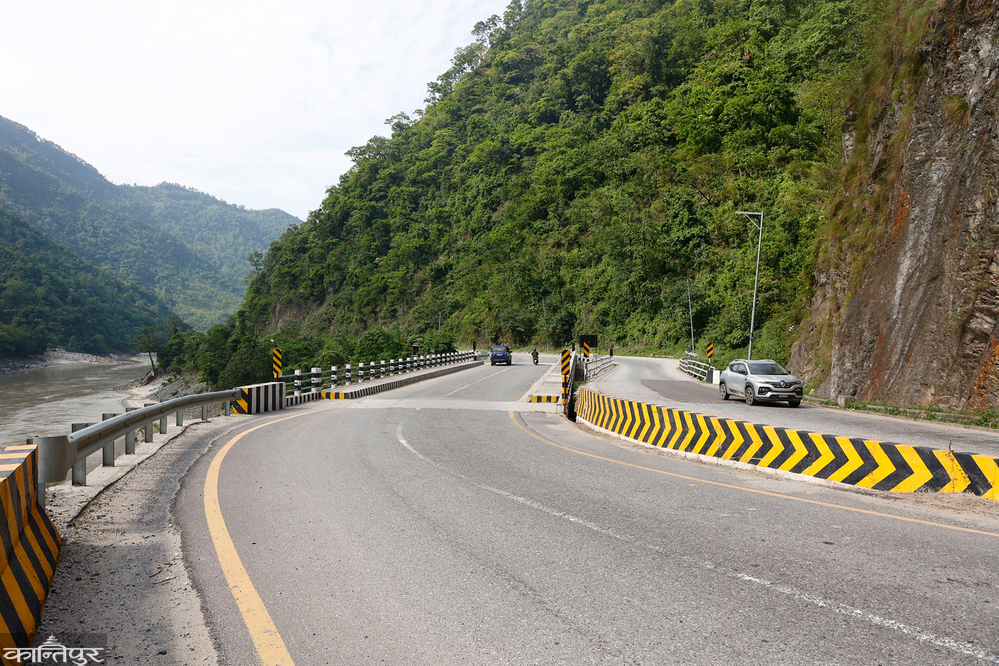
Some were contracted, some were in the process of being contracted. Until the new bridge was built, the old one was only an intermediate bridge. The new bridge built now has two lanes. Both old and new bridges are operational. The bridge built alongside the old one is one-way, with vehicles coming from one and leaving from the other. Krishna Acharya, engineer and information officer of the road division office of Bharatpur, said that due to the geographical situation, it was not possible to demolish the old bridges and build new ones.
'There is more traffic in this section, so we kept the old bridge running during the construction of the road, we did not demolish the old bridge while building the new one,' he said, 'It was possible to demolish the old bridge and build a new one by making a diversion on the plains towards the plains, due to the hilly terrain, difficult place, it was difficult to build a foundation on the width of the road, so we did not demolish the old bridge and built a new one in parallel.'
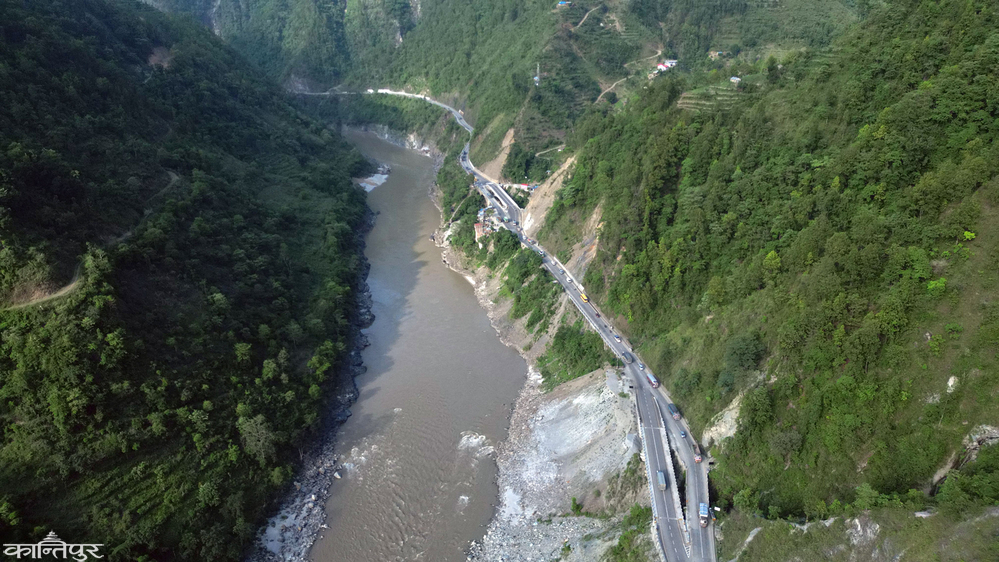
He said that if the old bridge could be demolished and a new one built, the level of the road and the bridge would match. "But it was not possible because it was a very difficult section," he said. 17 bridges have been built along with old and new ones. Vehicles ply at Jalbire and Setidovan bridges from the new bridge. Jalbire also has an old bridge. Drivers use the new bridge because they have to go around a lot to reach the old bridge.
Engineer Acharya said that it has been a year since the four earlier and later bridges have been in operation. According to him, the bridge was also built with a concessional loan of 1 billion 27 million rupees from the World Bank. "Bridges start from Jugedi," he said, "which are 35 to 90 meters long." "Until now, the old bridges are in a condition where they can be repaired and run," he said. Where the bridge faces, the road has been widened. "When the bridge was narrow, it was a problem to pass large passenger vehicles, there was also a risk of accidents," he said.
Before the road was not upgraded and the new bridge was not built, the risk of accidents was higher. Due to the narrow bridge, the risk of vehicle collisions was the same. Not only that, there was a traffic jam on the bridge and the vehicles had to move back and forth. How many vehicles fell from the dangerous bridge and got into an accident. By breaking the railing of the bridge, the cargo vehicles used to have more accidents. At that time, the scene of driving a vehicle with a red ribbon hanging on the railing without immediately installing the railing was not new at that time. Because with the onset of rains, landslides occur. Even now, the risk of landslides remains.
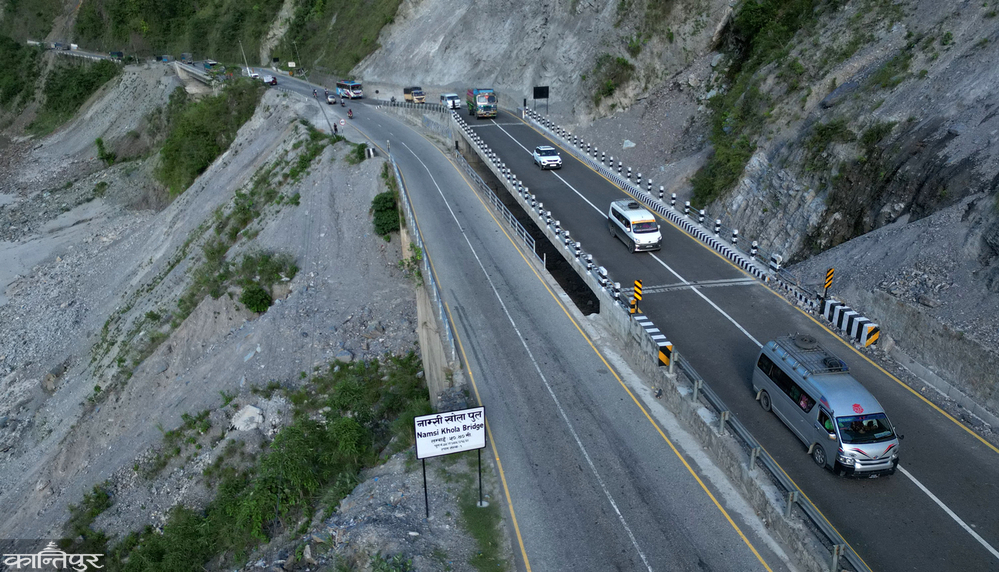
As there was no place to demolish the old bridge and build a new one, a new one was built next to it, said Lojijan Khanal, head of the bridge division. "The geographical structure is complex, the road has been built from the bottom of the mountain," he said, "therefore, it is not possible to build it by demolition, the traffic pressure is also high in this section."
Ex-Secretary Arjunjung Thapa said that due to the lack of condition to construct a bridge by digging the wall, there is no coordination between the road and the bridge. "However, there seems to be a fault in some of the bridges, bridge number four from Muglin is faulty, the first bridge coming from Narayangarh towards Muglin is built in an unwanted place," he said.
"It is difficult for vehicles to move when the bridge is not in harmony with the road, now it is difficult to improve it," he said.
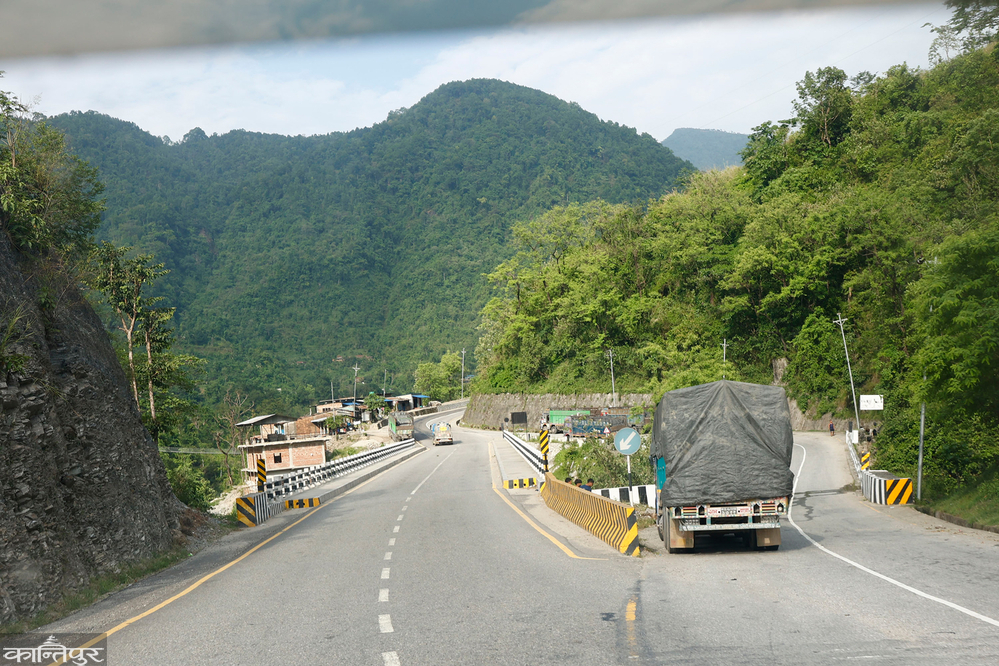
'Due to geographical complexity, the bridge could not be built according to the road layout'
Keshav Kumar Sharma Secretary, Ministry of Physical Infrastructure and Transport
Narayangadh-Muglin road has not been built according to the level of the road, why?
 Now the old bridges are demolished and new ones are built or are they repaired and operated?
The old bridge is no longer needed. A new two-lane bridge has been built. Old bridges are narrow. Again, the old bridges are of 'Intermediate' type. The upgraded road has two lanes. Therefore, the old bridges have not been demolished. If the road is widened at some point, the old bridges have been kept intact. Gradually, the use of this bridge also decreases.
Is this a problem only on road bridges, is it similar elsewhere?
This is the most difficult road. The end is not that much of a problem. Little by little, the bridge and the road may not be coordinated on the Narayangarh-Butwal road. The problem is that the old bridge has to be preserved. Now the road from Nagadhunga to Muglin has not been able to work because of the new diversion at the place of the old bridge. Therefore, it is difficult to coordinate the drawing of the bridge and the road because the old bridges have to be preserved and the wall cannot be used much.
Bridges are built only after some roads are built, can't construction of roads and bridges be done at the same time?
A bridge cannot be built on a small budget. Building a bridge is not as easy as building a road. There is little budget, even if it is one km, we should not build a road. Bridge work should be done at once. Earlier, road and bridge contracts were done separately. Not so now. Currently, Narayangadh-Butwal, Nagadhunga-Muglin, Muglin-Pokhara, Kakdvitta-Laukhi and other highways, which have been expanded, have been contracted for roads and bridges at the same time. For two to four years, bridge and road contracts were being worked simultaneously. Before, bridges were built only by building roads.

