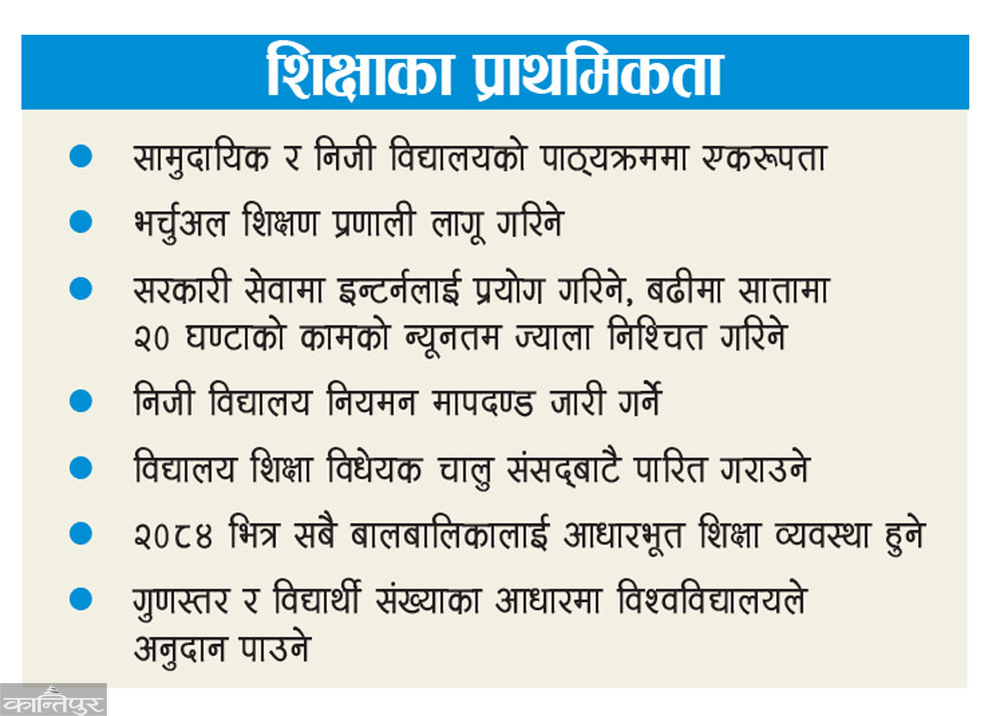
Uniformity in the curriculum of public and private schools, virtual teaching system will be implemented, government service interns will be used, minimum wage will be fixed for a maximum of 20 hours a week.
We use Google Cloud Translation Services. Google requires we provide the following disclaimer relating to use of this service:
This service may contain translations powered by Google. Google disclaims all warranties related to the translations, expressed or implied, including any warranties of accuracy, reliability, and any implied warranties of merchantability, fitness for a particular purpose, and noninfringement.
The government is going to implement the public and private school partnership program. President Ramchandra Paudel, while presenting the government's policy and program for the fiscal year 2082/83 in the Parliament on Friday, announced that the educational quality of public schools would be improved by implementing the Institutional (Private)-Community School Partnership Program with the participation of private schools as well.
It has been announced to bring uniformity in the curriculum of private and public schools. He said that national regulation standards for private schools will be issued. "Virtual teaching system with everyone's access, student consultation arrangement, digital platform arrangement of interactive e-learning materials and intensive training in attractive teaching art based on teacher mentoring will be arranged," it is mentioned in the policy and program.
It has also been announced to appoint students as interns in government services. Interns will be used in government services from the local level to the center. Students above graduation level will be involved in various researches. At most, the minimum wage of 20 hours of work per week will be fixed and the policy of studying while earning will be implemented,'' said in the policy and program.
The past policies and programs of opening residential schools targeting difficult geographical areas, establishing a teacher bank in collaboration with the university to review teacher vacancies, issuing national qualification standards for teachers, and handing over the work of teachers' libraries to the state government have been continued.
The government has announced that the school education bill pending in the parliament will be passed from the current budget session. The government has also agreed with the Nepal Teachers' Federation, which has been protesting for 29 days, to pass the bill by June 15.
'Legal, policy and institutional reforms will be made to improve school education. The bill to amend and unify the law on school education will be passed in this session, said President Paudel. It is mentioned in the policy and program to make education universal, quality and useful for life.
'A long-term roadmap for government reform of school education will be prepared and restructured. Arrangements will be made for all children to get basic education by 2084,' it is said in the policy and program. It has been announced that the President's Educational Reform Program will be revised and strengthened as the National Educational Reform Program.
It has been announced that technical education will be extended to the university level. "On completion of school education, students will be admitted to technical and professional education or university education based on their grading," it said. President Paudel said that higher education will be based on research. He said that the university grant system will be improved and distributed based on the quality of students and the sustainability of the institution.
It is mentioned in the policy and program that the government system of the university will be improved, and a national standard of educational quality will be prepared. It is said that learning achievement tests will be conducted at the local, state and national levels. "The university will prepare the professional development and position classification of the teachers teaching in the community campus and arrange the system so that it is compatible with other teachers," he said, "an environment of cooperation will be created between the public-private educational sector for the development of scientific research and technology." Linking intellectual property innovation and research with traditional knowledge, skills and community The government has said that it will proceed with the
. "Scientific manpower will be produced in coordination with local, provincial and central and private educational institutions," it is said in the policy and program.

