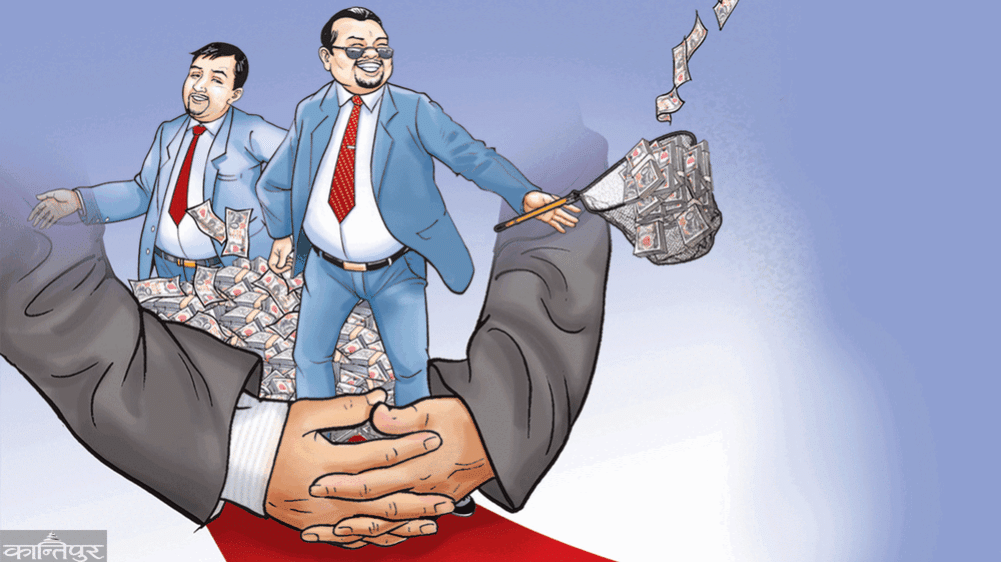
The Asia Pacific Group (APG) under FATF, an international organization that monitors money laundering and terrorist activities, has placed Nepal on the ”grey list” twice from 2008 to 2014 and again in 2025.
We use Google Cloud Translation Services. Google requires we provide the following disclaimer relating to use of this service:
This service may contain translations powered by Google. Google disclaims all warranties related to the translations, expressed or implied, including any warranties of accuracy, reliability, and any implied warranties of merchantability, fitness for a particular purpose, and noninfringement.
Since it has been a long time since structural arrangements have been made to control the crime related to money laundering, the government seems to be apathetic in their effective implementation. The government has not been able to act according to the commitment made by Nepal in the international forum against money laundering.
In order to investigate and prosecute against money laundering, the government introduced the Money Laundering (Money Laundering) Prevention Act on January 10, 2064. However, due to not establishing a mechanism for investigation and prosecution according to the law, the Asia Pacific Group (APG) under the Financial Action Task Force (FATF), an international organization that monitors money laundering and terrorist activities, put Nepal on the "Grey List" in 2008 (2065).
Only on June 31, 2068, the government established the 'Money Laundering Investigation Department', a mechanism for investigation and prosecution. After that, the government became apathetic about the reforms in other laws and the effective implementation of the laws, and till 2014, Nepal was included in APJ's "grey list". Nepal, which was removed from the "grey list" after a commitment to comply with the specified conditions and some improvements in the legal arrangements, has returned to the same list after 11 years.
Since the promulgation of the Prevention of Money Laundering Act, the leaders of the major parties Congress, UML and Maoists have become prime ministers many times. During this period, Girija Prasad Koirala, Pushpa Kamal Dahal, Madhav Kumar Nepal, Jhalnath Khanal, Baburam Bhattarai, Sushil Koirala, KP Sharma Oli, Sher Bahadur Deuba have led the power. In the meantime, a non-party election cabinet was also formed under the leadership of the then Chief Justice Khilraj Regmi. Regardless of the party led by the government, priority cannot be given to prevention of money laundering.
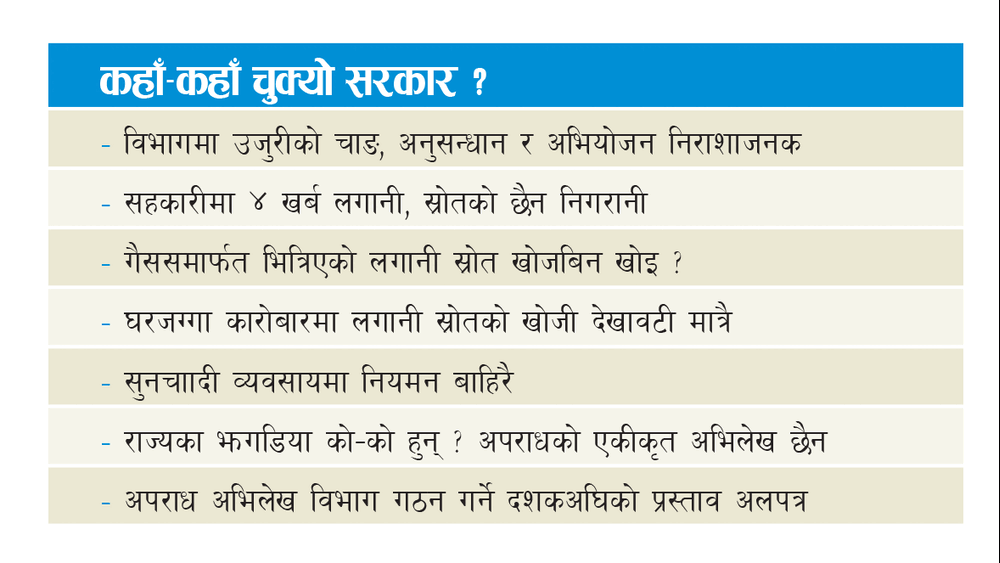
There have been 17 Director Generals in the Money Laundering Investigation Department so far. The then joint secretary Khumraj Punjali is the first director general of the department. In the department, instead of doing the work according to the mandate, there is still a tendency to send officials close to power and power as 'Molahija'. Because of this, the department has not been able to show results as per the target. About 2,000 complaints of asset laundering are pending in the department. So far, the department has investigated complaints and filed only 112 cases. The
department was initially placed under the Ministry of Finance. After the general election of 2074, UML president Oli became the prime minister, and the revenue investigation and national investigation department along with asset laundering were brought under the office of the Prime Minister and Council of Ministers. Even now these powerful mechanisms are under the Prime Minister's Office. But the department has not been able to work effectively.
In the meantime, the department has not given any interest to investigate the leaders, employees, traders/intermediaries involved in the fake Bhutanese refugee case, Lalita Niwas land embezzlement, and the Bhatbhateni supermarket fake bill bill/taxation case. Although 131 people have been found guilty by the special court in the case of embezzlement of the land of Lalita Niwas by the Abuse of Authority Investigation Commission, the investigation of the money laundering related to that case is still there.
FATF, the World Bank, the International Monetary Fund, and related bodies under the United Nations have repeatedly warned to do effective work against money laundering crimes. In 2012, after FATF warned that Nepal would be included in the 'black list', Nepal made some reforms in the law. Under the pressure of FATF, the government amended 19 laws in March 2080.
The revised law has also given authorities and Nepal Police the authority to investigate and prosecute complaints related to money laundering. According to that, the authority has investigated two people who were involved in the investigation of corruption and the police have investigated six complaints including the transactions of cooperatives, gold and cryptocurrency and have taken the case to the court.
The department, which was established to investigate and prosecute money laundering, has filed 14 cases in 8 months of the current financial year. The department filed 11 cases in 2080/81, 11 in 2079/80, 3 in 2078/79, 14 in 2077/78, 10 in 2076/77, 9 in 2075/76, 4 in 2074/75 and 6 in 2073/74. Before that, 4 cases were brought to court in 2072/73, 1 in 2071/72, 3 in 2070/71, 14 in 2069/70 and 8 in 2068/69, the year the department was formed. The government was also criticized for "abruptly" transferring some director generals of the department after conducting investigations on major cases. Khumraj Punjali, the founder director general of the
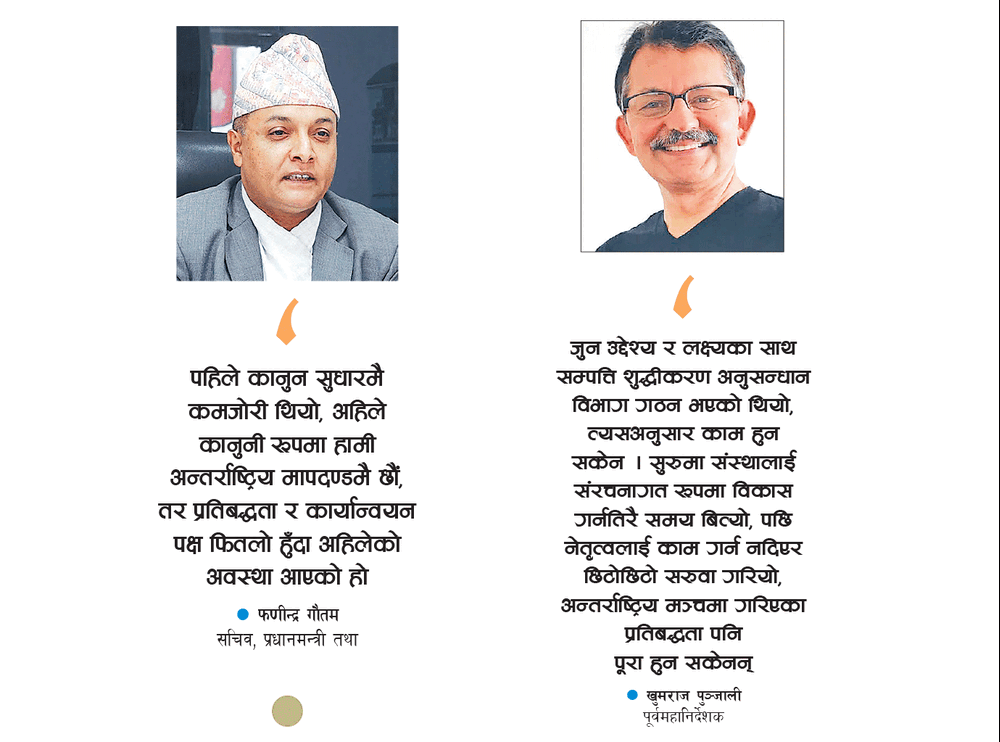
department, says that the country's image has been negatively affected by the weak action against money laundering. The purpose and goals with which the department was formed, the work could not be done. In the beginning, time was spent on structurally developing the organization,'' he said, 'even after that, it could not be done. On the contrary, the leadership going there was also transferred quickly without being allowed to work. The commitments made in the international arena could not be fulfilled, as a result of which the country was included in the 'Grey List'.
Organized criminal groups and illegal or fraudulent extortion, subversive and terrorist-related, human trafficking and trafficking, all kinds of sexual exploitation, corruption, drug trafficking, illegal trafficking of weapons/equipment, trafficking of stolen goods, fraud, labor, There is a legal arrangement to investigate more than 3 dozen crimes related to money laundering, including counterfeiting/currency, production/illegal copying or theft, environmental destruction, death and dismemberment, kidnapping and body hostage, theft/robbery, customs/excise duty and tax evasion.
According to Nepal's National Risk Assessment Report (NRA)-2020, corruption, revenue (tax) evasion, banking/financial crime, money laundering, human trafficking, environmental crime, abuse of law have been listed as high-risk crimes. If the investigation and prosecution of high-risk crimes are effective, Nepal can get more points in the evaluation to get out of the "grey list". However, there has been no effective work by the government.
The government has not been able to micro-regulate cooperatives which are outside the regulation of Nepal Rastra Bank. Although billions of rupees have been invested in cooperatives, its source has not been investigated. According to Economic Survey-2080, 31 thousand 450 cooperative organizations and 7385 thousand 528 savers in the country have transferred 4 trillion 5 billion 3 crore rupees. But what is the source of savings? What background do people have savings? The government does not have a clear record of how much the cooperative's savings have been invested in.
The founder and businessman of Civil Cooperative Ichcharaj Tamang was arrested in the co-operative fraud case and later he was found guilty by the court for the case of money laundering. However, a detailed investigation has not been done in other cases of cooperatives that have been purified by misappropriating the cooperative's savings.
Every year, questions are being raised about the expenditure of billions of rupees from international non-governmental organizations under the guise of social and development work in Nepal and its transparency. It has not been possible to find out how INGOs have brought money into Nepal from which source and whether it has been utilized according to the state's priorities. According to the Auditor General's office, in the last 9 years alone, more than 3 billion rupees have flowed into Nepal through gas. Even though the Accountant General has been raising questions about the source of the money and the transparency of the expenses incurred, the government has not been able to address it properly.
In the three years of 2072/73 to 2074/75 only, the government ignored the fact that Gasus had hidden and 'embezzled' more than 1 trillion 2 billion rupees in more than 29,000 different bank accounts in Nepal, and the government had instructed the government to confiscate the amount.
The commission led by ex-judge Mohanraman Bhattarai to investigate the financial irregularities within the Samaj Kalyan Council and the assets brought in through GASS also submitted a report to the government saying that the investments made through GASS should be monitored in connection with terrorist activities, but the suggestions pointed out in the report were not implemented. One of the reasons why Nepal was recently included in the "grey-list" by FATF is one of the weak regulation of the state on investments conducted through gas.
During this period, the government failed to monitor the individuals and organizations dealing in precious metals including gold and silver. The sources of investment in precious metals transactions and the legality of acquired assets have not been regulated. Many facts have already come to light that international gangs smuggle gold and other goods through Nepal. Among them, even though it has been revealed through the police investigation that the smuggled gold is also consumed in Nepal, no proper investigation has been done on it.
Another risky area where black money earned from illegal assets is invested is 'real estate'. However, the government mechanism has not paid attention to its investigation. On the contrary, due to conflicts of interest, businessmen involved in 'real estate' business have reached the stage of making laws. Since the past, there has been talk of bringing a law related to conflict of interest time and time again, but the parties have not been serious about it. Casinos have also been identified as a risky area for money laundering in
crimes. However, the government has not been able to find out which people have invested in the casino. The Asia Pacific Group (APG) under FATF has been raising questions even though the monitoring of casinos is lax.
The secretary of the Prime Minister and Council of Ministers Office, Fanindra Gautam, says that even though Nepal has a very strong legal basis against money laundering, the current situation has come about because of lack of commitment and implementation. "Now, the effectiveness of the implementation should be increased, the real estate business should be registered and operated only, questions have also been raised about the method of land evaluation.
We have to improve more on these issues,' says Gautam, 'Earlier there was a weakness in law reform, now legally we are in line with international standards. FATF also assesses effectiveness. It has been said that the understanding of the risk is not sufficient not only in the government but also in the regulatory agencies and stakeholders.'
The 'Criminal Assets and Means (Prevention, Control and Confiscation) Act' was issued in 2070 to confiscate and manage the criminal assets that have been concluded through the judicial process. The regulations came in 2077 only after 7 years of the Act. The next year, on October 5, 2078, the criminal property management department was formed. Being placed under the Ministry of Home Affairs, this department has been given all the powers of confiscation, detention and control of criminal assets, but it has not been implemented.
The agencies that investigate and prosecute and judge criminal cases have not coordinated the work that should be done by the department according to the law. One aspect of the country being on the "Grey List" last time is the inability to confiscate, stop and control criminal assets. APG has pointed out that the amount of nationalization of criminal assets is low and weak.
Similarly, the government has not been able to create an integrated record system of various crimes related to the state. In the year 2070, when the Criminal Assets Act was promulgated, the Ministry of Home Affairs made a commitment to set up a department-level mechanism under the Ministry and create a 'Central Record System of Crime'. However, the House has not been able to implement its own commitment yet.
The report of APG has pointed out that Nepal has not achieved concrete achievements even against financial investment in terrorist activities. Nepal has not been able to convince the international forum that people and organizations involved in terrorist activities will not be allowed to do any kind of activities in Nepal. For this reason, the strategies introduced against money laundering and financial investment control in terrorist activities have not been effective. Likewise, the issue of inadequate regulation and monitoring of Nepal-India open border has been raised.
The commission formed under the chairmanship of ex-judge Dilliraj Acharya to investigate gold smuggling had suggested the government to install appropriate equipment as there was no electronic equipment to check the traffic and goods at the Nepal-India and Nepal-China international borders. However, even after a year of understanding the report of the commission, the government has not shown seriousness about it. In Transparency International's Corruption Perceptions Index, Nepal has been consistently included in the list of highly corrupt countries. Since participating in the measurement of transparency, the situation of Nepal has not been able to come out of the list of countries with high corruption.
Former Secretary Punjali says that since what Nepal has to do to get out of the 'grey list' has been clearly defined, only its literal compliance will be taken seriously. The investigation and prosecution should not be obstructed from anywhere, the department and other investigating bodies should be empowered. There is no way for the government to come back from this,” says Punjali. Secretary of the Prime Minister's Office, Gautam, says that FATF has also shown weakness in the level of action taken by the government.
The cases that have been decided have not been implemented, the assets that should be confiscated have not been confiscated. Three/four sectors including casinos, large cooperatives, precious metal business (gold and silver) businesses, remittances and money transfer companies have been pointed out as high risk," says Secretary Gautam. There was also a self-assessment of everything FATF said. That is what he is saying now. If there is a commitment to implementation and a collective effort, we will soon come out of the 'grey list'.''