We use Google Cloud Translation Services. Google requires we provide the following disclaimer relating to use of this service:
This service may contain translations powered by Google. Google disclaims all warranties related to the translations, expressed or implied, including any warranties of accuracy, reliability, and any implied warranties of merchantability, fitness for a particular purpose, and noninfringement.
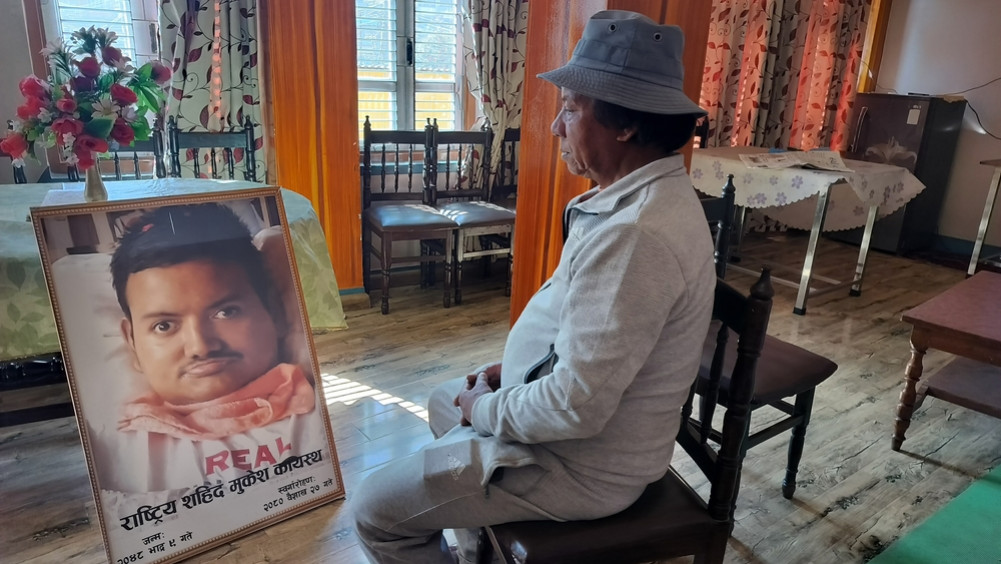
A large photograph hanging in one corner of the room reads, 'National Martyr Mukesh Kayastha'. Several pictures of Mukesh are kept in the drawer in the other corner of the room. Mukesh's 65-year-old father Krishnaman takes care of himself by looking at these pictures. "Looking at the picture, Mukesh seems like nothing," he said, "whereas, he is not in this world."
A long period of Krishnaman's life was spent in an excruciating wait. It was a long wait of 17 years, to hear the words 'father' from the son. After Mukesh passed away, this wait also ended.
Sometimes Krishnaman meets with Mukesh's friends these days. Sometimes Mukesh's friends come to meet us, he said, 'They also look like Mukesh. When I meet them, I can't hold back the tears in my eyes, my heart is heavy. They are happy when they come. They also leave with a glimpse of Mukesh.'
Krishnaman will never forget the day of 27th Chait 2062. On that day, an unexpected incident happened in Mukesh's family. Mukesh was then 14 years old and was studying in class 8. He was in his free time after finishing his final exams. The people's movement of 2062/63 was at its height. Bhimsen Dahal of BANEPA-4 was killed by security personnel's bullet on 26 Chait 062 in Pokhara. After Dahal's death, Kavre became more agitated. Mukesh also participated in that movement. In the anti-regression movement, the police and the army used not only water cannons, sticks, tear gas, rubber bullets, but also bullets. The bullet hit Kalila Mukesh in the back.
Mukesh, who was seriously injured by the bullet, was taken to Shir Memorial Hospital for treatment. After treatment was not possible there, he was taken to various hospitals in Kathmandu. But Mukesh did not recover. He could not get up. Krishnaman and mother Meera continued to try hard to bring their son back to his former state. They ran to many places and met many people. But nothing happened. 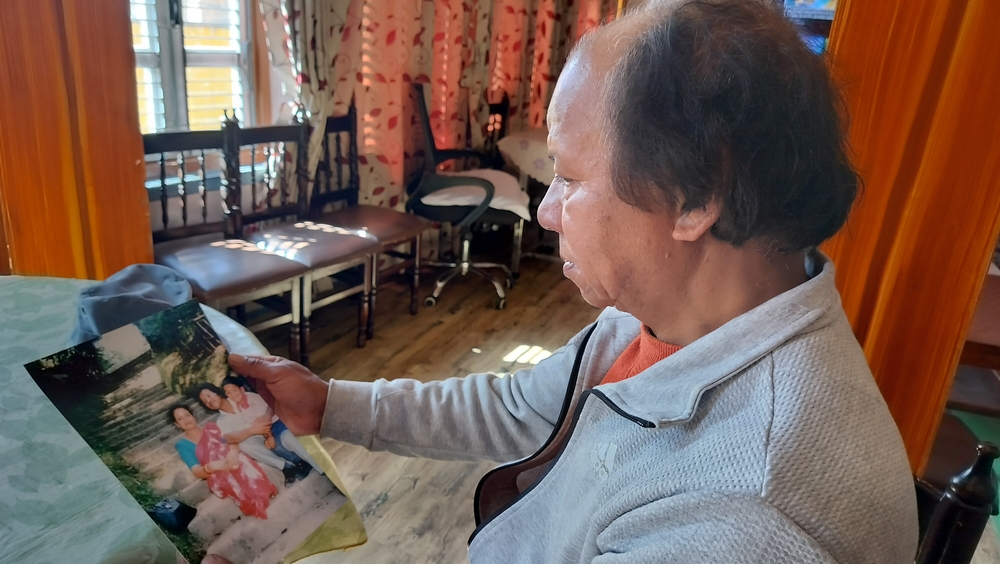
Like Mukesh, the system was changed by the bullet taken by a citizen. The monarchy collapsed and became a federal democratic republic. Many leaders came and went in the government. Mukesh was called a 'living martyr'. He spent 6,235 days in semi-consciousness.
In this long battle with life and death, Mukesh lost his life on 27th Baisakh 2080 at 6:13 pm. "My father is not with me, but today I am haunted by the events of that day," said mother Meera, "I still remember the day when people gathered in Banepa for the people's movement, how many were martyred, how many were injured in the people's movement, their dreams All must be completed together.''
The government provided Mukesh's treatment expenses, 15,000 monthly allowance, 6,200 allowance for a convalescent and a nurse. The Warriors of Democracy, Documentation and Honors Committee established by the government in 2078 awarded Mukesh the 'Warrior of Democracy' award in appreciation of his contribution to the people's movement.
Mukesh's father Krishnaman said that the government is always grateful for the treatment of Mukesh and the respect shown to him. According to him, the government has already declared Mukesh a martyr. However, he said that the martyr's family did not get the services that the government should provide. "The government has declared Mukesh as a martyr," he said, "we have not received anything that the martyr's family should get, it is said that the service facilities have not been provided because of some problems in the documents." Krishnaman said what he thought. "The amount given by the government is only for a few days," he said.