We use Google Cloud Translation Services. Google requires we provide the following disclaimer relating to use of this service:
This service may contain translations powered by Google. Google disclaims all warranties related to the translations, expressed or implied, including any warranties of accuracy, reliability, and any implied warranties of merchantability, fitness for a particular purpose, and noninfringement.
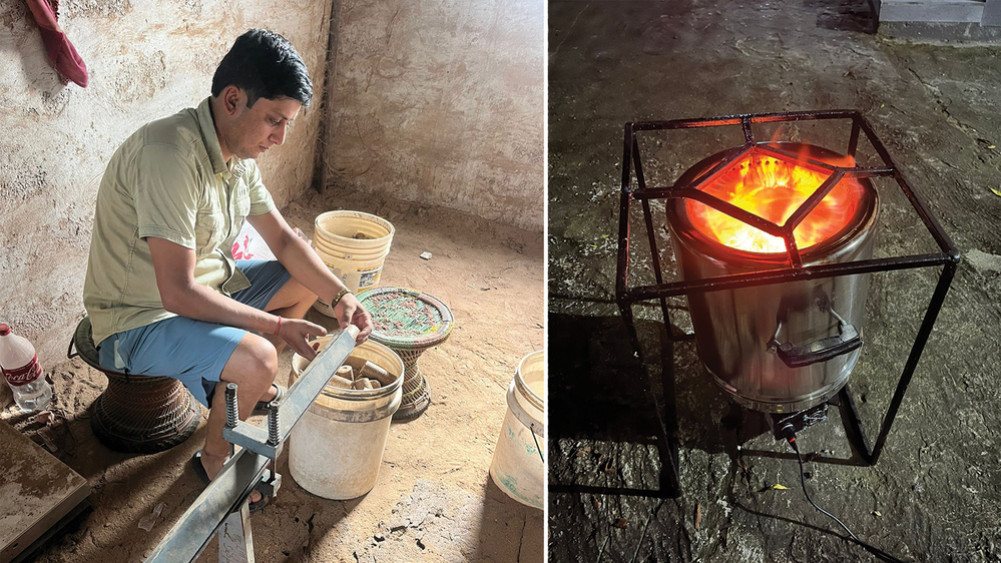
Fuel including firewood, gas and electricity is required to run a kitchen. Bimal Sharma of Nawalpur is keen to find alternatives to these sources of fuel. Bimal, who was born in Bhakunde of Baglung, has now created jobs by operating a bio briquette industry at Gaindakot in Nawalpur with an investment of around 4 crores, and is also producing environment-friendly fuel.
"We are making bio briquettes and pallets from forest and agriculture-based sources as raw materials," said Bimal. '
Bimal said that in the beginning raw material will be collected and made into powder, the powder will be dried with a machine to remove the water moisture in it and then the briquette will be prepared by placing the powder in the machine. "It is at least 6 to 90 millimeters (mm) in size," he said, "6 to 12 mm is called pallet and 40 to 90 mm is called briquette." Bimal says. He claimed that briquettes are the best alternative to other fuels as they are smokeless and air-conditioned. Its temperature is double compared to wood. Therefore, work is done quickly and efficiently at low cost,'' says Bimal, clarifying the characteristics of briquettes. So it is environment friendly.'
Bimal, who completed his master's degree in Information Technology (IT) from UK, started working in the furniture industry in the village after returning to the village in 2012. I studied IT, but at that time there was no scope for it in Nepal. That's why I started the enterprise," he said. Bimal, who worked in a wood mill at home in Sano, returned from Britain to his ancestral village Bhakunde and invested in the wood industry. At that time, his family had moved to Gandakot in Nawalpur. But he decided to do business in the village. So he expanded his old wood industry in the village.
We started working by opening an industry in the village for a few years and in Baglung market for a year. By making attractive designs on wood, our products started going to Baglung and surrounding districts," he says, "Until 2019, the business of the wood industry in the village and Baglung market was going well. But after covid the industry had to be closed for some time. After that we moved the business to Nawalpur. After going there, he started to inquire whether something new and different could be done, he said. "I came to the conclusion that it is possible to make briquettes by using small pieces and dust from the wood industry," says Bimal They have also expanded the wood industry and at the same time they are also working on the briquette industry. He said that 17 people are employed daily in the briquette industry alone. In addition, during the season, more workers are being managed on daily wages, he said.
He is making briquettes by collecting unusable items from his own and neighboring wood industries and farmers as raw materials. "We buy the scraps from the wood, as well as the scraps from the farmers," he says He says that there is.
According to Bimal, the production of briquettes up to 4 tons per day is going on. "We are selling it per kilogram," he says, "We are selling one kilogram of briquettes at 30 to 33 rupees."
Bimal says that the demand for it is increasing in small and large industries and hotels rather than for home kitchens. "Especially in Kathmandu, there is a lot of demand for it," he said, "lately, we are planning to meet the demand of industries in the Patan Industrial Area of Lalitpur. They are slowly realizing its importance. Therefore, the demand is also increasing.'
Bimal claims that there are advantages of briquettes, such as making good use of things that are wasted by using raw materials, reducing the negative effects of climate change, reducing deforestation, preventing diseases caused by dust and even reducing the import of fuel.