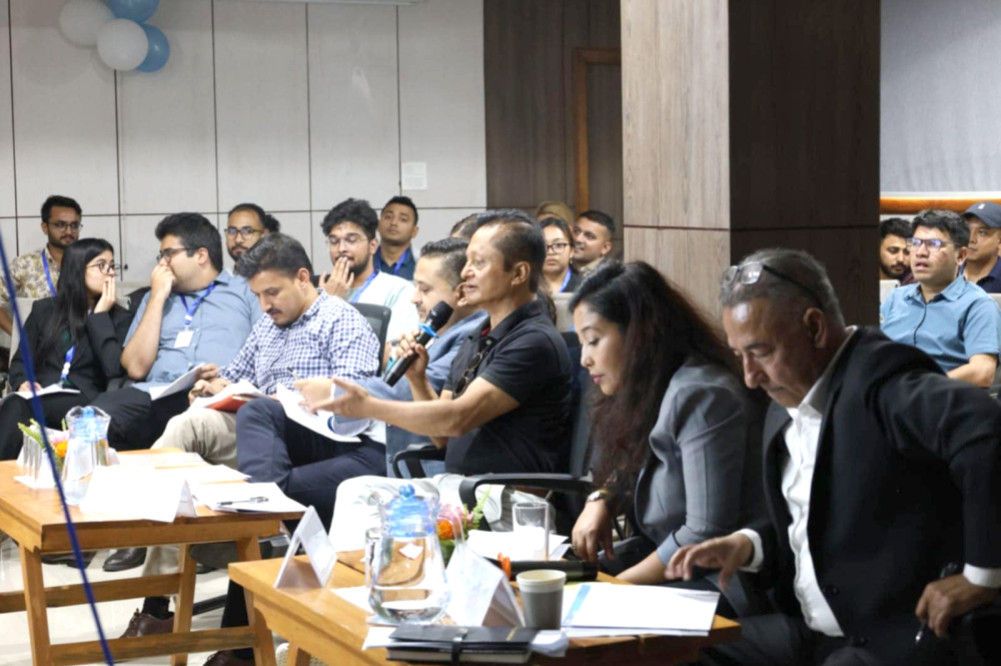
In order to solve the problems related to natural disasters, some young people from the Institute of Himalayan Risk Reduction have gone to Nepal and prepared a digital list of landslides and are determined to find a solution through AI.
We use Google Cloud Translation Services. Google requires we provide the following disclaimer relating to use of this service:
This service may contain translations powered by Google. Google disclaims all warranties related to the translations, expressed or implied, including any warranties of accuracy, reliability, and any implied warranties of merchantability, fitness for a particular purpose, and noninfringement.
The entire Thame village in Khumbu Pasanglhamu rural municipality-5 was swept away due to the flood of the Thame river that broke out on Friday afternoon. On the one hand, the flood displaced the settlement, but also caused a great loss of property. Erosion continues in coastal areas.
Two buses that fell into the Trishuli River in Simaltal under the Narayangadh-Mugling road section of Chitwan last July along with a landslide have not been found even after a month has passed. Every rainy season, the account of financial losses due to inundation and flooding in the plains and landslides in the mountains is even greater.
With the aim of solving similar problems related to natural disasters, some young people associated with the Institute of Himalayan Risk Reduction have prepared a detailed digital list of landslides in Nepal and have developed a solution based on AI (Artificial Intelligence). They are engaged in the development of technology that can predict such disasters through the use of past data and AI along with satellite imagery. Meteorologist Pooja Lamichhane, who is leading the group who is currently in the debugging phase, i.e. determining where the problem may be and solving it, said.
'The prediction score of our technology is about 92 epochs, it's like a patch of landslides, it can give the exact level of information,' says Pooja, 'We initially collected images of landslides across the country and Sentinel. We trained this model by taking satellite images from the hub and digitizing them from Arc GIS.'' .
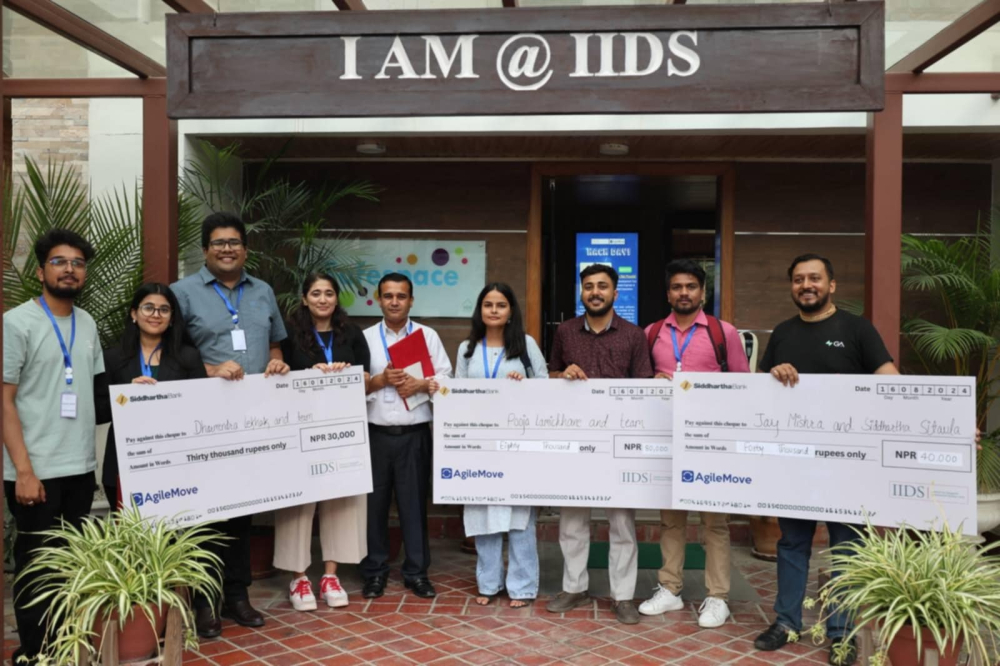 The technology, developed by a team of Pooja, Nikesh Sharma and Hem Kiran Paudel with the help of experts in disaster management, weather and environment, came first in an AI competition held recently. At the 'Hack Day, Zen-AI Hackathon' organized by the Institute for Inclusive Development Studies (IIDS) in association with Azayal Move Inc., Pooja's group presented on the effectiveness of AI in disaster management and landslide forecasting. It aims at disaster risk management and damage reduction through satellite imagery and AI to detect landslides.
In the same event, a chatbot called 'AI Generative Vehicle Info', which answers the questions asked by customers about all the details, prices, and official sellers of four-wheeled private vehicles available in the Nepali market, was also exhibited.
Jairaj Mishra and Siddharth Sitaula gave a presentation on the technique of designing vehicle parts to be useful in Nepal using AI algorithms. "We have built this chatbot on dot net platform, Ella 3.1 model foundation, we have taken the data set of vehicles needed to train it from Cagle," he said. When you ask for a car between so and so price, the chatbot provides a list of sellers where you can find that car.'
Jayaraj's group came second in the competition, while 'AI Tool for Breaking Language Barriers', which reverses government documents from Nepali to English, came third. Its makers claim that the tool was developed to provide access to government publications to non-Nepali speakers. This tool was developed by Dharmendra Author, Sneha Ghimire, Arjun Pokharel, Aryan Rizal and Saurabh Thakur. In the competition aimed at promoting the proper use of 'Generative AI' for problem solving, there was a competition between 8 projects such as My Health AI for Nepal's Healthcare, GenAI to Enhancing Travel Experience in Nepal, Generative AI for Automation of Teacher Transfer in Nepal.
In the 'concept paper on the use and practice of AI in Nepal' published by the government last June, it is mentioned that AI has started to be used in the fields of education, health, tourism and agriculture. According to the concept paper prepared by the study committee formed in the Ministry of Communication and Information Technology after a long discussion with experts, stakeholders, representatives of the academic field, the most used types of AI companies in Nepal are chatbots, object detection/biometrics, predictive analysis or financial evaluation and agriculture.
In recent times, the use of AI is not limited to content generation and chat, but it seems that young people are trying to use AI technology to solve socio-economic problems. Tribhuvan University, Institute of Engineering Studies has also prepared many plans and research papers under the Large Language Model.