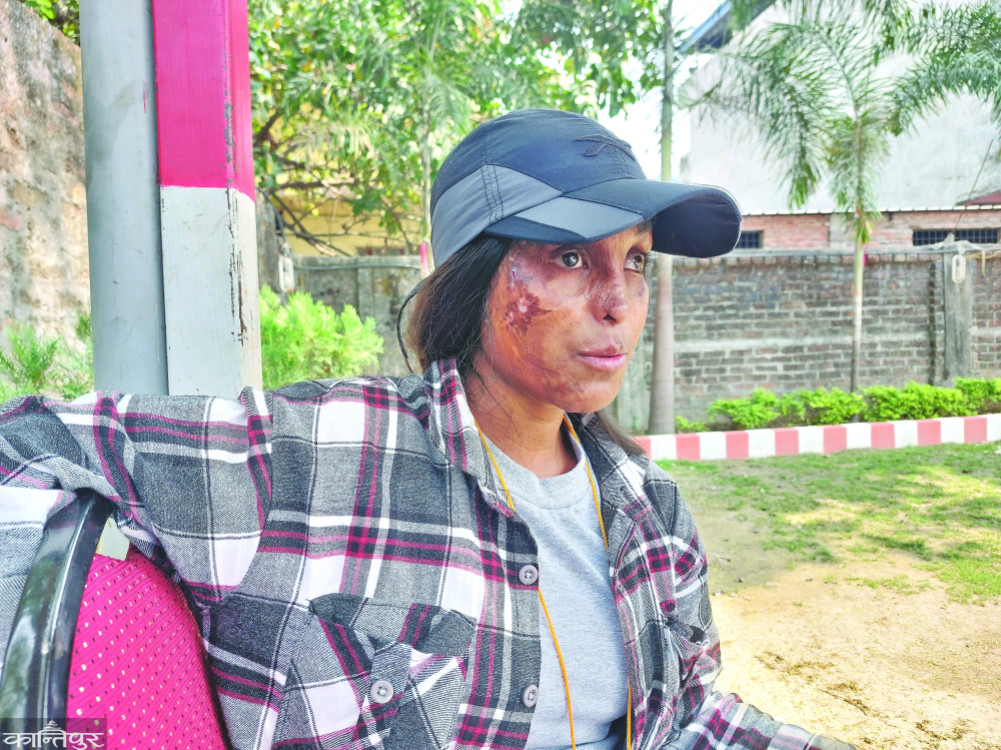
Dhana, who suffered from burns as a child, was afraid to walk and speak openly until she reached puberty, but now she is raising her voice for victims like her.
We use Google Cloud Translation Services. Google requires we provide the following disclaimer relating to use of this service:
This service may contain translations powered by Google. Google disclaims all warranties related to the translations, expressed or implied, including any warranties of accuracy, reliability, and any implied warranties of merchantability, fitness for a particular purpose, and noninfringement.
Dhana Pariyar, 26-year-old from Dailekh, walks in search of shade when she feels burning from head to toe while walking in the sun. "I feel like I should not be able to walk when the sun is shining," she said.
The custom of women staying away from home during menstruation is widespread in Karnali and Far West. When Dhana was three years old, her mother Namsara was menstruating and living with her one-year-old brother in a slum near the house. Around 7 in the morning, father sent Dhana to the neighboring grandfather's house to get the oil pan. Dhana did not go to her grandfather's house because of the freezing winter, her mother who lived far away, and her brother's naysayers.
"There was a shed where goods were tied, I reached the shed where my mother and brother were," said Dhana, who came to narrate her experiences as a speaker at the Dalit Gyan Utsav held in Tilottama, Rupandehi, "My mother left my brother in charge and went to cut grass. There was the roar of a fire lit at night in Agena. After I brought the straw and added it there, the fire started burning.'' After seeing the fire, the mother who was cutting the grass came screaming. Dhana was protecting her brother from the fire by covering her with a cloth. "Some brother was taken out of the barn first, but I was able to get out only after being burnt," she said, "I was lucky and I survived." She said that she came to know about the incident after her mother told her about the incident.
All the fingers on the right hand are burnt. You should eat with your left hand. "On the first day, when I ate rice, everything spilled after two bags," she said. After the fire burned the body, it was not the same as before. There is no hair on the head. Most of the face is burnt. Palms are also burnt. Burned from head to toe, there is still a problem of burning the body. After the burn, lack of funds prevented him from being taken to the city hospital for further treatment. After that she was forced to live with the wound. She said that she started school after she was 7 years old and had to hear bad words even from her father. "Father also said what will he do after reading like this," she said, "promise that it will be sad to be raised forever."
Dhana's two sisters became his support. Dai was also friendly. Dhana used to tell Dai what was on her mind. She was able to read with her brother and Adan. "I went to school thinking that I should study and do something," she said. His eyes still tear when he remembers those days. "I can't hold back tears when I remember the things of that time," she said, "Bhoots, demons, Luli, what did I get upma ke-ke."
She told us that friends should not read with us, it would make our day bad. She endured similar abuse until she studied at Ganesh Mavi in the village. He was a good friend, but he used to make excuses if he had to take money with him. "After such behavior, I thought that there would be no friends for me," she said. There too his friend is bound to suffer like him. Physically taller people don't want to mingle with her. She said that it hurts her heart. Now she is roaming the streets of Kathmandu in search of work. However, she has neither found a job nor is with anyone.
She participated in the SLC exam in 2070 and failed. Don't stop trying. She passed in 2072 and left. Then the desire to study on campus arose. She urged her brother. His father still does not speak to him. Brother Arjun suggested that he should open a small shop and earn a living by working there. "I wanted to walk, raise my voice, read, be a social person," she said, "living in a shop was like being locked in a cage." When her family did not agree, she decided to leave home and go to Kathmandu. School teachers became helpful in fulfilling his desire for higher education studies. With the help of her teacher, she reached Kathmandu and dreamed of becoming an artist. She hummed. She used to sing in school whenever she got a chance. She won many awards for singing. But she was not allowed to go on the stage because other students were afraid of going on the stage to receive the award. Even after winning first place, she would return home without going to the stage. She was beaten many times while going to school and returning home.
She started living in Kathmandu after 2073 and got a chance to sing Deuda song of 'Sudoorki Maina' lyrics. A friend of his teacher composed a song and made him sing it. That song got a lot of airplay on the radio when it was only playing audio. A video was also made later. The song helped make Dhana famous. Since then she has given voice in more than 65 songs. "Kehi chale, kehi bilaai audio," she said, "It was a relief to see that even the so-called ghosts were listening to my songs." Dhana was afraid to walk and speak openly until she reached her youth due to the fear of being struck by an arrow. So she endured the pain and tried to hide the marks made by the fire on her physical body. "Even though I only had hair on my head, I used to cut my mouth," she said, "so I sent a letter to my brother and asked him to buy fake hair."
She said that when she left home and came to study in Kathmandu, she took the money given by her brother as a loan. She said that she did not dare to talk to her brother for a long time because she had to return the money. Dhana's uncle bought hair from India and brought it. He himself went to leave Kathmandu. With such support and love, Khushi Dhana says that she wished her life would end only by paying all the debts of her brother. Life in Kathmandu is not easy. She is currently studying for her graduation with the money she earns by asking for help, sometimes by singing a couple of songs. "She had to sleep hungry for many days because of not being able to eat," she said, "nights soaked in hunger tears helped her to understand the pain." For some time, she sold goods online. But Hepaha's tendency did not make him an environment to stick to it.
In Kathmandu, he has problems eating, reading and living. There is nowhere else to go. Last October, she established Apangata Sahayata Samaj Nepal to help people with disabilities like her. She said that the aim of the organization is not only to enable disabled people to learn skills, but also to earn their livelihood using these skills in the long term. She herself becomes a parent of many disabled people and tries to gather financial support for their treatment, education and other issues.
'Life will be blessed if I can continue to serve as a means of finding a helping hand,' she said, 'Only those who suffer the pain of social discrimination and being disabled will know.' Now her passion for music has increased. She wakes up in the morning and hums a song. Riaz does. "I want to become an artist that everyone knows," she said, "I like to sing, I feel very happy when I sing."