Exactly one hundred years after the Buddha's death, a controversy arose over the teachings of the Buddha. Amidst such confusion, the Second Sanghayana was held in Vaishali. By the time of King Ashoka, different sects had emerged in Buddhism, and different groups had begun to interpret the teachings of the Buddha differently.
We use Google Cloud Translation Services. Google requires we provide the following disclaimer relating to use of this service:
This service may contain translations powered by Google. Google disclaims all warranties related to the translations, expressed or implied, including any warranties of accuracy, reliability, and any implied warranties of merchantability, fitness for a particular purpose, and noninfringement.
बुद्ध दर्शन आजको जटिल, तीव्र र अस्थिर विश्वमा झन् प्रासंगिक हुँदै गएको छ । प्रविधिको तीव्र विकास, उपभोक्तावाद, मानसिक तनाव, युद्ध, वातावरणीय संकट र मानवीय मूल्यहरूको ह्रासबीच बुद्धका शिक्षाहरूले आजको मानवतालाई दिशानिर्देश गर्ने क्षमता राख्छन् । आजको सन्दर्भमा बुद्धको महिमाबारे कोसेलीले तयार पारेकाे विशेष प्याकेज।
For those interested in the history of Buddhism, the biography of Gautama Buddha is a fascinating subject. It always attracts attention. The question arises, what is the source of his life?
If we study Buddhist literature, there are five sources available to know the biography of Buddha. They are – Mahavastu, Lalitavistar, Buddha Charita, Nidan Katha and Abhinishkraman Sutra. Mahavastu is of the Mahasanghika. Latilavistar is written in mixed Sanskrit. Buddha Charita is in pure culture in poetic style. Jataka is in Pali language. Abhinishkraman Sutra is by Dharmagupta.
The Mahaparinirvana Sutta mentions the details of Buddha's last journey and funeral. Similarly, the Buddha's biography is briefly mentioned in the sections of Sutta Nipat, Apadana and Mahavamsa. The work done for 45 years to propagate Buddhism is described in the Jataka Katha. Of the five biographies of Buddha, the most systematically mentioned is in the Lalitavistra. The events of the Buddha's life are mentioned in the Mahavastu according to different traditions. The original text of the Abhinishkramana Sutra is not available yet, only its translation is available.
Exactly a hundred years after the Buddha’s Nirvana, a controversy arose over the Buddha’s teachings. Amidst such confusion, the second Sangayana was held in Vaishali. Buddha was born in 623 BC. His father was Suddhodana. He was the chief ruler of the Shakya Republic. Buddha's mother Mahamaya was going to Maiti Devdaha from Kapilvastu. Buddha was born between two sal trees in the Lumbini forest. The greatest proof of this is the monument built by Ashoka as the birthplace of Buddha. After birth, Asita, who was an old monk, came to the palace of Suddhodana. Seeing the fortunate signs of the baby, he said, ‘The savior of the world has come.’
The child was named Siddhartha Gautama. Mahamaya died seven days after his birth. He was raised by his younger mother Mahaprajapati. She was Mahamaya’s sister. Siddhartha Gautama was a recluse from a young age. He was serious in nature. He married Yashodhara. Yashodhara also had a son. He was named Rahul. One midnight, Siddhartha Gautama left his wife and sleeping son and went to the forest.
He threw off his royal robes and cut his long hair with a sword. First of all, he went to Guru Alar Kalam. Then he went to another guru, Uddhakaramputra. He learned as much as they taught him. Finally, he went to a beautiful region near Bodh Gaya. Siddhartha Gautama performed various types of penance by torturing his body. The penance did not yield anything. After six years of penance, he was 36 years old and he had a feeling of attaining enlightenment. In the afternoon, he ate the kheer given by Sujata. In the evening, someone gave him a handful of dry grass.
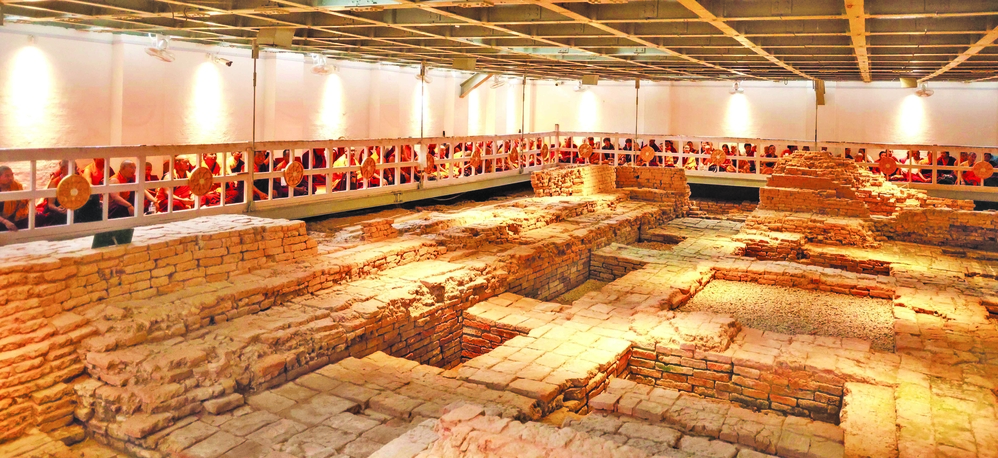
He sat down under a peepal tree and tried to attain complete enlightenment. The pain kept hindering him. That same night, Siddhartha Gautama attained enlightenment. He became the Buddha. Later, the Buddha met two merchants. Their names were Tapasya and Bhallika. They gave the Buddha a meal of barley and honey. Thus, they became the first disciples of the Buddha. While on his journey, the Buddha reached Sarnath. There he turned the wheel of the Dharma. There he preached to five disciples of the Middle Way. Thus the Sangha was established. Later, Sariputra and Maudgalyayana also became disciples.
A year later, Suddhodana called his son to Kapilavastu. The next day, the Buddha went around the city and asked for alms. Three years later, there was a big dispute between the Sakyas and the Koliyas over the water of a river. The Buddha reconciled the two sides. Soon after, Suddhodana passed away.
By the time of King Ashoka, different sects had come into existence in Buddhism and different groups had started interpreting the Buddha's teachings differently. The meeting lasted for nine months to bring uniformity to the Buddha's teachings. With this, the compilation of the Tripitaka was completed. Gautami entered the Sangha and became the first nun. The Buddha and his disciples continued to travel from place to place. When the Buddha was 72 years old, Ajatashatru killed his father, Bimbisara, the king of Magadha. Later, Devadatta tried to create a split in the Sangha but failed.
Two years before the Buddha's death, the Sangha faced a great misfortune. King Prasenjit of Kosala had a son by a Shakya queen. His name was Vidudava. Because of the insult, he vowed to take revenge on the Shakyas and later massacred the entire Shakya race. When the Buddha reached the age of eighty, he felt that his end was near. The Buddha had indicated this to Ananda. Within a week of the massacre of the Shakyas, Sariputra and Maudgalyayana died. At that time, the Buddha was in Pava.
After eating the food given by Chunda, the Buddha fell ill. In that state, the Buddha reached Kushinagar. There, Ananda was asked to spread his clothes under two sal trees. He was born between two sal trees. He also passed away in the same situation. Thus, on the night of Vaishakh Purnima, the Buddha passed away. He was born on Vaishakh Purnima. He also attained enlightenment on Vaishakh Purnima. This day is celebrated as a holy day in three ways. That is why this day is special for Buddhism.
During the Buddha's lifetime, there was a certain apprehension that the religion would disappear after his nirvana. Buddha's special disciple was Mahakashyap. Like him, other followers were worried, who would now take care of the Buddha's words? In this situation, all the leading monks along with Mahakashyap made a big decision, to call a meeting of the Sangha. Some such special meetings have been called in the history of Buddhism and this has helped to prepare the history of Buddhism. These gatherings are known as Sangayana in Buddhist literature.
Buddha gave sermons from his enlightenment to Nirvana. He did not give these sermons only to his disciples, but also to the general public. He also made various rules at different times for the operation of the Sangha he founded. During the Buddha's lifetime, his sermons were oral. There was no practice of keeping them in writing. Again, he did not give all of his sermons in one place. When there was a doubt in the Buddha's words, he would resolve them himself. Again, towards the end of his life, the Buddha had said that after Nirvana, Dharma and Vinaya would be the most important.
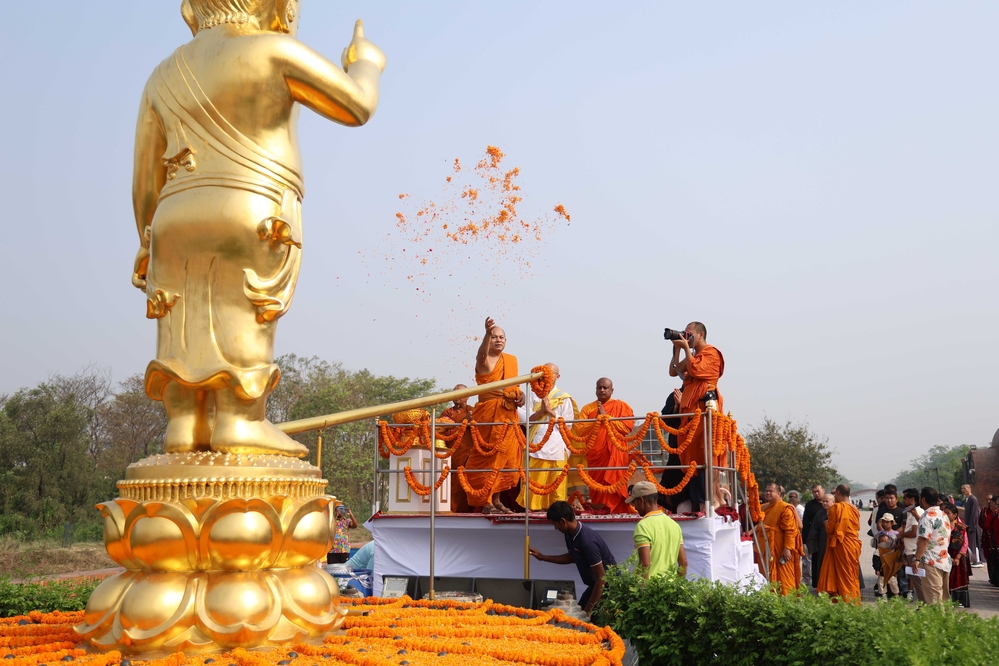
The extensive Tripitaka is available as a collection of Buddha's words. The Buddhist words that have been passed down orally for thousands of years have been authentically collected in the Tripitaka. Those Buddhist gatherings are the most important in the history of Buddhism. If those gatherings had not taken place, the form of Buddhism would not have been the same as it is today. The study of the history of Buddhism began only in the year 1800. The main source of the history of Buddhism is the Tripitaka. The Pali language Tripitaka is considered the most authentic. The Tripitaka contains the Sutra Pitaka, Vinaya Pitaka, and Abhidharma Pitaka.
The first Sangayana was organized after the Buddha's Nirvana. Mahakashyapa himself became the head of that assembly. The venue was Rajagriha. Five hundred monks participated in the assembly along with Ananda. The Dharma and Vinaya were fixed at that assembly. Sufficient care was taken to keep the Buddha's words in the oral tradition safe and permanent. The Buddha's words collected from the first Sangayana were divided into small parts. The responsibility of preserving them orally was given to different groups.
The monks began to recite the parts of the Dharma and Vinaya that came to their share. From here, the Bhanak tradition began. Thus, the Buddha's teachings began to be preserved. But exactly a hundred years after the Buddha's Nirvana, a dispute arose regarding the Buddha's teachings. Amidst such confusion, the Second Sangayana was held in Vaishali. The Third Sangayana was held during the reign of King Ashoka. By the time of Ashoka, different sects had come into existence in Buddhism and different groups had started interpreting the Buddha's teachings differently.
In this way, uniformity in the Buddha's teachings was necessary. This gathering lasted for nine months and with this, the compilation of the Tripitaka was completed. The most important aspect of the Third Sangayana is that at its conclusion, Ashoka sent his envoys to various countries to propagate Buddhism. Thus, the actual propagation of Buddhism also began and this remains an important campaign in the history of Buddhism. The Tripitaka was given a written form in Sri Lanka, which is preserved with us till now.

