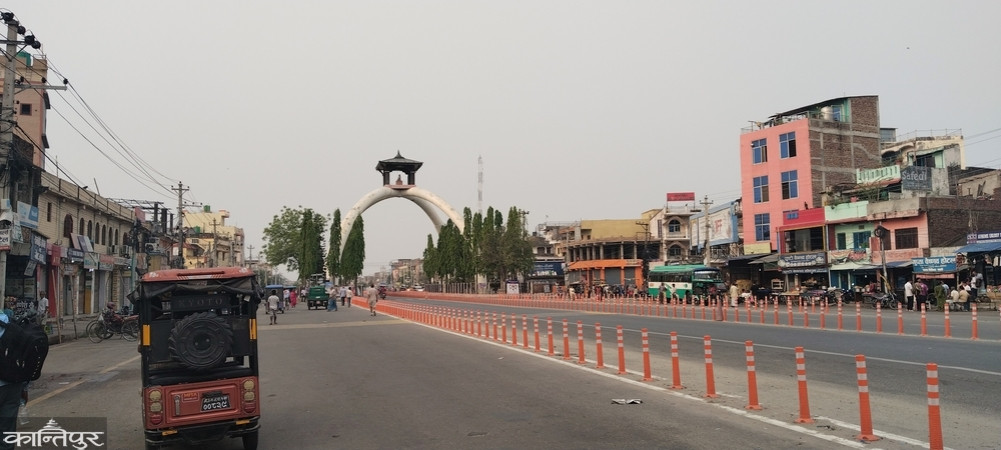
Around 2033-34, there were five shops in Ramananda Chowk in Janakpur - two grocery stores, two tea shops, and a paan shop. But now it is choked by commercial crowds.
We use Google Cloud Translation Services. Google requires we provide the following disclaimer relating to use of this service:
This service may contain translations powered by Google. Google disclaims all warranties related to the translations, expressed or implied, including any warranties of accuracy, reliability, and any implied warranties of merchantability, fitness for a particular purpose, and noninfringement.
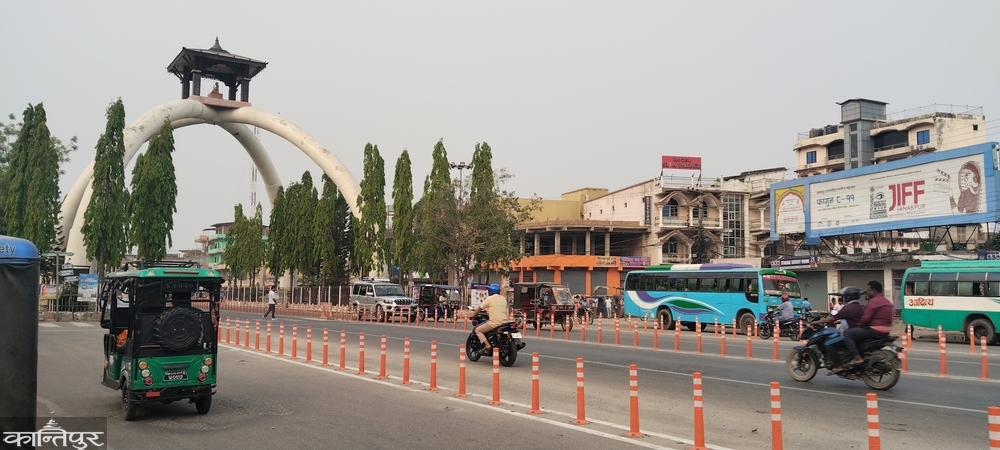
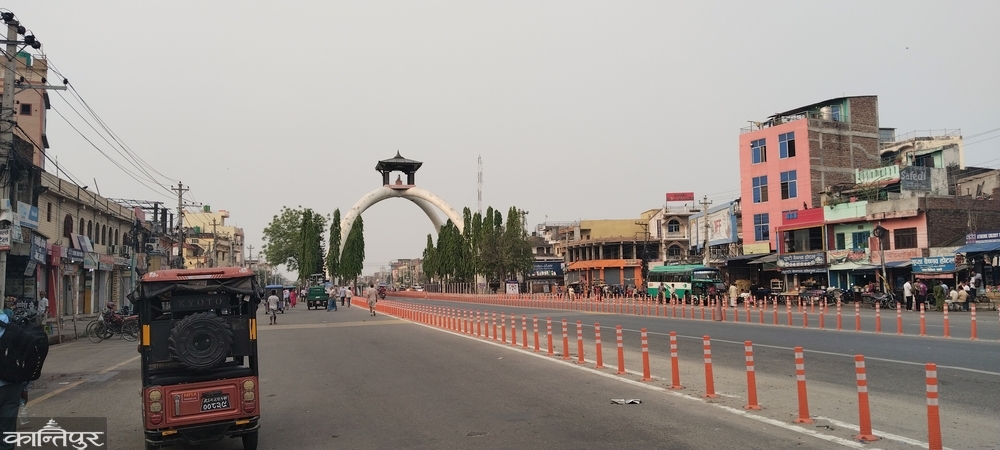
Two months ago, a reflective flexible spring post was installed for traffic management at Ramananda Chowk in Janakpur for the first time after Kathmandu. The post installed for traffic management at Ramananda Chowk, which has become ugly due to parking and parking, has further increased its attractiveness.
The post installed to organize the chaotic Ramananda Chowk has not only made traffic management easier, but it has also become a selfie point, says Surya Bahadur Shahi, Chief Inspector of the District Police Office, Dhanusha.
Although Ramananda Chowk is not associated with the history of Janakpur, its origin is from the Ramananda Vaishnava civilization. Ramananda Chowk in Janakpur is the main crossroads here. The Bhithamod-Dhalkebar road connecting Janakpur to the East-West Highway passes through Ramananda Chowk. To reach the famous Janaki Temple or to exit Janakpur via Kurtha, one must reach Ramananda Chowk.
The current Ramananda Chowk was like a temple, a hut, a field and a garden before 2025. ‘Agni Kund and Dulhadulahi Temple are old places. The name Ramananda Chowk was coined later,’ said Roshan Janakpuri, who is knowledgeable about Janakpur. ‘After awareness and publicity among saints and mahants increased, the name Ramananda Chowk was named around 2025 to 2030.’ At that time, there was nothing in that chowk, there was a thin road connecting the border market Bhithamod to Dhalkebar via Janakpur. There was a small path to reach the other Kurtha. ‘Because of these two roads going in different directions, Ramananda Chowk became a crossroads,’ said Janakpuri. ‘Ramananda Chowk gradually expanded.’
Around 2033-34, there was only a temple and a hut in Ramananda Chowk. At that time, there was neither a dharamshala nor a hotel in Janakpur for religious tourists coming from India. Indian tourists used to stay in the same huts and temples at Ramananda Chowk. ‘About a hundred years ago, my grandfather Hari Prasad Singh had bought land at this place and built a hut,’ said Amarchandra Anil, the founding president of Ramananda Youth Club. ‘At that time, it was customary to buy land and build a hut or temple. After the road was built, many people’s land fell on the road.’
Before Ramananda Chowk was built, the huts and temples there were designated for a place, caste, or community. For example, Ratan Bhawan is for Begusarai in India, Bihar, Madhubani hut is for Madhubani, Bihar Kund, Agni Kund, etc.
According to Anil, there were only five shops at Ramananda Chowk in Janakpur around 2033-34 BS – two grocery stores, two tea shops, and a paan shop. Later, a salon shop was added there on Anil’s initiative. There were mango trees lining both sides of the road at Ramananda Chowk. ‘Mango trees were being cut down in the name of road expansion. Land for huts and temples was being encroached upon during the construction of houses,’ Anil said, ‘Ramananda Chowk was gradually getting thicker.’
Anil recalls, ‘At that time, there were only four main chowks in Janakpur – Ramananda Chowk, Khukuri Chowk (now Bhanu Chowk), Devi Chowk and Brahmapuri. At that time, the Janakpur Cigarette Factory supplied electricity to the government hospital near Ramananda Chowk. At Ramananda Chowk, electricity was supplied from a government generator from 11 am to 2 pm and from 8 pm to 11 pm. ‘The rest of the night was spent on torches and lanterns,’ he said.
In 2037 BS, a body building and weightlifting club was established in Ramananda Chowk under the leadership of Anil. About 20 members of the club used to work out in a thatched house behind the Sankatmotan Temple. ‘The club office was established by renting a room in Ram Ayal,’ Anil recalls, ‘Later, that house started being called the club house.’ According to him, the club was renamed Ramananda Culture Club around 2039-40. In 2042, it was made Ramananda Youth Club. Until 2061, there were no meat and liquor shops in Ramananda Chowk.
After Ramananda Chowk became the main entry point of Janakpur, Mahant Ramtapeshwar Das of Janaki Temple led the work of building a model gateway in Asia and installing a symbolic statue of Ramananda Vaishnav at its head. Towards the end of 2059, a gateway claimed to be the model gateway in Asia was built at Ramananda Chowk. This further increased the attraction of Ramananda Chowk.
Ramananda Chowk is also a witness to the movement and struggle. On 18 Baisakh 2068, the Mithila Rajya Sangharsh Samiti sat on a sit-in at Ramananda Chowk demanding a Mithila state. During that time, a powerful bomb exploded at Ramananda Chowk. Five protesters were killed and 32 injured in the incident. The bomb blast at Ramananda Chowk shook the country. Since then, Ramananda Chowk has become a place of sit-ins, rallies, demonstrations and protests for various demands.
A modern bus park is under construction in Janakpur. A bus stop has also been built at Ramananda Chowk. With dozens of hotels, restaurants, modern shops and bus stops, Ramananda Chowk in Janakpur has now become a place of great commotion.