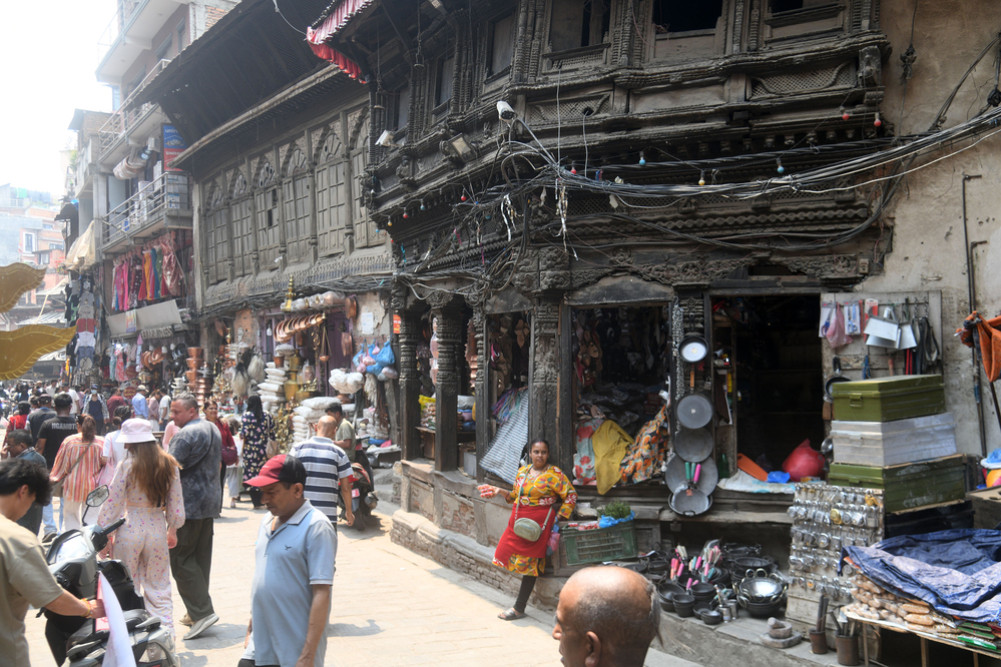
Everything in Asan has changed - the style of consumers, merchants, goods, and homes, which tell the story of Kathmandu's life, food, and lifestyle at every turn.
We use Google Cloud Translation Services. Google requires we provide the following disclaimer relating to use of this service:
This service may contain translations powered by Google. Google disclaims all warranties related to the translations, expressed or implied, including any warranties of accuracy, reliability, and any implied warranties of merchantability, fitness for a particular purpose, and noninfringement.
The story of that Asan Chowk was different. There was no crowd of people – there were houses that were tightly packed like pomegranates and tightly hugged each other. The streets may have been small for now, but back then they were very ‘wide’.
Now the story of Asan has changed. Times do not take time to change – Asan also says this. People who come and go are getting lost in Asan. No matter what the people are like, the streets are suffocating. Perhaps Asan is suffering from the sadness of losing ‘originality’. This one square, which was once the world – has now become a narrow thread for people to reach their destination, where there is a mixture of everything – some sadness, some pain, some happiness, some excitement, laughter and harmony.

Kathmandu Metropolitan City has started a ‘Vehicle Free Asan’ campaign every Saturday to preserve the originality of this ancient, narrow settlement. Now, vehicles are prohibited from entering Asan on Saturdays – from Kamalakshi Chowk to Asan, from Bhotahiti Chowk to Asan, from Mahabouddha to Asan. Those who reach there on Saturdays will now have to leave their vehicles in the underground parking lot of Dharahara or somewhere convenient for them and walk around Asan on foot. Acting Mayor of the metropolis Sunita Dangol believes that the ‘Vehicle Free’ campaign will preserve the originality of Asan and control air pollution.

Cultural expert Malla K. Sundar, who was born in Bangemuda, the surrounding area of Asan, discusses the originality of Asan. In his experience/feeling, Asan is the same, the geography has not shifted. However, the Asan that he saw/experienced in his childhood has now disappeared from Asan. His memory is – a two/two and a half storey house with equal height on all sides – a thatched roof – artistic wooden windows! Not only the blue sky, but also the distant snow peaks could be seen from the house.
Everything changed in Asana – the style and form of consumers, traders, goods and houses, which tell the story of Kathmandu’s life, food and lifestyle every moment.
Everything changed in Asana – the style and form of consumers, traders, goods and houses, which tell the story of Kathmandu’s life, food and lifestyle every moment. Legend has it that when Mahamanjushree shot three arrows to measure the depth of a pond in the vast Kathmandu Valley submerged by water, one of the arrows hit Asana. After the arrow shot, an unbearable ‘Ashani thunderclap’ occurred. And, the name ‘Asana’ came from the word ‘Ashani’.
Malla K. He grew up wandering the streets of beautiful Asan-Bangemuda. Now, the local vendors selling vegetables cover the entire road, the bulls/cattle that attack the vegetable market at every opportunity, and the uncontrolled vehicles trying to move forward, the crowd, the hustle and bustle, the hustle and bustle, and the disorderly street trading remind him of the scenes of yesterday's Asan market - the lottery stalls decorated on small tables next to them and the hoarse voice of the vendor blowing a hand microphone to awaken people's fortunes! A group of porters looking for a livelihood with ropes! Local dogs clinging to the roadside! Some are naked, decorated with cigarette butts, some with almonds, peanuts, and chocolate bottles! Old people sitting with thermoses filled with ice cream pieces! Rainwater in the potholes and muddy roads!
A collage of these and other Asanas. What a beautiful sigh – where did it come from?

Here is the grandest market and old people in the market. Somewhere in the maze of Asan's crowds, shops, consumer goods and curios, a magnificent, beautiful and gentle history of buying and selling is stuck. After King Mahendra took power in his hands, in 2017, the British Queen Elizabeth II paid a state visit to Nepal. It is also said that the visit was very meaningful in sustaining Mahendra's rule. Perhaps, that is why there was a lot of pomp and circumstance. At the same time, a fence was erected around Tundikhel. And the main roads of the city where Elizabeth's carriage would be driven were decorated. The route from Hanuman Durbar to the inner city via Makhan, Indrachowk and Jamal to Narayanhiti Durbar was chosen. The walls of all the houses along the roads there were whitewashed, and all the houses looked the same. However, the originality of Asana will probably be explained by contemporary Nepali historians.
Last Thursday, when the month-long Rato Machhindranath Rath Yatra arrived from Mangalbazar to Sundhara, I was there – visiting Asan. That Asan, where people have been buying goods for 300 years. Asan is selling goods. Here is the grandest market and old people in the market. Somewhere in the maze of Asan's crowds, shops, consumer goods and curios, a magnificent, beautiful and gentle history of buying and selling is stuck. If you look at the panoramic view of Asan, you can see – the joys, disappointments and the glorious story of centuries-old life of those who travel!
In Tirthanarayan Manandhar's book 'Kathmandu: Then and Now', he has written about Asan, 'The Madhesis, Muslims, Bhotes - whoever they are, who came to Asan to trade, all knew the Newar language. Since it was impossible to trade here without knowing the Newar language, they learned the Newar language. Women wore forty-hand-long saris. None of the women would go out without a khasto.'

Tirthanarayan has once written a story about the arrival of locusts in Kathmandu, 'When the locusts came from the southwest, the sky seemed to be covered with clouds, and it started getting dark in the afternoon. Some even bought and sold locusts by holding the leaves of the locusts, thinking that the meat of the locusts was delicious.'
This Asan Chowk has embraced a completely different life and style from the neighboring chowks and other chowks in Kathmandu. Just like during Dashain, the customs of Asan Chowk on Dashami are different. Here, ‘Chalam’ (vaccination) is not performed on Dashami, but on the next day (Ekadashi). There is no festival for the people of Asan on Dashami. That Chalam of Ekadashi is called ‘Asaam Chalam’. And this custom is followed only by the locals of Asan.

‘If the locals of Asan have left Asan and gone to live in another place, they perform Chalam only on Ekadashi,’ said Suresh Kiran, who has a deep interest in culture.
Where is Kathmandu only? Asan has become an icon of hustle and bustle all over Nepal. There is a crowd here from early morning till late evening. Suresh Kiran used to say – Asan is not only crowded with people, there is also a small crowd of gods and goddesses. In the middle of Asan is the temple of Annapurna Devi (Asammadu Ajima). There are also temples of Ganesh, Lakshminarayan, Umamaheshwar and Kumari. There is a statue of a fish in the middle of Asan – not flowers and Akshata, but often buried in water.

‘The aroma of salt, kerosene, ghee, knives and spices used to waft from the shops opened by the locals. Now, neither the locals are seen on the shelves of the shops in Asan nor are there any decorations of traditional items,’ says Malla. Ke Sundar. It is said that earlier this statue was on the road. After people trampled the statue, a pit was dug and kept. The people of Asan consider this statue to be a symbol of a living fish. ‘On the one hand, a unique presentation of medieval architecture, on the other hand, the fish of Asan, a symbol of ancient legends, clearly shows the importance of Asan in terms of heritage,’ says Malla.
Annapurna Devi has a spiritual story – the goddess of prosperity, prosperity, and wealth, in whose identity, loads of food grains were placed before her every morning/evening. Asan was a wholesale market for rice, pulses, nuts, and other food grains. It was especially a market for traders from outside the city. ‘The aroma of salt, kerosene, ghee, knives, and spices used to waft from the shops opened by the locals.’ Now, neither the locals are seen on the shelves of the shops in Asan nor are there any decorations of traditional items,’ says Malla. Ke Sundar.
In his memory, there is – the courtyard in front of the temple, although it is a cultural venue for the Kumari dance performance on the occasion of Dashain. But, at other times, the square was occupied by silver coins and other currencies. And by goldsmiths who traded currency. At that time, Nepal Rastra Bank had not been established, and Asan was the center of Indian currency exchange for people returning from and going to India, especially Mughals or Lahurs, which is no longer there.

Let's go back to the old days of a hundred years ago! At that time, Asan was not a cluster of buildings. There was no need to say that there was a ban on vehicles. If bulls were roaming here and there in Asan like back then, would there have been a 'bull ban' campaign now? That is probably why, as they say in 'A festival that never happened in Handigaun', the 'bull of Asan' is famous in the literature. Nowadays, there is a crowd of people day and night in the same Asan where bulls keep walking. And, Asan has become a city of crowds.
According to Tirthanarayan's book 'Kathmandu: 'Then and Now', to manage the congestion in Asan, Rana Prime Minister Juddhashamsher had removed the retail shops here and moved them to Bhotahiti - by filling up a stone stream called 'Bhotahiti'. However, the Bhotahiti market lasted only ten years. And, the market was moved to Asan again.

At one time, wholesale traders who came from Thimi to Kharpan with rice, chiura, dal, and beans mixed with the crowd in Asan - they would sell those goods and return to Thimi with salt, oil, and spices. At that time, the market prices in Kathmandu were determined by Asan itself. In fact, Asan is a primitive market, which has a history of urban Nepali commerce for hundreds of years.
History says that Asan was an old route for trade from Kathmandu to Tibet. Traders would reach Tibet after a difficult journey of months, and then return to Kathmandu after walking for months.

History says – Asan was the old trade route from Kathmandu to Tibet. Traders would reach Tibet after a difficult journey of months, and then return to Kathmandu after walking for months. In the book ‘Medieval Economic History of the Kathmandu Valley’ by Ramesh Dhungel and Aishwaryalal Pradhananga, it is written, ‘During the Malla period, goods such as radipakhi, chavar, horses, sheep, falcons, boars, bhotekukur, fish, pine needles, tiger skin, musk, panga, jyafus, namja, chhatrakusa, nambu (wool cloth), edible oil, tauli (pot), ghee, kurauni etc. were imported from the Dolakha region to Kathmandu.’
And, Suresh Kiran used to say – the place where those goods were sold was Asan. While wandering around the Asan market, the story of the old market that Suresh told me was very interesting. He had said, ‘In the old days, shops in Asan would open as early as 6 am. Around 12 noon, traders would go home for lunch. It was not customary to close the shop completely, they would hang a simple cloth on the door or close only half the door. By the time they returned after eating and resting, it would be 3-4 o’clock. After that, the pace of business would increase again. The shop would be closed only until 7-8 pm. Even when the door was kept open like this, incidents of theft or robbery were almost unheard of. That small piece of cloth hanging on the door indicated ‘lunch break’.’
This centuries-old market is witnessing change by recounting the stories of old people who came from far away to do business. For example, one of the spice shops standing on the right side of the road from Bhidbhad Chowk to Keltol is the shop of Birendra Tuladhar (73), who has been seeing the joys and sorrows of customers for three hundred years.

Birendra, who was met at his own shop in Asan on Thursday, said, ‘Customers from Dhulikhel, Bhaktapur, Thimi, Tokha used to come to our shop on foot to buy goods. There was a wholesale market between Asan Chowk. There were shops in houses all around. Salt, oil, ghee, knives, spices, and Ayurvedic medicines were sold there.’
Now, spices like cashew nuts and raisins are available in his shop. Even before this shop used to sell various medicines prepared from herbs and digestive powder. After allopathic medicines entered the city, such medicines disappeared from Asan’s shops. And now, only goods like cashews and kissim remain in his shop.
Tuladhar said, ‘This shop was started by my grandfather’s father, Tejbir Singh Tuladhar. Then his son Jogbir Singh took over, and after him Ratnabir Singh took over this business.’ Now, Birendra and his son Subindra (36 years old) are continuing this century-old legacy. Subindra is the sixth generation of the shop owner. This is not just an ordinary shop for buying and selling goods – it is also a living story of centuries-old trade history, social change, political ups and downs, and people changing with time. Let’s say, this shop is a living archaeological heritage.

Around 2007, a kiln shop, called ‘Suli’, used to run on the upper floors of houses in Asan, New Road, and Indrachowk in the ‘chota’ or ‘buingal’. पछि यी सुलिँहरू भुइँतल्लामा झरे । त्यहाँ पाइन्थ्यो– लोकल रक्सी, थ्वा (छ्याङ) र केही सितन । सुलिँ भुइँतल्लामा झरेपछि भट्टी पस्नेहरूको संख्या बढ्यो । ती भट्टी अहिले बार वा रेस्टुरेन्टमा बदलिए ।
प्राचीन कान्तिपुर नगरभित्रका जे–जति महत्त्वपूर्ण जात्रापर्व छन् (इन्द्रजात्रा पर्वका कुमारी रथ, सेतो मच्छिन्द्रनाथको रथयात्रा, गाईजात्रा, घोडाजात्राको द्यःल्वाके, बाह्रवर्षे नाच...) असनको परिक्रमा बिना सम्पन्न हुन्न । काठमाडौंको ‘कोर’ असनको सांस्कृतिक ल्यान्डस्केप र दैनिक जीवनशैलीमा आएको बदलावले हामीलाई यो सहरको पुरानो जीवनतिर फर्काउँछ । असनका गल्लीहरूले टाढा–टाढाबाट असन प्रवेश गर्ने शताब्दीऔं पुराना व्यापारीका कथा सुनाउँछ । भीड असनमा मात्रै छैन, असन छिर्ने सातै नाका बांगेमुढा, इन्द्रचोक, महाबौद्ध, भोटाहिटी, ज्याठा, कमलाक्षी र ठहिटीसम्मै तन्किन्छ । अन्नपूर्ण मन्दिरअघिको खुला चोक सदा ठेलमठेल हुन्छ । ‘असनको जस्तो भीड’ भन्ने वाक्यांश एक्लै यो भीडमाथि विमर्शरत छ । असन एक साझा चोक हो, त्यसैले यहाँ घुइँचो भइरहन्छ ।
असनको परिसरमा ६ वटा बौद्ध विहार छन्– अशोक चैत्य विहार (असंबहाः), अशोकवृक्ष विहार (क्वथुबहाः), सुरतश्री विहार (तःछोबहाः), अशोकविहार (न्होखाबहाः/हाकुबहाः), गौतमश्री विहार (धालसिक्वबहाः), रंगभुवन विहार (दगुबहाः) । मल्ल के. सुन्दरका अनुसार, अशोकमण्डपकै अप्रभंश–स्वरूप हो– असं अर्थात् असन ।
प्राचीन कान्तिपुर नगरभित्रका जे–जति महत्त्वपूर्ण जात्रापर्व छन् (इन्द्रजात्रा पर्वका कुमारी रथ, सेतो मच्छिन्द्रनाथको रथयात्रा, गाईजात्रा, घोडाजात्राको द्यःल्वाके, बाह्रवर्षे नाच...) असनको परिक्रमा बिना सम्पन्न हुन्न । अनि सत्ता आरोहणका क्रममा राज्याभिषेकको ततपश्चात् शासकको सिंदूरयात्राले असन प्रवेश नगरीकन सामाजिक मान्यता पाइन्नथ्यो ।
राणा शासनविरुद्ध जागरणका अभियानमा पण्डित मुरलीधर असन चोकमै आसन्न भएका थिए । केदारमान ब्यथितको नेतृत्वमा त्यसै बखत गठित नेपालको जेठो नागरिक अधिकार समितिले डेरा बनाएको थियो असन परिसरमै । प्रेमबहादुर कंसाकारको ‘नेपाल प्रजातन्त्रिक संघ’ यहीं जन्मियो । पहिलो सार्वजनिक पुस्तकालय प्रदीप्त पुस्तकालय यहीं थियो । नेपालको इतिहासमा पहिलो पटक जनता सडकमा ओर्लेर ‘इन्कलाव–जिन्दावाद’ नारा असनमै गुन्जिएको थियो । राणाविरुद्ध प्रदर्शनमा न्हुच्छेरत्न तुलाधर यहीं गोली खाएर ढलेका थिए ।

‘प्रत्येक आन्दोलन, जुलुस/प्रदर्शनको मूल थलो असनको भूमिमाथि छयालीस सालको जनआन्दोलन ताका पनि धेरैको रगत बग्यो । असन आज पनि प्रतिरोध र प्रतिवादका लागि प्रदर्शनस्थलकै रूपमा अवस्थित छ,’ मल्ल के. सुन्दर भन्छन् ।
खासै फराकिलो छैन होला असन भौतिक रूपमा, तर त्यही सीमित भूगोलभित्रै छ– संस्कृति, परम्परा, जात्रा, पर्व र मूर्त तथा अमूर्त सम्पदाका असीमित आयाम ।