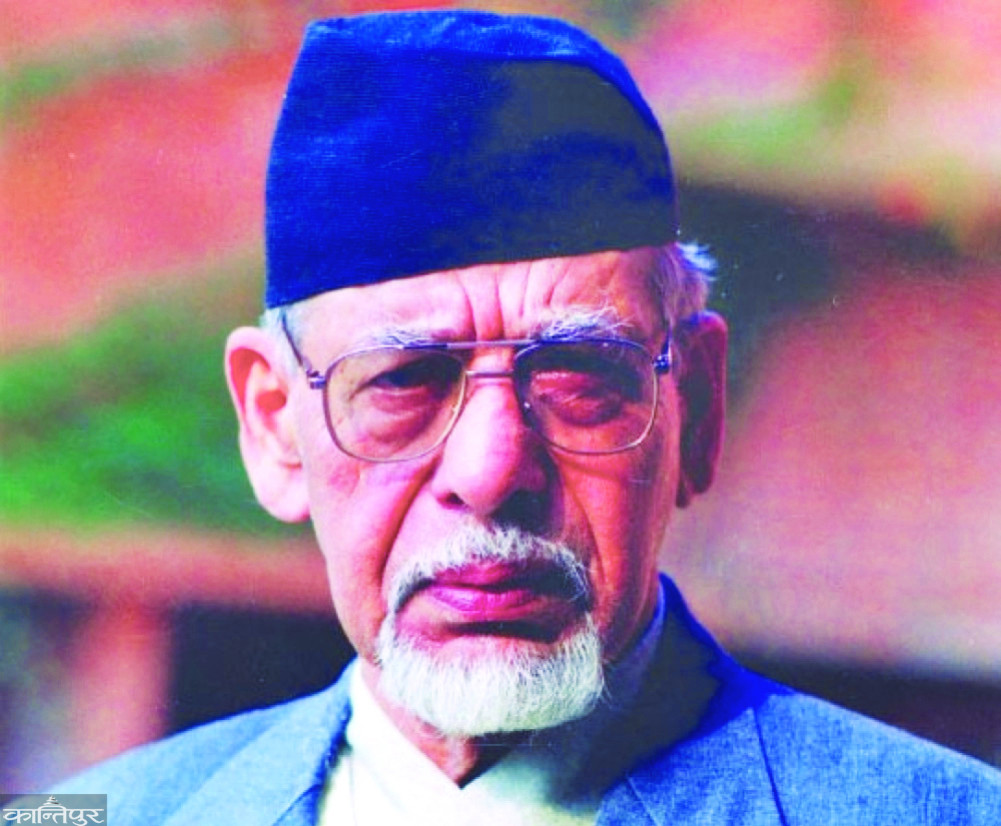
Manmohan Adhikari always emphasized that the government should be responsible to the people, and that the people should see and be able to see evidence of that responsibility in practice.
We use Google Cloud Translation Services. Google requires we provide the following disclaimer relating to use of this service:
This service may contain translations powered by Google. Google disclaims all warranties related to the translations, expressed or implied, including any warranties of accuracy, reliability, and any implied warranties of merchantability, fitness for a particular purpose, and noninfringement.
इतिहासकै शक्तिशाली जनमतसहित वालेन्द्र शाह प्रधानमन्त्री बनेको तीन साता पुगेको छ । प्रधानमन्त्रीका रूपमा उनको भूमिका कस्तो रहनेछ ? उनलाई इतिहासले कसरी सम्झिन्छ ? अहिल्यै आकलन गर्नु हतारो हुनेछ । नेपालको राजनीतिक इतिहासमा ४० जना प्रधानमन्त्री भइसकेका छन् । तीमध्ये कतिपयलाई निरन्तर सम्झना गरिन्छ । कतिपय भने गुमनाम जस्तै छन्, औपचारिक सन्दर्भभन्दा बाहेक चर्चा गरिँदैनन् । ‘कोसेली’ ले केही प्रधानमन्त्रीको कार्यकाल सम्झना गरेको छ । ‘कान्तिपुर’ को सम्पादकीय समूहले पदमा रहँदा निर्वाह गरेको भूमिका र सार्वजनिक विमर्शमा नाम आइरहने १२ पात्र छनोट गरेको छ । उनीहरूको पदावधिको चर्चा गर्दा नेपालको मूलभूत शासकीय प्रवृत्ति उजागर हुनेछ भन्ने हाम्रो विश्वास छ ।
I don't remember the date when I first met Manmohan Adhikari. However, I do remember that my closeness with him grew after that first meeting during the Panchayat period.
I feel proud - even today, when I remember those days, when the ideas expressed in the weekly columns I wrote became a topic of discussion among the Nepali intellectual community and conscious readers. I felt happy when my friends and brothers told me about the discussions that were going on between Ganeshman Singh, Krishna Prasad Bhattarai and Manmohan Adhikari and the general reader, and I felt that my hard work had been successful.
The people whom Manmohan Adhikari had tried to meet, and who told me to meet them were Kamal Koirala and Bharatmohan Adhikari. Both of them were central leaders of the party led by Manmohan Adhikari.
At that time, I was organized in the then Communist Party of Nepal and was the editor of a famous weekly.
I had already realized that the divided leftist movement could not play a decisive and effective role in the country's politics. And some of us friends within the CPN (ML) had come to the conclusion that the Panchayat could not be defeated unless the leftist forces and the Nepali Congress stood together and fought.
However, the situation was different. At that time, due to the issue of removing CP Mainali from the party leadership and the dispute over whether the slogan of party independence or political independence was right, I, Tanka Karki and many cadre friends were at the mercy of the party leadership.
But still, it was our beloved party. One day at that time, I met Manmohan Adhikari in a room in Patan. He knew that I was a 'Jhapali'. At that time, supporters of the then CPN (ML) were called 'Jhapali'.
A few years had passed since Pushpalal's death. At the time of meeting Manmohan Adhikari, discussions were underway for unity between the party he led and the party led by Sahana Pradhan.
He and I had a long conversation on topics ranging from national politics to international politics. Immediately after that, Tanka Karki and I met him and had a long conversation. Meetings and discussions began with Siddhilal Singh, Sahana Pradhan, Kamal Koirala, Balram Upadhyay, Govinda Gyawali, Ramsingh Rawal and Borna Bahadur Karki. In the same vein, the number of meetings with Manmohan Adhikari also increased.
After the success of the 2046 BS movement and the restoration of the multi-party system, the party was unified between the CPN (ML) and the group led by Manmohan Adhikari and the CPN (UML) was formed, and Manmohan Adhikari became the president. After that, my meetings and closeness with him increased. I could feel from his behavior that his affection and trust towards me was increasing.
After the 2048 BS election, he was elected as the leader of the main opposition party, and after the 2051 BS election, he became the Prime Minister of the minority government as the largest party in the parliament. When he became the Prime Minister, he wanted me to be his press advisor, but since I was a self-elected member of the House of Representatives at that time, I did not accept the offer. Later, when he dissolved the House of Representatives and announced new elections, I was appointed as his advisor.
As the Prime Minister, Manmohan Adhikari never used his position as a means of power. He did not want to appoint any of his relatives to any position. He seemed neutral or indifferent to power and authority. Position and power never brought arrogance to his speech or behavior.
His lifestyle was very simple. He was also very simple in his dressing. His behavior was also very easy and humble. He was gentle and kind to everyone he met, from ordinary citizens to adults. Sometimes he would joke a little.
He was concerned about the ministers doing a good job. He would call them alone at the Prime Minister's residence and repeatedly ask them, 'What do people say about the government?' 'What is the intellectual sector saying?' 'What is the reaction of the common people?' and so on.
The popularity of the government at that time had increased greatly due to programs like 'Old Age Allowance, Nine 'S' and 'Let's Build Our Own Village'. Manmohan Adhikari's popularity as Prime Minister was constantly rising, but he seemed as decent, serious and responsible as before.
Manmohan Adhikari had the rare nature of not wanting to use power while in power. Even though he was in office, he had a simple and easy-going demeanor as if he were not in office. His thinking was to consider the position as a responsibility and duty rather than power.
During his tenure, Nepal put forward a proposal to amend the 1950 treaty. During his visit to India as Prime Minister, he logically presented the issue of replacing the 1950 treaty with a new treaty. By visiting China, he not only further expanded Nepal's stature and influence, but also advanced its foreign policy in a balanced manner.
He always emphasized that the government should be responsible to the people, and that the people should see and be able to see the evidence of carrying out that responsibility in practice. Manmohan Adhikari was not only popular, he was the people's Prime Minister.
He liked academics and intellectuals and listened to their suggestions carefully. He was found to have special respect for journalists, professors, writers and personalities in the field of art and literature.
Democratic character and behavior were visible in his lifestyle. He never had the tendency to say that others must accept his opinion and that he is right. Even if he did not agree with the majority, he would easily accept it. When asked, ‘Why did you do that?’, he would easily answer – ‘They do not accept what is said, they find out for themselves after things go wrong in practice. What to do if they do not accept it unconsciously through behavior and experience!’
His clear belief was – ‘Even though China is geographically connected, there are some limits to it. There are also limits to the cooperation it can provide. India is geographically very close and convenient, but it wants Nepal to run as it says. Which seems against our independence and right to make independent decisions. We need the cooperation of both to move forward. Therefore, we should not lose balance and should not give up our stance. We should take cooperation from both countries for development and expansion of our economic capacity, but we should make our own decisions independently. We should not be under anyone's pressure and influence.'
He believed that relations with America and Europe should also be given importance, but Nepal should not compromise its position, strengthen its geographical integrity and sovereignty, and advance its economic base and development by adapting its foreign policy to the times.
He wanted the multi-party system not to weaken. He always emphasized on adhering to the norms and conduct of the parliamentary system. He gave immense importance to the parliament.
Even when he was the Prime Minister, he wanted to be as regular as possible in the parliament. When he was the leader of the opposition, he would regularly appear in the parliament and participate in discussions and address the parliament as the leader of the opposition party.
I remained close to him as an advisor to the Prime Minister when he was the Prime Minister and as an MP when he was the leader of the opposition party.
I used to occasionally make notes on the topics he had to speak on as the leader of the opposition party. He would call on some topics himself, to discuss.
He kept inspiring the MPs to actively participate in Parliament and speak with research on the topics. I have repeatedly experienced and seen him calling and praising MPs who spoke in a logical and effective manner and encouraging them.
Manmohan Adhikari wanted the Parliament to be effective, to pay attention to matters of public interest and for the people to consider Parliament as an institution that represents them. That is why he would regularly attend the party office at Singha Durbar and even when he had a slight fever, he would enter Parliament saying, ‘I will sit in on a meeting for a while.’
‘If we do not strengthen this multi-party democracy and parliamentary system that we have fought for all our lives, who else will?’ This was his question to us.
Continuous dedication to the country, the people and democracy, a decent, peaceful and simple life, this was the life of Manmohan Adhikari. As the leader of the opposition party and a very popular Prime Minister who was completely committed to the people, Manmohan Adhikari has remained indelibly in the memory of the Nepali people.
The dignity of the Prime Minister's office is a matter of decisive importance for the nation. In a democracy, anyone can reach that position by winning the election, but if those who cannot protect the dignity and importance of that position reach the position, not only will their dignity be lost, but the nation itself will also be weakened.
When we remember a personality like Manmohan Adhikari, we can still be proud that the country once had such a Prime Minister.
Today, we can take inspiration and learn from history and historical figures. Whatever popularity and respect Manmohan Adhikari earned during his nine-month period was the result of his personality and good deeds. Such popularity is extremely rare.