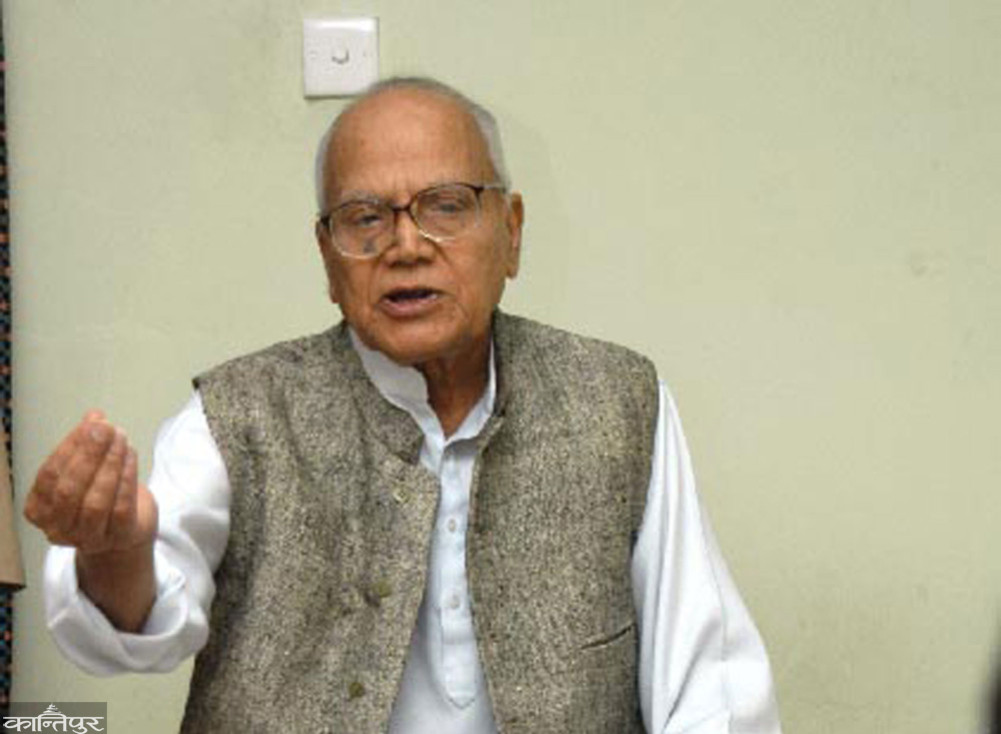
Born into an ordinary family, Krishna Prasad Bhattarai was a 'proletarian' leader in the true sense of the word. He lived a life of constant struggle for the self-respect of ordinary Nepalis against the lies of the elite.
We use Google Cloud Translation Services. Google requires we provide the following disclaimer relating to use of this service:
This service may contain translations powered by Google. Google disclaims all warranties related to the translations, expressed or implied, including any warranties of accuracy, reliability, and any implied warranties of merchantability, fitness for a particular purpose, and noninfringement.
इतिहासकै शक्तिशाली जनमतसहित वालेन्द्र शाह प्रधानमन्त्री बनेको तीन साता पुगेको छ । प्रधानमन्त्रीका रूपमा उनको भूमिका कस्तो रहनेछ ? उनलाई इतिहासले कसरी सम्झिन्छ ? अहिल्यै आकलन गर्नु हतारो हुनेछ । नेपालको राजनीतिक इतिहासमा ४० जना प्रधानमन्त्री भइसकेका छन् । तीमध्ये कतिपयलाई निरन्तर सम्झना गरिन्छ । कतिपय भने गुमनाम जस्तै छन्, औपचारिक सन्दर्भभन्दा बाहेक चर्चा गरिँदैनन् । ‘कोसेली’ ले केही प्रधानमन्त्रीको कार्यकाल सम्झना गरेको छ । ‘कान्तिपुर’ को सम्पादकीय समूहले पदमा रहँदा निर्वाह गरेको भूमिका र सार्वजनिक विमर्शमा नाम आइरहने १२ पात्र छनोट गरेको छ । उनीहरूको पदावधिको चर्चा गर्दा नेपालको मूलभूत शासकीय प्रवृत्ति उजागर हुनेछ भन्ने हाम्रो विश्वास छ ।
‘Kisunji’ – that’s all. In the larger social, economic and political society within the Nepali borders, there is no need to call him ‘Krishna Prasad Bhattarai’. He remained known as Kisunji among the leaders and workers of the Congress and other political parties. The purity of his soul and cheerfulness in character were the distinctive features of his personality. His political and social personality was not complex. He was spiritual. However, he always stood against the hypocrisy and pomp in the name of religion. His every day began with the recitation of the Gita.
Kisunji was also a journalist. The first president of the Nepali Journalists’ Association. During his visit to Soviet Russia as a journalist, he interviewed the influential leader of that country, Nikita Khrushchev. In his youth, he was associated with the magazine ‘Yugvani’ published from Banaras. At that time, his thought-provoking works were published in several other newspapers and magazines.
In a way, Kisunji was a 'Hathayogi'. King Mahendra had arrested Prime Minister BP Koirala, Ganeshman Singh, Krishna Prasad Bhattarai and important leaders of the Nepali Congress on 1 Poush 2017 and imprisoned them in Sundarijal Jail. His move was opposed internationally. King Mahendra released BP Koirala and his friends in 2025 BS after being unable to withstand national and international pressure. A paper was signed for the release. BP did not make it a big issue. However, for Krishna Prasad Bhattarai, it was an important issue. Since the king had imprisoned him without any charges, he refused to sign any paper and be released from prison. Then he was taken from Sundarijal to Nakkhu Jail. Later, he was released from there.
He had no house. He had no property. After being released from prison, he started living in his nephew's house in Kupandol Heights. From there, he started restructuring the Nepali Congress. Time slowly turned its back. After being released from prison, BP and Ganeshman went into exile. BP started an armed struggle for the establishment of democracy from there. Kisunji was against violent struggle. He started the work of gathering friends and organizing for a non-violent movement to restore democracy within the country.
Concluding that change was not possible through violent movements, BP and Ganeshman returned home in 2033 BS, calling for national unity and reconciliation. Before returning home, BP had organized a conference of Congress leaders and cadres in Patna city. At that conference, BP made Kisunji the acting president of the Nepali Congress. After BP's return to the country, the political events of the country began to move in the direction of rapid change.
From National Unity and Reconciliation-2033 to National People's Movement-2046, there were extensive changes in Nepali political life in a period of thirteen years. The Nepali political time-cycle that started with the referendum-2036 stopped in the National People's Movement-2046. The country moved towards the highway of constitutional monarchy and multi-party democracy.
After this, Kisunji's new journey began. During this journey towards the multi-party democracy desired by the people under the active leadership of the king, Kisunji became the Prime Minister of the interim government. The all-party government formed under his leadership established greater peace in the country. A constitution was made conducive to the efficient operation of constitutional monarchy and multi-party democracy. Elections were held for the parliament. However, the influential and popular Prime Minister of that time, Krishna Prasad, was defeated in the elections.
King Birendra appointed Nepali Congress President Krishna Prasad Bhattarai as the interim Prime Minister on 2047 Baisakh 6. He remained in office until 2048 Jestha 12. As the interim Prime Minister, he easily resolved political problems. About a dozen and a half influential generals of the then Nepali Army had reached his office to pressure him to ‘not reduce the royal rights of the king’ in the new constitution that was being written. He sent those generals away, saying, ‘I have already spoken to His Majesty the King.’
During this interim period, I was a member of the board of directors of Nepal Television. I was given the responsibility of watching news related to Prime Minister Bhattarai before it was broadcast. Congress intellectual leader Manmohan Bhattarai was appointed advisor to the Ministry of Communications.
Kisunji won the parliamentary election for the second time and became the Prime Minister on 2056 Jestha 17 as a people’s representative. The Nepali Congress's parliamentary election campaign was led by him. The Nepali Congress had won a clear majority in the election. The Nepali Congress had presented him as the future Prime Minister. A week after becoming Prime Minister, Kisunji called me and invited me to his office. During the meeting, he gave me a letter appointing me as his press advisor. Many influential people had gathered to reach that position. They were using various formulas to influence Kisunji. However, Kisunji was not a person who was influenced and greedy.
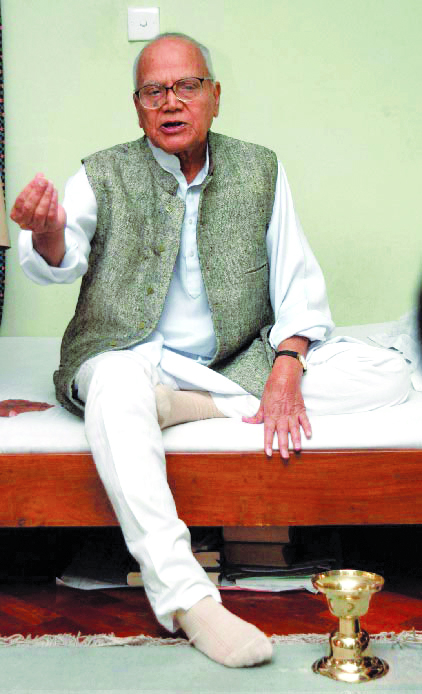
Kisunji's rule was relatively 'pure'. Ministers were afraid of taking commissions and bribes. The movement and activity of commission-takers and middlemen in the Singha Durbar premises was stopped. This situation was unbearable for some Congress leaders who were involved in financial transactions. Some responsible leaders of the party had united against the Bhattarai government and started making speeches that ‘the Singha Durbar is in a state of complete silence’.
The Maoist ‘people’s war’ was raging in the country. Kisunji was trying to resolve it. He knew who was behind the ‘people’s war’. Some of his influential European friends were discussing ways to end the ‘people’s war’ in Nepal. In the meantime, he was invited to visit France. However, some people in the Nepali Congress party opposed his visit to France. Vested interests inside and outside the party started saying, ‘We don’t mind Kisunji wherever he goes. He can go anywhere except France.’ This was a surprising argument.
During the period when Kisunji was not here on earth, there has been a great upheaval in Nepali society. The people have felt that the country is going downhill at a faster pace. The memory of Kisunji is still fresh in the minds of ordinary Nepali people who are devoted to the country: He was the ‘own man’ of the Nepali people. The memory of his long and painful struggle for the establishment of democratic rule in the country is unforgettable.
The current political environment and contemporary society are neither in accordance with Kisunji’s wishes, nor has his absence been felt by anyone. In the current situation, Girija Prasad Koirala, the father of the Republic of Nepal, has already been pushed into the womb of oblivion. There is no reason for those involved in the ‘business’ of politics to remember Kisunji at this time. This is not even when remembering the treatment of the Congress towards the leader who led the Congress to a majority victory in the last parliamentary elections held under a constitutional monarchy and a multi-party democratic system.
Kisunji used to joke. He had the skill of translating his pain into jokes. His style was lively. There used to be raids against the jokes he made. His political opponents used to say and rejoice that his personality had lost its relevance.
In recent times, Kisunji had distanced himself from self-centered and insensitive politics. He would console anyone who came to meet him who was in the race for power and authority with a disinterested spirit. He was seen as he was. Kisunji never allowed any lapse in his decisive ability.
The standards of Nepali politics have changed in the present. However, Kisunji continuously struggled for human freedom, for the establishment of the rights of the Nepali people, and for the self-respect of the Nepali people. He remained steadfast throughout his life in the belief that ‘the Nepali people should be able to enjoy their rights to the extent of freedom, beyond the limits of freedom’. Kisunji never had a right-wing orientation in the political pole. He was neither intimidated by anyone nor afraid of anyone. Kisunji had to struggle a lot to maintain the 'supremacy of the Nepali people over the country' in the 2047 constitution. In the current situation where the monarchy has ended, Kisunji's memory will be relevant for the leaders of political parties who are trapped in an 'irregular' relationship with the Nepali army.
There is a drought of ideas and reflection in the political parties representing Nepali society. The leaders have proven the proverb that an empty jar makes a lot of noise. They neither want to learn from history nor can they analyze the present. Politicians are obsessed with the unlimited greed to exploit state power. Kisunji used to say, 'Those who wear slippers should be allowed to wear shoes.' However, wearing three pairs of shoes on one foot is certainly unnatural behavior.
Kisunji was a constant consciousness of Nepali time. He kept time under control even by going against the flow of time. Only a person who has been refined by experience and study can control time by working wisely. Politically, was Kisunji successful or unsuccessful? There is no need to worry about it.
Born in an ordinary family, Kisunji was a 'proletarian' leader in the true sense. He lived a life of continuous struggle for the self-respect of ordinary Nepalis against the lies of the elite. It seems that Kisunji, who is respected by the Nepali people as a 'saint', is still joking with me, 'The water of Bagmati has the power to corrupt everyone's intelligence, father!'