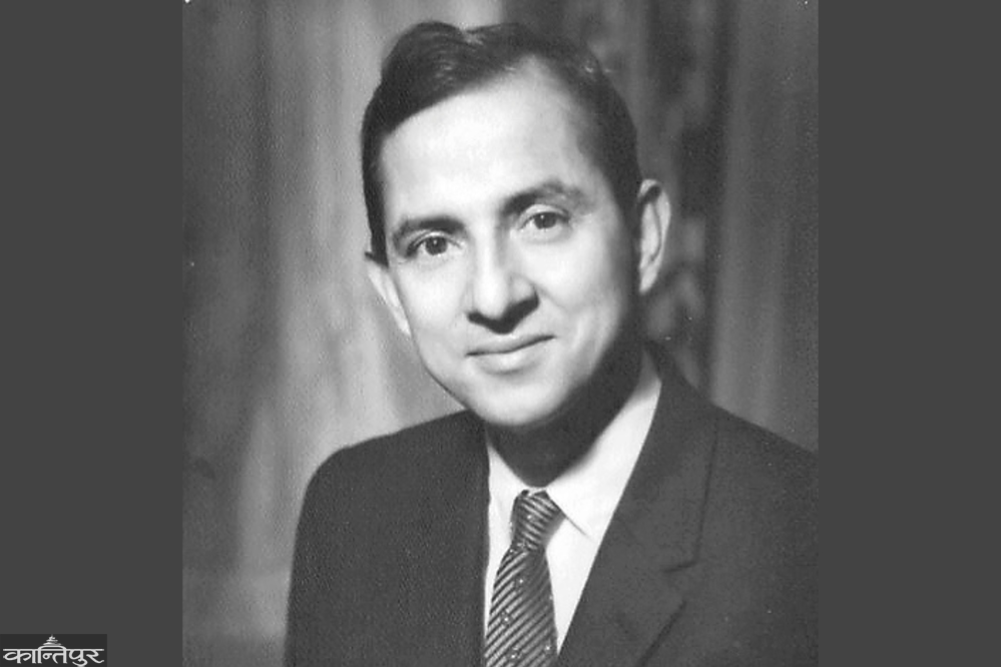
BP had its shortcomings, but his governing ability was never fully tested.
We use Google Cloud Translation Services. Google requires we provide the following disclaimer relating to use of this service:
This service may contain translations powered by Google. Google disclaims all warranties related to the translations, expressed or implied, including any warranties of accuracy, reliability, and any implied warranties of merchantability, fitness for a particular purpose, and noninfringement.
इतिहासकै शक्तिशाली जनमतसहित वालेन्द्र शाह प्रधानमन्त्री बनेको तीन साता पुगेको छ । प्रधानमन्त्रीका रूपमा उनको भूमिका कस्तो रहनेछ ? उनलाई इतिहासले कसरी सम्झिन्छ ? अहिल्यै आकलन गर्नु हतारो हुनेछ । नेपालको राजनीतिक इतिहासमा ४० जना प्रधानमन्त्री भइसकेका छन् । तीमध्ये कतिपयलाई निरन्तर सम्झना गरिन्छ । कतिपय भने गुमनाम जस्तै छन्, औपचारिक सन्दर्भभन्दा बाहेक चर्चा गरिँदैनन् । ‘कोसेली’ ले केही प्रधानमन्त्रीको कार्यकाल सम्झना गरेको छ । ‘कान्तिपुर’ को सम्पादकीय समूहले पदमा रहँदा निर्वाह गरेको भूमिका र सार्वजनिक विमर्शमा नाम आइरहने १२ पात्र छनोट गरेको छ । उनीहरूको पदावधिको चर्चा गर्दा नेपालको मूलभूत शासकीय प्रवृत्ति उजागर हुनेछ भन्ने हाम्रो विश्वास छ ।
BP Koirala's overall personality and the political identity that has been shaped by his tireless struggle for democracy, it is not fair to limit it to his eighteen-month term as Prime Minister. There is no coherence in this except that he became Prime Minister in almost the same Prachanda constituency. However, it seems appropriate to remember that period of history and its hero BP here in a meaningful way. With changes in time, technology and generations, the meaning and usefulness of those values cannot be understood.
In the recently concluded elections, just as the Prachanda victory of the Rastriya Swatantra Party (RSWP) and the emergence of Walendra Shah as Prime Minister have been achieved, how to connect the relevance of this sixty-six-year-old matter is a challenge. 36-year-old Walendra, who had the privilege of becoming Prime Minister at a young age, became known in politics only three years ago after being elected as the Mayor of Kathmandu Metropolitan City as an independent candidate. The Gen-G rebellion that took place on Bhadra 23-24 last year brought him to the center of national politics. Gen-G wanted him to become the interim Prime Minister, but he proposed Sushila Karki. With a non-partisan political background, the need for a political party was inevitable for him to go to the elections and become the Prime Minister. The Rashtriya Swayamsevak Sangh (RSS) paved the way for him with the Prime Minister's proposal on the eve of the elections. The 'Balen Craze' brought a tsunami in favor of the RSS. After defeating the powerful UML chairman KP Oli in Jhapa-5, Balendra rose to the top of power very quickly. He is not obliged to carry the old legacy, he has received the mandate like that. If necessary, he can amend the constitution and even change laws and laws.
While BP's political personality had become very high even before becoming the Prime Minister. Before 2007, Nepal was under the totalitarian rule of the Rana dynasty. It was unusual, it was considered a crime to even imagine freedom, equality, justice and the supremacy of the people. In such a situation, a certain philosophy and intellectual and political foundation were needed to advance the revolution against the Rana regime, from which the country's politics could take a specific path after the revolution. The revolution introduced modern thinking and thinking not only in political and economic matters, but also in social, cultural and other matters. It brought openness to a society that had been closed for centuries. The ideological and political leadership of that revolution was led by BP Koirala. That revolution first introduced democracy in Nepal. It established the concept and practice of an open society, including a political system based on the constitution, the rule of law, and civil rights. Eight years later, the first general election was held in Falgun-Chait, 2015. The Congress won a two-thirds majority in the lower house of parliament, the House of Representatives, and on 13 Jestha, 2016, BP Koirala became the first people-elected Prime Minister.
He was 45 years old when he became Prime Minister and was also the President of the Nepali Congress, the party that led the revolution. BP's identity is not limited to his 18-month tenure as Prime Minister, trying to do that would be a one-sided endeavor. If BP's name were to be removed, the end of the worldly Rana regime, democracy and socialism would not be found in Nepal.
His challenge was to convert the height of political ambition into work after becoming Prime Minister. At that time, there was also the facility to start new work in the Nepali society suffering from poverty. Whatever he did would be new. On top of that, the announcement of the party adopting socialism as a policy, the promises made in the election manifesto, which guided the government. BP's team in the government was also strong and capable. BP himself took charge of defense and foreign affairs, Suvarna Shumsher held the finance ministry, Surya Prasad Upadhyay was given the home ministry, Ganeshman Singh was given the construction and land reforms, and Ram Narayan Mishra was given the industry and commerce ministry.
The government's highest priority was agriculture, industry and rural development. BP believed that if the land was established in the hands of the farmers who tilled the land, a revolutionary change could be made in agriculture. Until then, the rulers of Nepal had traditionally given land to their relatives, servants, and servants in the style of a baksa. Those who received the land in this way did not have to pay any taxes or fees to the government. Most of the landowners lived in Kathmandu and did not even cultivate the land themselves; they were cultivated by tenant farmers. The farmers who cultivated the land were the most exploited, and their children and grandchildren lived their lives as raitis in the service of the landowners. Therefore, the abolition of landownership was an important link in land reform. The law on the abolition of landownership was enacted and implemented in the first session of Parliament. The work of distributing the land available from it to the landless and tilling farmers by fixing the minimum land limit remained.
Nationalization of forests is another revolutionary step taken by the BP government. Till then, Nepal's forests were owned by the rulers and their relatives, and their use and production were in their hands. By nationalizing forests, the government fulfilled the saying that 'green forests are the wealth of Nepal'. Similarly, even though Nepal was a unified state, the petty Raja Rajouta remained as a remnant of the twenty-two-twenty-four kingdom. During the elections, the Congress had promised to end it. Accordingly, the Raja Rajouta Abolition Bill was also passed by the parliament. But the bill was approved by King Mahendra only in Chait after the 2017 Poush move and became an act. During its implementation, the king had already overthrown the Congress government.
Road transport can also be considered among the other notable works of the government. At that time, the East-West Highway, Kathmandu-Sindhuli, Dharan-Dhankuta, Sunauli-Pokhara, Surkhet-Dailekh and Dhangadhi-Dadeldhura routes connecting the hills and the Tarai were proposed. The construction of some of them had also begun. The Kathmandu-Hetauda Ropeway and domestic air transport were also priority programs. Education, health, expansion of hospital services, industry, especially small industries, and power projects were among them. The Tribhuvan University Act was also enacted and implemented at that time. Women, including those who were left behind in education, training and opportunities, as well as remote areas and castes, were given special priority. Overall, the government was committed to spreading the message of change, development and progress in the country through these and other such programs.
The diplomatic skills shown in foreign relations, especially towards India and China, are another successful example of BP's tenure. BP was aware of Nepal's geopolitics and its borders. His words are still relevant. He used to say, ‘We have two neighbors. We should not do anything to irritate them. In many ways, India is the closest to us, that is what has bound us together. But if someone does politics here by depending on Hindustan, it will not be successful. If one depends only on China, it will not be successful either. It will not be possible by depending on Russia or America, but they should not be irritated.’
Less than two weeks after BP became Prime Minister, Indian Prime Minister Jawaharlal Nehru visited Nepal. This visit was of symbolic importance in the context of Nepal entering a constitutional system after a long transition and confusion. Nehru was also excited about this kind of political development in Nepal and wanted to express his happiness. During the visit, he said, ‘Recently, general elections have been successfully and peacefully held here and a people-elected government has been formed.’ I have full faith in the perseverance of the Nepali people, now this country will become strong and prosperous.' After this, BP visited India in Magh at the invitation of the Indian government. BP was welcomed by a large crowd at the Delhi airport along with Nehru and his ministers. At that time, he had said, 'Nepal always appreciates the respect and honor shown by Nehruji for our sovereignty and democracy.'
The 1950 treaty concluded between Nepal and India has been a very controversial treaty since its signing. It is understood that this treaty has established influence and interests in Indian security over Nepal. Nehru had said in November 1959, while speaking in the Lok Sabha, the lower house of the Indian Parliament, 'India will consider any attack on Nepal or Bhutan as an attack on itself.' Nehru used to claim that India's security border extended to the Himalayas. His statement seemed to imply that India could send troops at will in the event of an external attack on Nepal. But BP held a press conference and said, ‘Nepal is a completely sovereign and independent country. It decides its domestic and foreign policies according to its own discretion and will without consulting any external power.’ Our Treaty of Friendship and Peace with India indicates this. This does not mean that India can take unilateral action.’ After BP’s statement, Nehru clarified on December 3 that Koirala’s explanation was realistic by saying, ‘What Nepal’s Prime Minister Bishweshwar Prasad Koirala said is completely true.’
After becoming Prime Minister, BP visited China towards the end of Falgun 2016. Even before he became Prime Minister, relations between India and China had become uneasy. Tibet was under Chinese control. There was a rebellion there and the Dalai Lama had fled to India. Tibetan refugees were entering Nepal. In addition, the India-China border dispute had emerged as a serious problem. In this situation, it was a challenge to develop relations with China in confidence. During that visit, the Mount Everest dispute arose. The Chinese side had presented a map showing Mount Everest within its territory. BP opposed it and said, "Mount Everest has belonged to Nepal since historical times and there can be no compromise on it." This issue was also raised during the meeting with Chairman Mao Zedong. Chairman Mao's proposal was to make Mount Everest a common summit of friendship between the two countries, but BP did not agree to it. Both countries agreed to find a solution to this issue at the level of the Prime Minister. However, when a border treaty was signed between China and Nepal in 2018, according to China's proposal, the northern part of Mount Everest was owned by China and the southern part by Nepal.
Immediately after Chinese Prime Minister Zhou Enlai returned from his visit to Nepal, Chinese troops entered the Nepali border in Mustang and shot and killed an army sub-district commander and took some employees prisoner. This was an unexpected incident for Nepal and also a violation by China of the declaration made by both countries not to enter the 20-kilometer border area. BP and Prime Minister Zhou Enlai exchanged letters. In response, Zhou wrote a letter to BP Koirala, apologizing to the Nepalese government and mentioning that the Chinese government had agreed to pay compensation. It is commented that BP demonstrated diplomatic superiority in this incident with China. In that short period, it can be seen that very cordial relations and mutual understanding have developed with China, giving long-term importance.
BP was working according to his commitments and plans, but on December 1, 2017, King Mahendra not only deposed BP by using the army (coup), but also reversed the momentum of politics by throwing away the parliamentary system and democracy. BP had his shortcomings, but his governing ability could not be fully tested. However, that time has been established as a fruitful period in Nepali politics. The harsh test began after December 1. Whether in prison or outside prison, BP's unwavering loyalty and hard work have established his personality and identity as a capable politician.