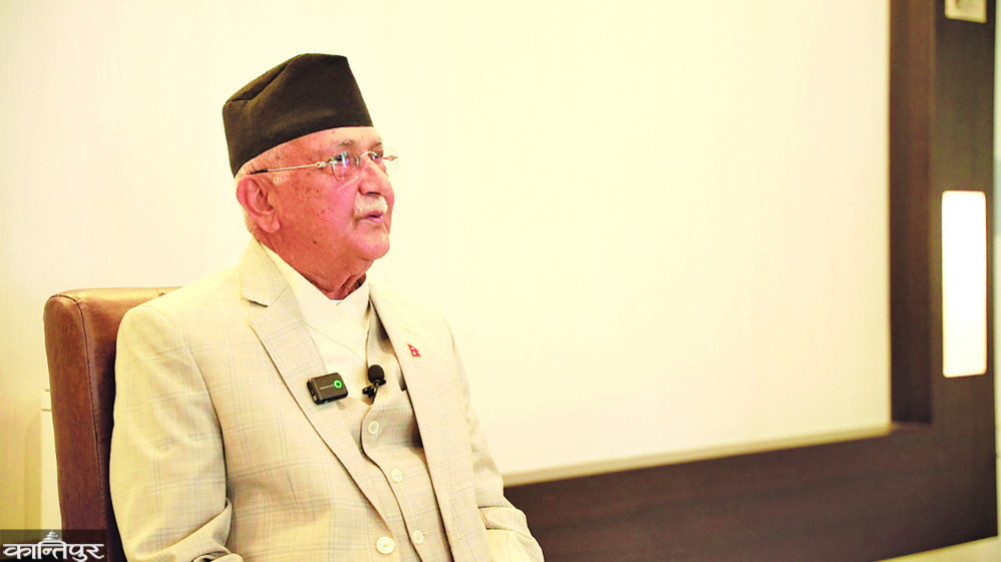
Oli is the one who is 'demoting' the UML, which has a strong organization and network, as a weak party in political and social psychology.
We use Google Cloud Translation Services. Google requires we provide the following disclaimer relating to use of this service:
This service may contain translations powered by Google. Google disclaims all warranties related to the translations, expressed or implied, including any warranties of accuracy, reliability, and any implied warranties of merchantability, fitness for a particular purpose, and noninfringement.
इतिहासकै शक्तिशाली जनमतसहित वालेन्द्र शाह प्रधानमन्त्री बनेको तीन साता पुगेको छ । प्रधानमन्त्रीका रूपमा उनको भूमिका कस्तो रहनेछ ? उनलाई इतिहासले कसरी सम्झिन्छ ? अहिल्यै आकलन गर्नु हतारो हुनेछ । नेपालको राजनीतिक इतिहासमा ४० जना प्रधानमन्त्री भइसकेका छन् । तीमध्ये कतिपयलाई निरन्तर सम्झना गरिन्छ । कतिपय भने गुमनाम जस्तै छन्, औपचारिक सन्दर्भभन्दा बाहेक चर्चा गरिँदैनन् । ‘कोसेली’ ले केही प्रधानमन्त्रीको कार्यकाल सम्झना गरेको छ । ‘कान्तिपुर’ को सम्पादकीय समूहले पदमा रहँदा निर्वाह गरेको भूमिका र सार्वजनिक विमर्शमा नाम आइरहने १२ पात्र छनोट गरेको छ । उनीहरूको पदावधिको चर्चा गर्दा नेपालको मूलभूत शासकीय प्रवृत्ति उजागर हुनेछ भन्ने हाम्रो विश्वास छ ।
When he was imprisoned for the Jhapa agitation in 2028, KP Oli probably did not think - I will become the Prime Minister. Even when he was the Prime Minister in 2082, he probably did not think - he would have to resign and escape in an army helicopter. Even before losing the election to Balendra Shah, he probably did not think - I will be arrested. In fact, Oli's entire life is a combination of unimaginable realities. And, the true color of his biography is - half light, half dark!
Oli's days of political adversity began after he was defeated by Balendra Shah in Jhapa-5 by a margin of about 50,000 votes in the elections held on 21 Falgun. Oli reached the constituency where he had been elected five times and Shah won by getting 68,348 votes. Only 18,734 votes were cast in Oli's favor. Oli, who had always sounded rude before 21 Falgun, congratulated Shah on 23 Falgun, saying, 'Balen Babu, congratulations on your victory.' May your five-year term be successful without any hindrance.'
Shah was the same leader who had called the state party's repression 'terrorism' on 23 Bhadra and had taken a stand that the then Prime Minister and Home Minister should be taken action. As soon as the government was formed under his leadership on 3 Chaitra, the process of taking action against the then Prime Minister Oli and Home Minister Ramesh Lekhak was initiated. The commission led by Gauri Bahadur Karki had already recommended that they be taken action for murder. Shah decided to implement that report from the first cabinet meeting.
Oli and Lekhak were arrested from their residence on the morning of 4 Chaitra and were released after 14 days due to the order of the Supreme Court. Despite being arrested, Oli did not have to stay at the police office due to health reasons, he stayed at the Tribhuvan University Teaching Hospital and served his detention period. Later, he underwent a gallbladder surgery there. He said that he was ‘released after being held illegally for 13 days but lacked the basis and evidence to prosecute’. But the court had ordered that ‘although his arrest cannot be called illegal, the work including the statement has been completed, and the investigation should be completed within the extended period and the case should be decided accordingly.’
000
What were those black and white days of the Jhapa uprising in Sambat 028 like? What terrible and difficult times did KP Sharma Oli go through?
After the ‘Jhapa Andolan Organization Committee’ was formed in 028 BS under the leadership of Oli and Radhakrishna Mainali, the government began intense repression. That committee of young people, who were deeply dissatisfied with the state, decided on 10 Baisakh 028 to launch a ‘guerrilla struggle to eliminate class enemies’. That movement wrote a different and new chapter in the communist history of Nepal. The goal of the uprising that emerged in Jhapa was patriotism, democracy, social justice, equality and public awareness.
 After Dharmaprasad Dhakal and his son Gyani were killed during the Jhapa uprising, Dharmaprasad's wife Dharmakumari filed a police complaint. The District Police Office, Jhapa, filed a case of murder and dereliction of duty against more than 50 people. The then government had formed a one-member special court headed by Supreme Court Justice Trilok Pratap Rana to dispose of the case.
Based on the statements of the accused and witness Rohwar, the police report and other evidence recovered on the spot, Rana's bench delivered the verdict on 11 Chaitra 030. The then government had filed a case accusing the then rebels in all the incidents that took place in Jhapa. Oli was one of the 44 people sentenced by the court. He was sentenced to 10 years in prison.
After his arrest in Rautahat, the police filed a case against Oli for dereliction of duty and other political offenses. He was sentenced to an additional 6 years in prison. After his arrest, Oli spent four years in Golghar.
000
Oli's 74-year life is a journey of struggle and success. Oli has embarked on his political journey to national leadership with a unique sense of personal sacrifice. Oli was attracted to political movements as a teenager. Perhaps he made social justice, equality, democracy and national independence his personal dream. From the Jhapa movement to the underground struggle against the Panchayat, the most difficult phase of his political life was 14 years of harsh prison life, torture, solitude and imprisonment. In his prison diary, Oli said, 'I faced death repeatedly.' During this period, he focused on his dream of changing the country and the system.
The second chapter of Oli's life begins with the restoration of the multi-party system after the people's movement of 046/47. In that phase, he was immersed in the institutional development of the democratic system, constitution-making, national independence and geopolitical balance. He became the Prime Minister after becoming a minister, deputy prime minister and then a minister. He raised the slogan of 'Prosperous Nepal, Happy Nepali'. He fought against the Indian blockade.
000
Oli is extremely eloquent, he can drive the opposition to the wall. There has been a long debate in society on Oli's every expression and strategy. That is why sometimes he seems aggressive, sometimes critical, sometimes easygoing.
Oli's life is a school - of struggle and stubbornness. He has been refined in politics through underground struggle. It is not that he has not debated development and prosperity. But how much it has taken shape is a subject of study. If his slogan of development and prosperity had been practically followed, he would not have been pushed out of power. At one time, those who said 'I love you KP Ba' would not have raised slogans against him in the Gen-G rebellion.
After development work stalled, the government focused on the distribution of power, resources, and strength, and the priority over the people changed, slogans against Oli started being raised.
000
Oli's life is also the story of his journey from a farming family to national leadership. Born on 11 Falgun 2008 in a farming family in Aathrai Iwa village, Tehrathum, Oli lost his mother Madhumaya at a young age. He spent his childhood under the care of his grandmother. In 2020, Oli's family left Tehrathum and moved to Jhapa. Later, his father Mohan Prasad took a school land contract and started farming. Initially, the earnings were good, but after the farm was washed away by the river, the family almost became homeless.
Remembering those days, Oli has said, ‘I was going to school and working. I did everything except carrying heavy loads, the only thing I could not do was carrying heavy loads.’ After the river washed away the land, we started buying land little by little. Our financial situation was very strong when we earned the school land on contract. At that time, we were in the position of rich farmers. Then we had to fall into the position of poor farmers and once into the position of homeless people.’
 Oli was caught in the conflict between the family’s financial crisis and political activism. In the autocratic Panchayat system, he started speaking and forming organizations. Then, in history, the Jhapa rebellion happened and he was imprisoned. Oli, who was expelled from the then party before going to jail, played the role of a founding member of the Communist Party of Nepal (ML) on 11 Poush 035 while in prison. He was released from prison on 11 Ashar 044 and on 2 Poush of the same year, the CPN (ML) Central Committee meeting gave him the responsibility of a central member and Lumbini Zonal In-charge. After the 2046 People's Movement overthrew the Panchayat, on 1 Jestha 047, he became the founding president of the Democratic National Youth Union, Nepal. On 22 Poush of the same year, after the merger of the CPN (ML) and the CPN (Marxist) to form the CPN (UML), he was elected a central member.
Oli was elected a member of the House of Representatives from Jhapa-6 in the 2048 general election. Three years later, he won again in the mid-term elections. In the meantime, he became a member of the party's Politburo, headed the Foreign Department, Propaganda Department, and Parliamentary Department.
In 2051, he became the Home Minister for the first time. Oli keeps claiming from time to time – I set a new standard as the Home Minister in the first elected communist government of Nepal led by Manmohan Adhikari, I won the trust of the people in security, administration and security. Not a single shot was fired during that time.
In 2052, while returning from Nepalgunj after inspecting the flood-affected areas, Oli along with the then Prime Minister Adhikari got into a helicopter crash and survived by chance. In Magh 2054, the ‘power accumulation’ strategy presented by Oli was passed by a majority at the sixth general convention of the UML. The general convention gave him the responsibility of a standing committee member and head of the foreign department. In 2059, at the seventh general convention in Janakpur, he proposed a multi-party system ‘to strengthen the party’s internal democracy’. Although the general convention postponed it until the next general convention, the eighth general convention in Butwal in 2065 passed it. However, Oli was defeated by Jhalanath Khanal for the post of chairman.
After being re-elected as a member of the House of Representatives from Jhapa-6 in 2056, he became the deputy leader of the parliamentary party. After the people's movement of 2062/63, he became the Deputy Prime Minister and Minister of Foreign Affairs. In the 2064 Constituent Assembly election, he was defeated in Jhapa-7. In the next election in Mangsir 2070, he became the leader of the parliamentary party.
Oli defeated former General Secretary Madhav Kumar Nepal in the ninth UML general convention in Shrawan 2071 and became the party chairman.
 Oli became the Prime Minister on 25 Asoj 2072 when India imposed a blockade on Nepal. He became popular due to his firm stance against India during the blockade. Oli's supporters say, 'Oli defended national independence and self-respect under external pressure.' Oli's foreign policy was, 'Friendship with all, no enmity with anyone. We seek friendship on the basis of equality, justice and international responsibility.'
Oli resigned in July 2073 after the then Maoist Center moved a no-confidence motion. However, after the 2074 election, he became Prime Minister again. At that time, Oli brought many plans and dreamed of many things - the North-South Railway connecting China and India, the East-West Railway, tunnels, expansion of highways, construction of the Mid-Hill Highway, Sunkoshi-Marine Diversion and other irrigation projects and the construction of iron ore mines.
The 'Chuchche Map' of Nepal, prepared to include the territory encroached by India, including Limpiyadhura, was released on 7 Jestha 2077. The parliament amended the constitution on 31 Jestha 077 and also updated the Nissan seal. This bold step of national map and border integrity became a memorable act of his political life. Oli created a grand 'nationalist image' with this. And, the slogan 'I love you KP Ba' was also heard on the streets.
In Baisakh 076, an agreement was reached on the implementation of the protocol related to trade and transit with China, which was another turning point in Oli's political 'career'. It was another step to break Nepal's limited dependence on India in foreign trade. That agreement gave Nepal the opportunity to use seven ports in China, paving the way for opening more border crossings in Nepal.
The UML and the then Maoists unified on 3 Jestha 075, but the unity did not last even three years. Oli became Prime Minister for the third time in Baisakh 078, when there was a rift in the party, but he was removed from office in Ashar after the Supreme Court's decision. In Mangsir 078, he was elected as the chairman for a second term at the 10th general convention in Chitwan. And, on Asar 30, 081, he became the Prime Minister for the fourth time. Oli has repeatedly reiterated, ‘We have set the destination of a prosperous Nepal, a happy Nepali.’ This is our national aspiration.’
While he was the Prime Minister, Oli dissolved the parliament twice - on 5 Poush 2077 and 7 Jestha 2078. The Supreme Court overturned it both times. This dissolution is considered a typical example of Oli-sanak.
000
After the Gen-G rebellion, Oli was installed as the leader for the third time at the 11th general convention of the UML held on 27-29 Mangsir, despite the wishes of another group within the UML (led by Ishwar Pokharel).
Even after the Gen-G rebellion, the UML's big ranks, ignoring the specific point of 'changing the old leader', kept saying - Oli is the only leader who can get the country out of the crisis. And, Oli's cadres kept saying - Oli's activism will help the party regain its rhythm.
There are many who say that Oli's 'arrogant and self-centered' style almost ruined his political reputation and pushed UML into an extreme defensive position politically. Oli has been the main leader of UML for a decade. In the meantime, he also led the government on behalf of the party. In that sense, he is also the one to blame for the poor 'performance' that he could not do by going to the government. Oli is also the one who 'demoted' UML, which has a strong organization and network, as a weak party in political and social psychology.
He is accused of weakening the internal democracy of his own party. The climax of democracy is - different opinions. तर, भनिन्छ– ओलीले पार्टीभित्रको लोकतन्त्र र फरक मत ध्वस्तै पारे । र, बागी प्रश्नलाई पार्टीमा टिक्नै दिएनन् ।