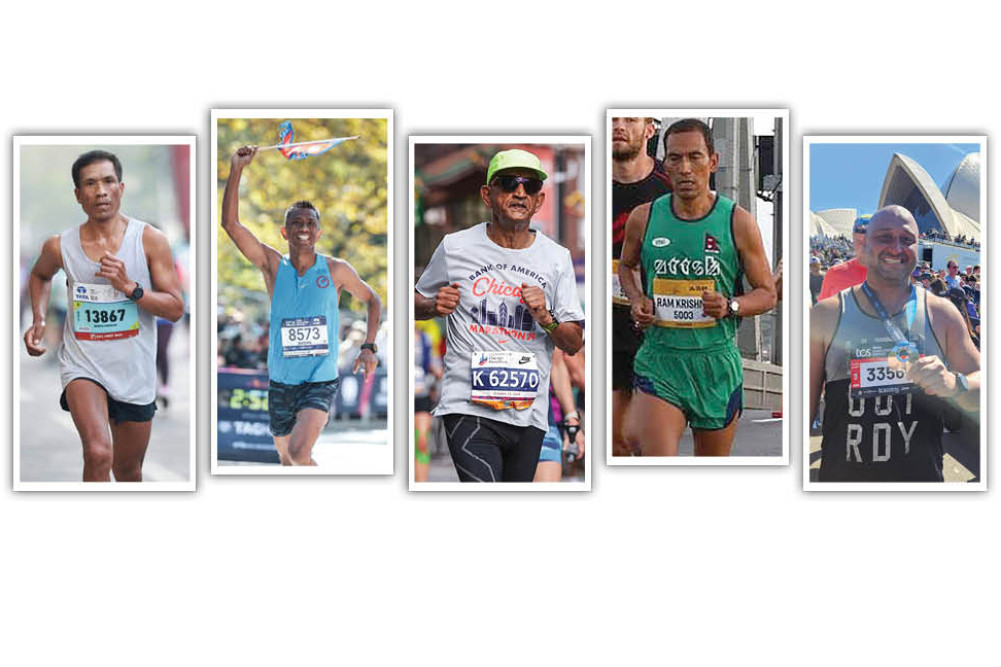
The number of Nepalis running in the world's premium marathons like Tokyo, London, Boston, Chicago, New York, and Berlin is increasing, and when they are preparing for them, even the 27-kilometer distance of the Ring Road seems short to them.
We use Google Cloud Translation Services. Google requires we provide the following disclaimer relating to use of this service:
This service may contain translations powered by Google. Google disclaims all warranties related to the translations, expressed or implied, including any warranties of accuracy, reliability, and any implied warranties of merchantability, fitness for a particular purpose, and noninfringement.
Cargo trader Sanjeev Aryal was running from Panipokhari in Kathmandu to Maharajgunj at his own pace early in the morning. Ramkrishna Maharjan, who was running at a fast pace, bumped into him. The purpose of running between the two was completely different. Sanjeev was running to lose weight, while Ramkrishna was continuing his 5-decade-long run.
Since that meeting nine years ago, their route from Maharajgunj to Chabahil has remained the same. Now, both of them have the same running rhythm. Maybe the only difference is the time difference. Sanjeev, who used to run to lose weight, is now eager to reduce his marathon time. ‘In the past, I was afraid that I would not be able to finish the race in the cut-off time, but now my timing is improving in every marathon,’ said Sanjeev. Ramkrishna, who is now 70 years old, runs at the same rhythm. He shows no sign of aging.
This group of Sanjeev and Ramakrishna, Shambhu Prasad Dahal, Sushil Kumar Shrestha, and Dharma Maharjan, have run in the world's major marathons. Tokyo in Japan, London in England, Boston in the US, Chicago, New York, and Berlin in Germany are among the world's major marathons. These are called the 'World Marathon Majors'. Since last year, the Sydney Marathon has also been added to this elite list. Cape Town, which will be held this year, will be the eighth major marathon, while the Shanghai Marathon will also be added to this list next year.
Even though Sydney, Cape Town, and Shanghai have been added, Tokyo, London, Boston, Chicago, New York, and Berlin are also called the 'Golden Six' marathons. In a way, it's like the 'Grand Slam' of tennis. Ramkrishna and former Sipradi CEO Shambhu have run the 'Golden Six' marathon, while Sanjeev has completed five and Sushil and Dharma have completed four major marathons in the world. They are also in the running to complete the marathon pilgrimage by running in the 'Golden Six'. Nepalis living abroad Ashok Kumar Chapagain, Prateek Gauchan, Khop Bahadur Gurung, Swaroopa Khadka, Pandav Mahato, Poonam Rai, Santosh Rai and Rajesh Shrestha have completed the 'Golden Six' marathon, while Indira Chapagain, Yuvraj Khanal, Kajiman Limbu and David Mendis have participated in five marathons.
Their 'Golden Six' marathon could not be completed as they did not get an 'entry' in the Boston Marathon. Everyone is aware of one fact, ‘It is not easy to get approval to run in the Boston Marathon,’ after not being selected in Boston, Sanjeev is adopting other methods for that. Even though Dharma has stepped foot in Boston, he has not been able to run the Chicago and New York Marathons. This is a different story. Ordinary people register themselves in the ‘ballot’ to run in the world’s major marathons. It is like a lottery, if not, you have to buy the World Marathon Majors Tour package, if not, you can run by donating to charity. Sanjeev ran the Tokyo Marathon for charity. ‘The number of applicants for the London Marathon is 1.4-1.5 million, after 19-20 thousand names come out of the ballot, about 50 thousand run. I have found that those who are not included in the ballot have been in this process for 10-12 years,' says Sanjeev, 'the registration fee for a marathon alone has to be paid up to $250.'
Sanjeev and Ramkrishna, along with Shambhu, Sushil, and Dharma, are preparing for the Cape Town Marathon to be held in the third week of May. Their preparations are in full swing. Since they are used to running 42.195-kilometer marathons, they find the 27-kilometer Kathmandu Ring Road short for practice. Then they head to the Bagmati and Dhobikhola corridors. According to their training schedule, they have to run more than 30 km two days a week. When they do it as if they are circumnavigating the world through running, their passion, desire, determination, and passion are clearly visible. They also have to raise the resources themselves. Running a world marathon costs around 500,000.
Most of them have the same dream, to have a 'premier' marathon in Nepal too. But Ramkrishna does not see the interest of the common people in Nepal's races. Sanjeev says that the traffic management in Nepal's marathon is not good. Shambhu understands that when running abroad, wherever a marathon is held, the spectators there take ownership of the marathon held in their city. The Japan Marathon is a bit narrow, but he is impressed by the gentleness of the people there and their commitment to the rules. His own 'Six Stars' was also the Tokyo Marathon. ‘When it comes to road races, vehicles should be completely banned on the day of the event. We haven’t experienced that when running in marathons in Nepal,’ admits Shambhu. ‘The financial aspect is a big challenge for us when organizing premium marathons, but being able to have athletes run on empty roads is the challenge right now.’
Sushil sees a big difference between the world’s famous marathon competitions and the races held in Nepal. ‘Even when the event is organized on Saturday, there are not people here, but cars running, and there is a fear of being hit by a car at some point. The top 3 finishers are scouted, and after that, no one cares much about the others.’ But outside, during the 7-8 hour cutoff time, no vehicles ply, all the roads are closed and the athletes run,’ says Sushil. ‘There is a festival-like atmosphere throughout the city, there is no place to stand. The spectators are cheering on every athlete. In Nepal, I only see athletes being cheered on a little in the Pokhara Marathon.'
Ramkrishna Maharjan has seen a big change in running before his own eyes. When he was a player, he used to run wearing 'green shoes with army stripes'. Now, when he runs in the morning, he sees people running in expensive branded shoes and goggles that cost 2-300 dollars. Many have called this a change with the times, but Ramkrishna considers it a love for running. Sanjeev also believes that the number of runners has increased significantly since Covid-19. Ramkrishna has not stopped practicing, so he has not seen any problems while running even now. He says that he will continue running as long as time and health allow.
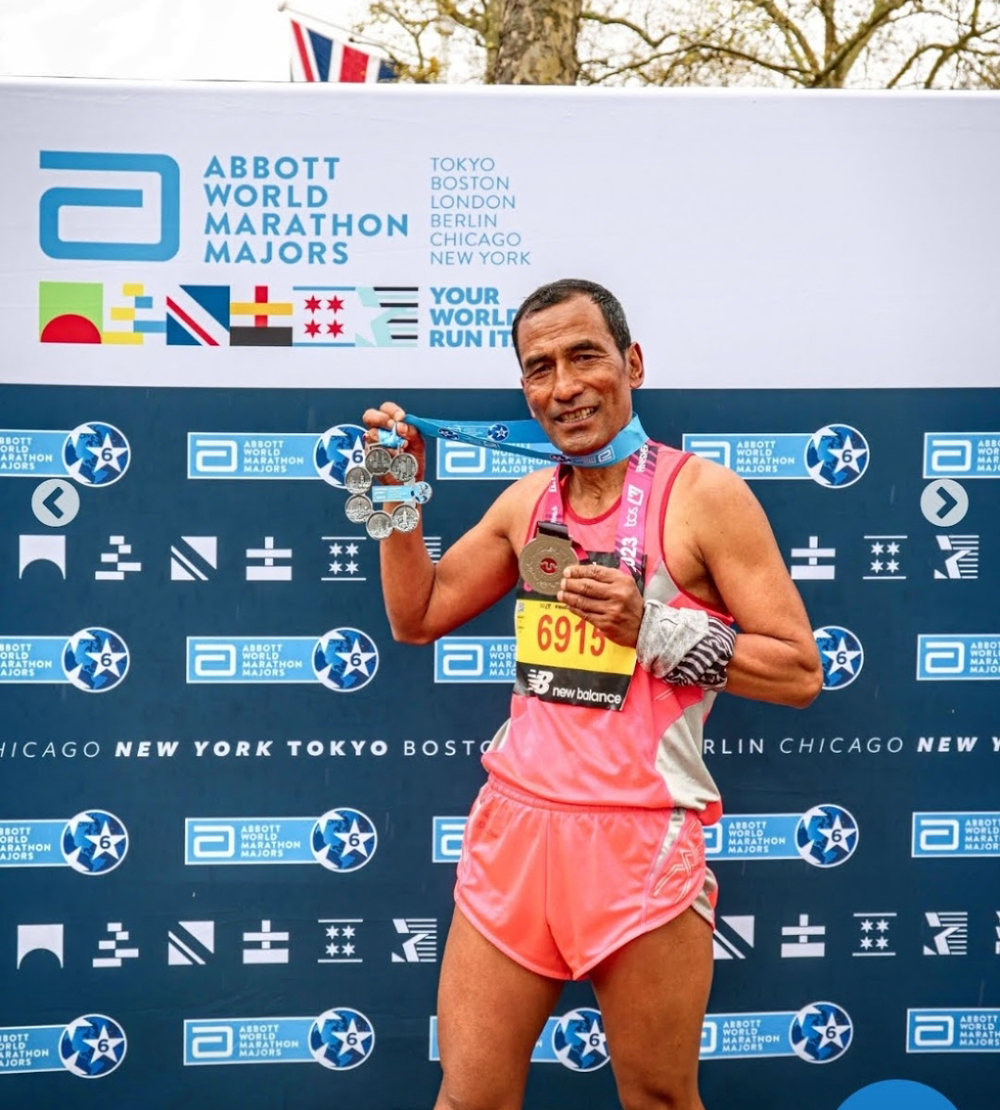
Since playing the Malaysian Open Masters Championship in 2002, Ramkrishna has been searching for marathons around the world. Since then, he has run 25 marathons abroad. He has run marathons from Bangkok, Lyon in France, Gold Coast in Australia, New Zealand, Canada to Venice. Having run in the ‘Golden Six’, he does not want to return there again. He is looking for a new destination abroad to run. He started the ‘Golden Six’ marathon from Boston in 2008. His cycle was completed after running the London Marathon in 2023.
He runs a traditional Newari restaurant ‘Harati’ in Sohrakhutte, Kathmandu and does not eat outside food. When asked why he can run in a rhythm even at this age, he gives this example. He suggests that it is advisable to practice for an hour a day and run since there are many adulterations in food. He is running to challenge the stereotype in Nepali society that ‘you are old’ after turning 40. But he sees some problems with this, saying, ‘After turning 40, it is necessary to be healthier, for that, it is necessary to run.’ But here there is only an open competition, there is not much competition for those over 40, if veteran events are included, it will increase the excitement of the race.’
He looks back to the past, ‘Whenever we used to run, we used to hear a lot of negative comments about it.’ The problems were the same. Even when we ran, they did not look at us with a positive eye. In that era of 50 years ago, I kept running with the determination to do something through playing.’ In 2024, his uncle went to Russia for an agricultural program. It was natural for him to want to go to Russia too. After that, he developed a desire to travel the world. He realized that this was possible through sports. By chance, he went to Russia to run as an athlete for the first time. That competition was the 1981 International Youth Track and Field Championship. There were 5 people with him in the Nepali team. He completed the 1500-meter race in 4 minutes and 19 seconds. It did not take him long to move up from the middle distance to the marathon. He also has experience of playing in the National Athletics Competition in Bhadrapur, Jhapa in 2035. Then he played in the Darjeeling Open, which boosted his spirits. After that, he was eager to go out and run. He used to be in the top three in running competitions and kept winning awards.
45-year-old Sanjeev Aryal introduces himself as a ‘Fun Runner’. Along with his passion for running, he also had the opportunity to travel the country and abroad, which inspired him to become a runner. ‘My body weight was increasing, when I started running for health reasons, I met Ramkrishna on the way, and since then my running has been continuous,’ said Sanjeev. Being a fun runner, he says he is not under pressure to perform results-oriented. He prepares for the marathon by running for 80 hours a week. He runs at Dasharath Stadium for two days to increase his speed.
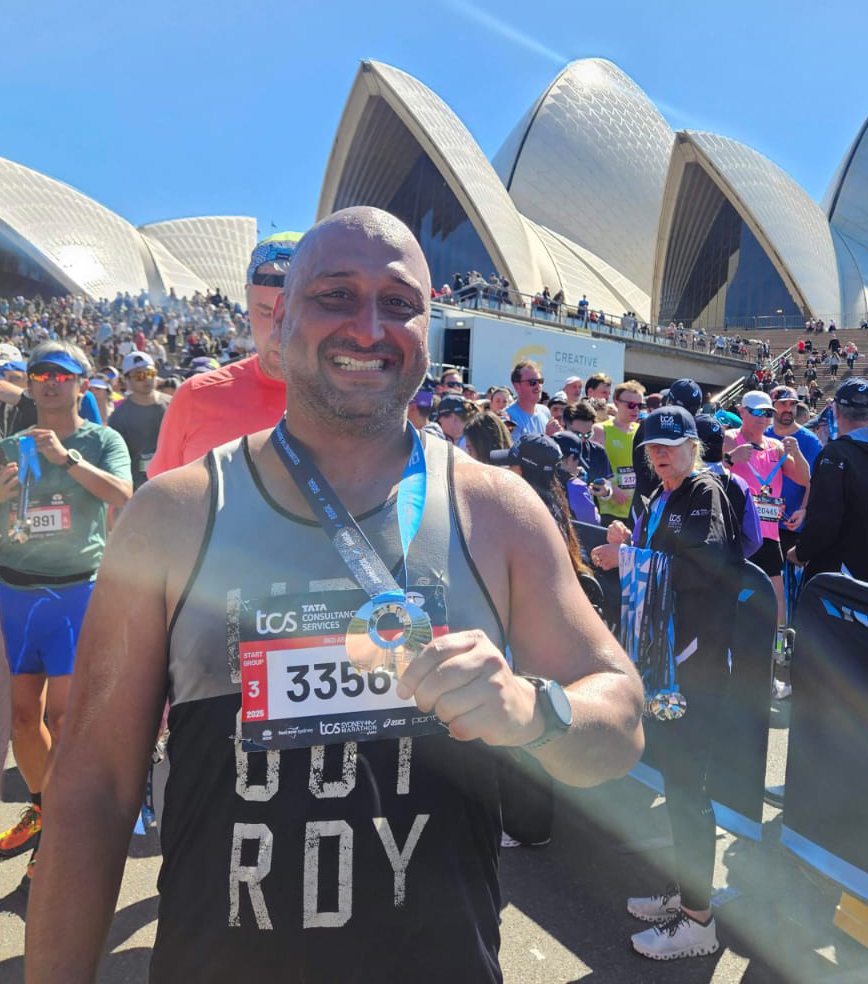
He has experienced that there are many challenges for Nepalis to run in major marathons in the world. The main problem is the visa problem. Whenever there is a marathon, the hotels there are expensive. Sanjeev says that he used to find relatives and Nepalis and stay with them to reduce expenses. When he started, he did not find many people who ran. But now, new people have appeared in running in Nepal, including many young people. Running clubs have opened. There has been a lot of interest. This has inspired him to run more. He started running in 2017 to lose weight. He calls Ramkrishna his brother. Sanjeev considers himself lucky to be able to run with him. He says, ‘He takes people like us to run with him, even though our skills are not very similar. He keeps us running while giving us water. In the 2-3 months we met on the road, my brother made us run on the Ring Road.’
Sushil Kumar Shrestha, a civil engineer, 46, is involved in the construction business run by his ancestors. He is active in the construction of roads, bridges, buildings, and hydropower from an ‘A’ category company. His company built the 4-lane bridge on the Mahakali. He had a great passion for sports in his school and college life. He used to play basketball, football, and gymnastics. He owned the franchise of Mahendranagar United in the Dhangadhi Premier League. ‘I started running after Covid-19. The Covid pandemic probably made everyone aware of health. The number of runners has increased in the sense that health should be given first priority,’ said Sushil. ‘I have a lot of free time during Covid, so running came to the fore while looking at options. Running, which started like that, has now become like an addiction. I had seen many people overcome by the addiction of marathons, and that addiction has not left me either. If I can’t run on a day due to rain, the whole day feels miserable.’ After waking up at 5 am, he says, ‘Running is life,’ and starts his running routine. Normal rain cannot stop him, and in case of heavy rain, he takes the help of a ‘treadmill’ indoors.
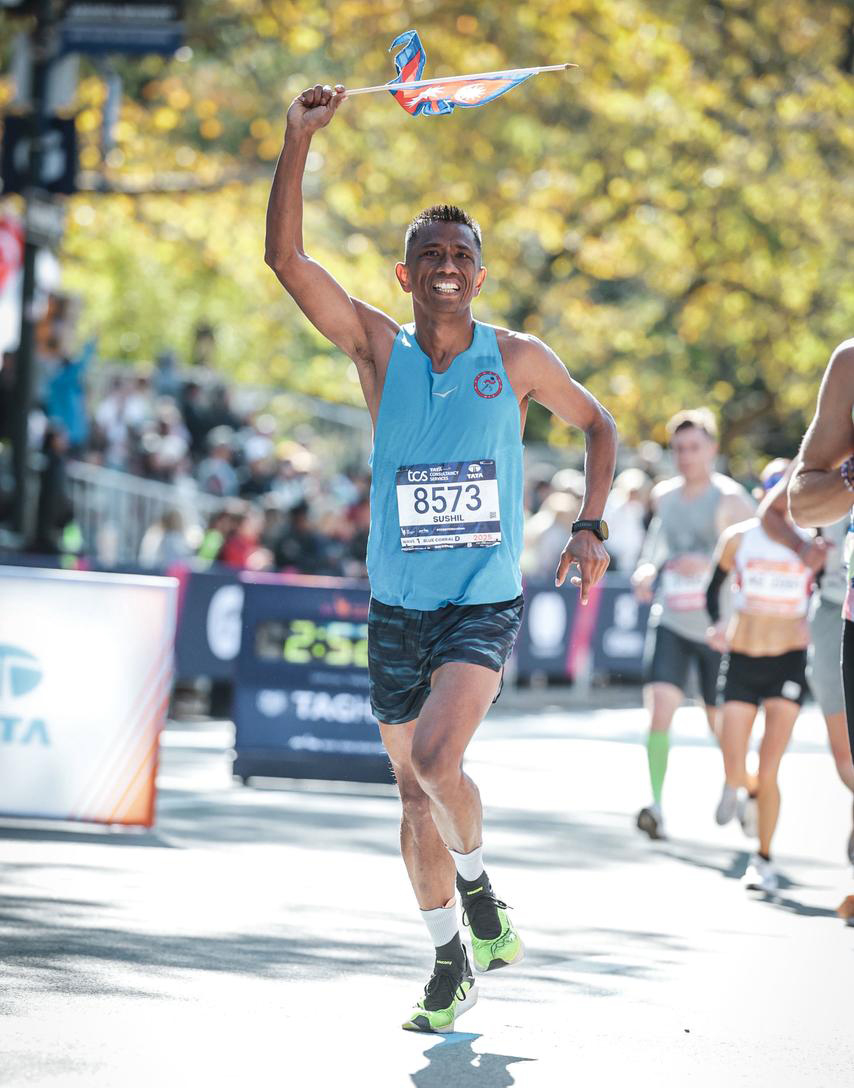
Since he has always had a passion for sports, running was not difficult for him at first. Initially, he used to run on the Ring Road, but an older brother suggested him to run in the Kantipur Half Marathon. After starting running, he has run the Kantipur Half Marathon for 5 consecutive years since 2021. This time, he will not be in Kantipur as he has to go to Boston. Since his first race was in Kantipur, he has a special attachment to it. Last year's Pokhara Marathon was his first, he ran it on a whim. He had a time of 3 hours and 8 minutes in Pokhara. He only realized it after watching the 'timing' of his first marathon and that this time was good for his age group.
After starting to run with his friends, he learned that there are 'World Marathon Majors'. Last year, he ran the London, Berlin and New York marathons. He has a desire to run eight major marathons. In his first year, he is clocking good times in the 45-50 age group. In Berlin, he clocked 2 hours and 48 minutes. ‘I completed the London Marathon in 3 hours and 6 minutes.’ Then, due to my good timing, I was selected for Boston and Chicago,’ he said. ‘With the result in Berlin, I got the opportunity to compete in the World Championships in my age group in Cape Town.’ This year, he has registered his name in four major marathons. With that, he will complete 7 out of 8. He is planning to run the Tokyo Marathon in March 2027. For that, he is waiting for the registration process to open in August. He also expressed his determination to complete all 9 major races by running in Shanghai next year. ‘After that, there was no need to run the same race again, I plan to do it every 2-4 years, I will run at least one marathon a year,’ says Sushil.
This year in Pokhara, he came second in the over-45 event, with a time of 2 hours and 58 minutes. He ran in preparation for Boston and was even more enthusiastic after getting a better result than expected. Former army player Rewat Dahal came first with a time of 2 hours and 57 minutes. It was natural for Sushil to be happy to come second in a marathon just a year and a half after a tug-of-war with Rewat, who had also won the Kathmandu Marathon.
‘Starting running at this age also means there is a high risk of injury. No matter what anyone says, no matter how much enthusiasm they show, their bones are already old. Some people can complete a marathon in 4-5 hours, but a runner like me who can complete it in 3 hours is at high risk of injury.' His ankles and knees keep hurting, but he doesn't stop running. Sometimes it takes 1-2 months to recover. But he hasn't stopped running. He is determined to keep running for the rest of his life, even if it's not a marathon.
Shambhu Dahal has been with Sipradi Group since 1992. After retiring as CEO in 2016, he is currently working as a director. After completing SLAC from Sankhuwasabha in 2034, he came to Kathmandu to study college. 'But the food in Kathmandu kept getting worse, and he kept getting stomach aches. A relative suggested running. Even when I was in school, I used to run around the fields,' Shambhu said, 'but I never found any competition for running. I would reach the Minbhavan campus running and return running. The college principals used to call me a runner.' After going to study in India in 2037, he gave up running abruptly.
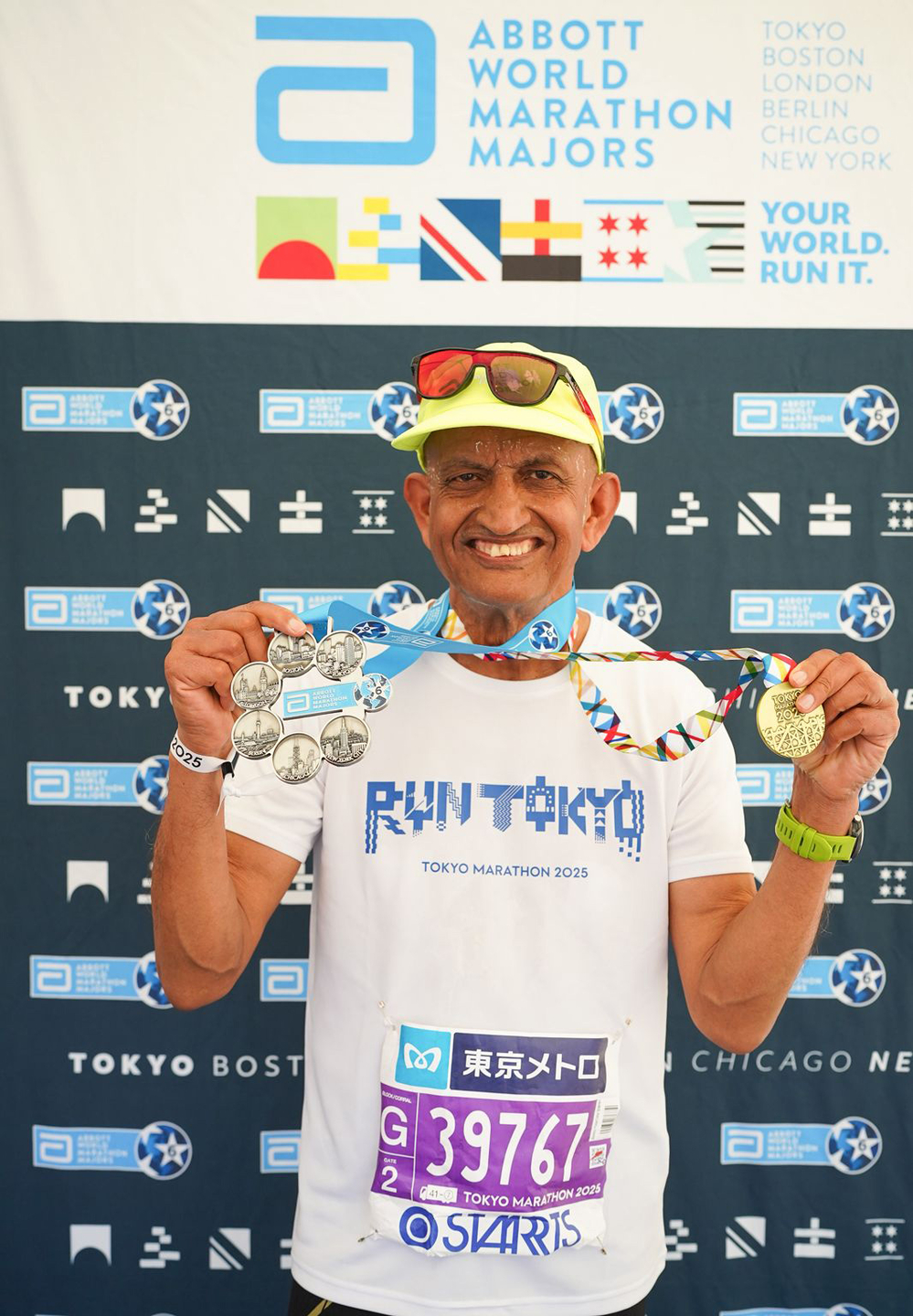
After two years of retirement, he started running again in 2018. Despite doing yoga, he remembered running again after the tiring work of the corporate world. I got the news from the media that Natarajan Chandrasekaran, the head of India's Tata Group, was running a marathon. That reminded me of running 40 years ago. After that, the determination to run at any cost seemed to have entered my soul. Shambhu was of the nature of doing something different from the beginning. He felt that only then would others notice. He understood that he could do anything and be respected.
But after 40 years, when he stretched his legs, he found it difficult to run even a short distance. ‘I had to run a marathon because Chandrasekaran, the head of Tata, had set an example by running from the corporate sector. I still read the news that Chandrasekaran was getting up at 4 am and running,’ Shambhu said, ‘I had run for 15 kilometers before starting corporate life. But since I heard that Chandrasekaran had run a marathon, I didn’t think that even a medium distance was a race.’
In 2018, he ran the Kathmandu Half Marathon for the first time. It was very difficult for him. Fortunately, he completed it in about 2 hours and 12 minutes. This continued for two years. Wherever he ran, he had a friend who would bring water and bananas on a motorcycle. He was trying to adjust his running rhythm by reading athletics books and listening to podcasts. ‘I spent 9 hours more in the Everest Marathon in 2022, there are various difficulties, that is why it is the Everest Marathon,’ Shambhu recounted the exciting experience of running the Everest Marathon, ‘Not even 20 percent of those who do the half marathon in the Everest Marathon, everyone’s attention is on the full marathon. Because that challenge attracts them to the full marathon. The experience I gain from going from base camp to Lukla that I did this gives me complete satisfaction.’
He ran the 49-kilometer Jumla-Rara Ultra Marathon in 12 hours and 50 minutes. The race, which started at 7 am, ended at 8 pm. While running in Jumla, bread and boiled potatoes were found on the way, and he ran while eating them. He also ran the Kathmandu Marathon and Pokhara Marathon. He took 4 hours and 52 minutes in Pokhara.
Then he wanted to run the Mumbai Marathon. But he would not be able to run there. After asking for the timing of the marathon he had run before to participate in it, he put the timing of Pokhara. He said, ‘I knew then that Nepalese marathons would not be internationally recognized.’ After many attempts including corporate links, he ran the 10 km of the Mumbai Marathon through charity. But since he was not included in the marathon category, the pain of running did not go away.’ Shambhu registered his name for the London Marathon in 2023. Since he is affiliated with Nepal Run UK, it was somewhat easier for him to register for the London Marathon through charity. He completed the race in 5 hours and 11 minutes.
Mumbai's 'cutoff time' was 6 hours, now he was going to run. But in the meantime, the news of 'Six Stars' reached his ears. Friends played a supporting role in getting him to participate in the Berlin Marathon. After 32 kilometers, his legs hurt and it was very difficult. It took him 5 hours and 23 minutes to complete the race. 'I put my hand on my head regarding the timing.' I then changed my running training style,' he said, giving the reason for the improvement in his timing in the marathon he ran, 'I started reading the book of American coach Floris Gierman. I paid $ 400 for a lifetime subscription to his podcast and modified myself accordingly through online training.' The effect of this was seen in the New York Marathon, he clocked 4 hours 44 minutes. Chicago's time dropped to 4 hours 33 minutes. It felt like the power of the mind was working for him. He discovered that a marathon is about testing his ‘limits’. He was participating in Chicago with the aim of completing the race in 4 hours 30 minutes. Just before finishing the race, he looked at his watch, and it showed 4 hours 29 minutes. ‘I didn’t look at the clock because the more pressure I looked at it, the more pressure I felt. I looked at the pace, I was running only by looking at my heart rate,’ he said. ‘I was surprised after looking at the watch. I had heard a motivational speaker say that the power of the mind is there. I got the opportunity to interview him and my life is also going like this.’
In January, he went to Mumbai with 7 stars instead of ‘six stars’ and completed the race in 4 hours 6 minutes. Cape Town will be Shambhu’s eighth Majors Marathon. There would have been no route to Africa. He believes that running is taking him there. He ran the Kantipur Half Marathon last year, and is running it again this year. ‘For those who do full marathons, half marathons don’t seem like anything. We take it as a warm-up for 32 kilometers. The real race is the last 10 kilometers, so we only had 21 kilometers to warm up,’ says Shambhu. ‘Whoever throws a ghost, throws it in the last 10 kilometers, so the fun of marathons is different.’
His neck, which was tight with a ‘corporate tie’, is now relaxed with a green T-shirt. After 60 years of running, he has even experienced a change in his life. Shambhu says that running is like flying when you focus on your breath and run, and its fun is incomparable to others. He eats only one meal in the morning, which rarely includes rice. At the age of 64, he lifts 86 kg from the ‘hex lift bar’ during training. He, who once suffered from stomach problems, says that he no longer gets colds due to marathons.
He also wanted to organize a premium marathon in Kathmandu, where he himself wanted to be associated. But that was just a fantasy. ‘There is a great atmosphere of running in Nepal, the organizers are short of resources. I had also prepared an initial plan to organize an international race of a recognized standard, but I abandoned it after there was uncertainty about whether it would be sustainable,’ he said, ‘It may cost around 40 million, the organization aspect is like the Mahabharata. There is a big challenge in the sponsorship aspect, the government’s support is not seen in any race, while the Prime Minister is working hard to make the Tokyo Marathon a success, that atmosphere is yet to come in our country. There is definitely a challenge in organizing a marathon in Kathmandu, but this is the cheapest compared to other marathons. This will greatly help the country through sports tourism.'
53-year-old Dharma Maharjan has been running international marathons since 2015. His focus is more on the Majors Marathon. He ran in Boston in 2019. Then he gained experience in the Berlin and London Marathons. His fourth Major was the Tokyo Marathon. He is currently preparing to run in the Cape Town Marathon in the over-50 age group. Since he could not run in Chicago and New York, his 'Six Stars' have not been completed.
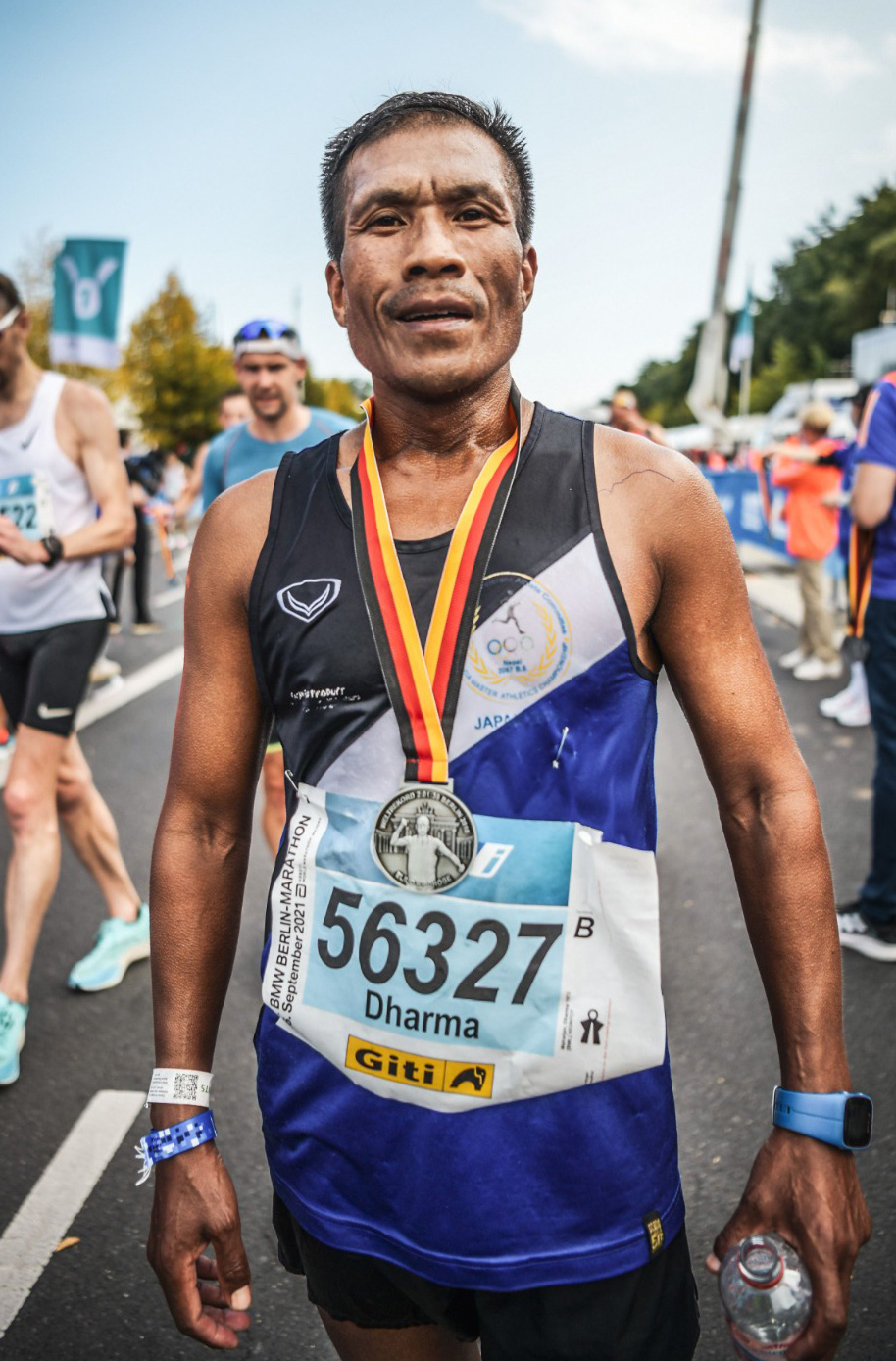
There was a large digital poster on a large building in Chicago. Seeing that, Dharma's friends called him in tears. Dharma was also on the poster with a photo of a star athlete saying that he was coming to run the Chicago Marathon. Dharma, who is in Nepal, came to know about it after his friend called him emotionally. In 2022, I was scheduled to run the London Marathon to Chicago and from there to the New York Marathon. After this, my Majors Marathon would have been completed. ‘But immigration stopped me at the Chicago airport. After running the Boston Marathon, I stayed with a friend for 4-5 more months and trained there. That is probably why I was not allowed to enter the US again,’ Dharma said, ‘I was scheduled to run the Chicago and New York Marathons within a month, I had 2500 US dollars. Immigration stopped me saying that that amount would not be enough to eat and stay for a month.’
‘It is very difficult for Nepalis to get entry, play, and return after returning. We have been facing this problem. Nepalis face challenges, I am overcoming this challenge by running,' says Dharma, 'I am running at my own pace without imitating others. I would like to keep running to see if I can introduce the country to the major marathons. I will continue running until my life ends.'
He participates in all kinds of races in India, from 5 km races to marathons. He has won the Mumbai Marathon twice in the over 50 age group. His 'timing' is under 2 hours and 50 minutes. He has secured third place in the Tata Slam. TCS World 10 km Bengaluru, Medanta Half Marathon Delhi, Tata Steel World 25 km Kolkata and Mumbai Marathon fall under this Slam. Those who complete all these four races in a single year are called Slam, where the winner is declared by adding up all the minutes. He claims to be the first Nepali to complete this Slam. पछिल्लो दुई वर्षदेखि भारतमा दौडिरहेका उनी त्यहाँको पुरस्कार रकमले पुगिरहेको सुनाउँछन् । भारतमा दौडँदाको एक क्षण स्मरण गर्दै उनले भने, ‘मैले धेरै जित्ने हुनाले नेपालबाट धर्म आएको छ, दौडका लागि बाटो छाडिदेऊ भन्छन् ।’
नेपालमा पनि आफ्नो समूहको अधिकांशमा विजेता बन्ने गरेकाले उनी आफूलाई ‘भेट्रानको हिरो हुँ’ भन्दै परिचय दिन्छन् । एभरेस्ट म्याराथनदेखि जुम्ला, काठमाडौं, लुम्बिनी, पोखरा, नेपालगन्ज म्याराथन सबै दौडिएका छन् । तर धेरैमा भेट्रान नसमेटिएकामा उनी गुनासो गर्छन् । जबकि विदेशमा खेल्दाको अनुभव उनले भेट्रान भन्ने नै सुनेका छैनन् । ४०–४५, ४५–५०, ५०–५५, ५५–६०, ६०–६५, ६५–७०, ७०–७५ वर्ष उमेर समूहमा खेलाडीहरू खेल्ने उनले पाएका छन् ।
सानैदेखि घरको जिम्मेवारी लिएको हुनाले दौड अलिक ढिला सुरु गरेको उनी सुनाउँछन् । दौड सुरु गर्दा उनी ४० वर्षका थिए । जितबहादुर केसी, वैकुण्ठ मानन्धरका बारेमा उनले सानैदेखि सुनेका थिए तर घरको जिम्मेवारीले उनलाई दौडमा खुल्न दिएको थिएन । कीर्तिपुरको बाघभैरव मन्दिरमा भदौ १ मा जात्रा हुने गर्छ । त्यो दिन मन्दिरलाई १ सय ८ फन्का लगाउनुपर्छ । मन्दिरको क्षेत्रफल सानो भए पनि उनी दौडिएर फन्को लगाउँथे । यसैले उनलाई दौडन सिकाएको थियो ।