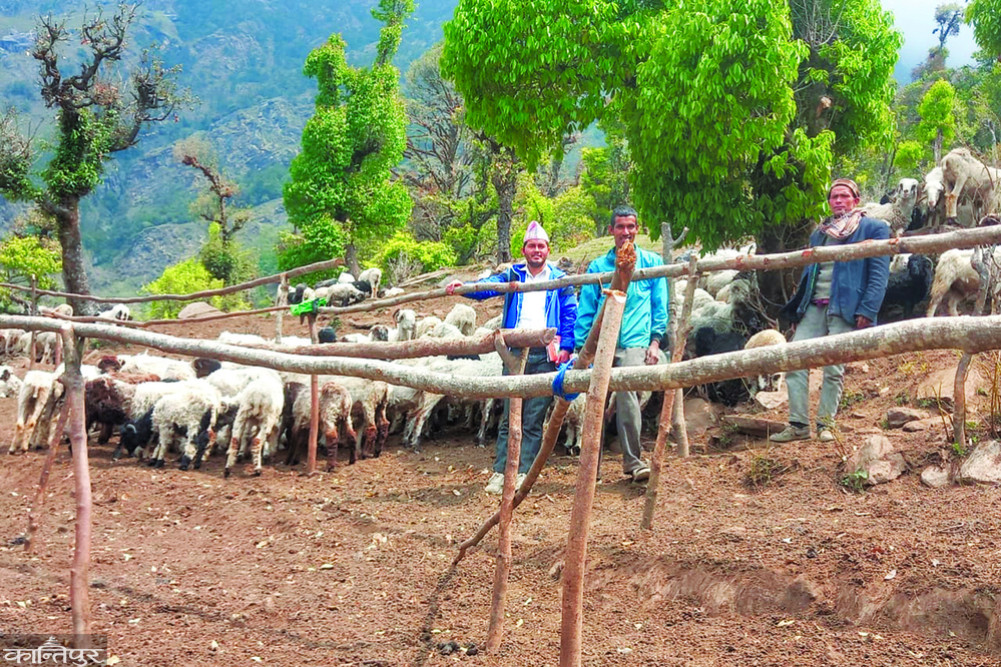
Last year alone, Narharinath Rural Municipality distributed 'shepherd allowance' at the rate of Rs 10,000 per year to 157 farmers.
We use Google Cloud Translation Services. Google requires we provide the following disclaimer relating to use of this service:
This service may contain translations powered by Google. Google disclaims all warranties related to the translations, expressed or implied, including any warranties of accuracy, reliability, and any implied warranties of merchantability, fitness for a particular purpose, and noninfringement.
Dal Bahadur Shah, a farmer from Narharinath Rural Municipality-4 in Kalikot, has raised five buffaloes. He is earning Rs 700 by selling 10 liters of milk a day in the local market and is also selling ghee worth Rs 50,000-60,000 annually.
‘The income from buffalo farming is helping to cover the household expenses, I am sending my two children to a private school in Surkhet,’ he said. ‘Now the municipality has also started providing allowances, which has helped to make buffalo farming more organized and professional.’
Balindra Shahi of Shubhakalika Rural Municipality-5 in Kalikot’s main occupation is buffalo farming. He also has 5 buffaloes in his cowshed. ‘I am earning Rs 3 lakh annually from animal husbandry,’ he said. ‘With the money saved from running the household expenses, I was able to build a barn in the district headquarters.’
The number of commercial farmers has been increasing since Narharinath and Shubhakalika Rural Municipality in Kalikot started providing ‘shepherd allowances’ to encourage farmers who raise livestock. Last year, Narharinath distributed ‘shepherd allowances’ at the rate of Rs 10,000 annually to 157 farmers. This year too, the municipality has allocated a budget of Rs 2 million. Kamal Kumar Shah, the vice-chairman of the rural municipality, said that he is distributing subsidies as 'shepherd allowance' to farmer families raising 5 buffaloes, 51 goats and 57 sheep.
'We have tried to make the farmers who raise livestock self-reliant in the village by encouraging them, which is attracting the younger generation towards animal husbandry,' Shah said, 'This has also helped improve the economy of the municipality.' Most of the approximately 4,200 households in the municipality are raising livestock. He said that although all households are raising livestock in the traditional way, allowances have been arranged to make it commercial. Megraj Budha, 35, of Narharinath-9 Chautha, said that he has been raising goats commercially since the municipality started providing incentives, even though it is a small amount. A graduate, he said that he has been raising 56 goats for the past 5 years without looking for a job. ‘The pasture area is also good, animal husbandry is gradually making me self-reliant,’ he said, ‘I am earning up to Rs 250,000 per year by staying in the village.’
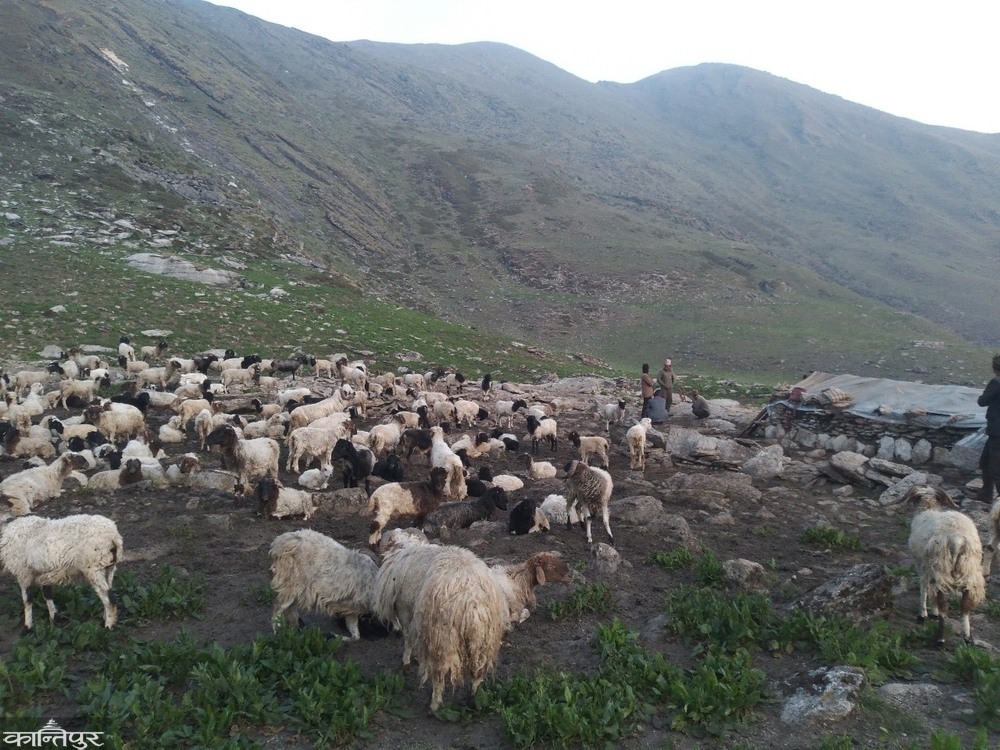
Dil Kumar Budha, a resident of Chauthai, who has been raising 5 buffaloes for the past four years after leaving his job as a temporary teacher. He is selling 10 liters of milk a day and producing up to 40 kg of ghee annually. ‘Since the pasture area is sufficient, it is suitable for animal husbandry here, there is no problem in the market and the price of animal products is also increasing,’ he said, ‘Since there is not much suffering, I am earning a good income by staying in the village.’ In the local market, the price of milk is Rs 70 per liter and ghee is being sold at Rs 1,000 per kg.
Katak Bahadur Budha, head of the animal service branch, said that the rural municipality has been running a program to provide allowances to farmers for the past three years. ‘We have tried to make farmers self-reliant in agriculture through animal husbandry,’ he said. ‘It also encourages them to use cow, buffalo and sheep manure in their fields, which has reduced the use of chemical fertilizers and made it easier to adopt organic farming systems.’ He said that the municipality has good potential for animal husbandry due to the suitable climate and abundant pasture land. According to him, ward number 5 has been declared a buffalo pocket area, while preparations are underway to make ward number 7 a sheep and goat pocket.
Shubhakalika has made a procedure since 2076 BS and has arranged tents for farmers with an annual amount of Rs 5,000. ‘Farmers go to various pastures to graze their livestock, so that they do not have any problems staying there,’ said Rural Municipality Chairman Govinda Prasad Acharya. ‘After the municipality arranged allowances, a wave of commercial animal husbandry has started even among the younger generation.’
A budget of Rs 5 lakh is being allocated for this program every year. He informed that the insufficient amount will be transferred from other titles. As per the procedure, ‘shepherd allowance’ is being distributed to farmers who have raised 5 buffaloes and 50/50 sheep. Last year, the rural municipality has stated that 97 farmers received this amount. According to the municipality, 25 farmers received the allowance in the first fiscal year 2076/77. There are statistics that about 3,900 farmers across the municipality raised about 8,200 buffaloes and 11,000 goats. Animal Service Technician Dhanjit Budhathoki, who has brought a grant program with a plan to make the rural municipality self-reliant in meat, said. ‘We have arranged for the allowance to make farmers self-reliant and increase animal production including meat,’ he said, ‘We plan to increase the allowance amount every year.’