Locals are buying rice by selling forest logs, bamboo shoots, and sisno at the market run by Aanbukhaireni Rural Municipality. The market is changing the lifestyle of the residents.
We use Google Cloud Translation Services. Google requires we provide the following disclaimer relating to use of this service:
This service may contain translations powered by Google. Google disclaims all warranties related to the translations, expressed or implied, including any warranties of accuracy, reliability, and any implied warranties of merchantability, fitness for a particular purpose, and noninfringement.
The Chimkeshwari area, at an altitude of about 2,134 meters above sea level, is the highest mountainous area in Tanahun.
There is a dense settlement of indigenous and tribal communities here. Despite its religious, natural and biological diversity, this area is far from the reach of development.
The rural municipality has now brought forward a special program for the development of Chimkeshwari, which is under Aanbukhaireni Rural Municipality, which is at the entrance to Gandaki Province via the highway. This has also started to change the lifestyle of the residents here. Wards No. 5 and 6 of the rural municipality are remote wards. The rural municipality has brought in an agricultural market every Monday and Friday as a place to easily sell and distribute the agricultural produce produced by local farmers.
With the provision of subsidies based on transportation and production, local farmers have now started earning money by selling and distributing their produce from the market. Ward No. 5 Rasauli, 48, says that this market has put an end to the situation of having to wait for festivals to eat rice. "We used to wait for Dashaitihar to come and eat rice, but now that this market is open, our lives have changed," said Chepang. "We used to eat tubers and yams found in the forest to feed ourselves. Now, when we sell the same gittha, bhakur, siplikan, and sagasisno, we have money to buy rice and salt at home. Now we don't feel bad about eating rice."
"The first time I went to the market and bought wild blackberries, I thought, 'Is it true that no one will eat this?'" she said. "Later, I was happy when all the blackberries were sold one by one. With that day's earnings, I bought 5 kg of rice, 1 kg of potatoes, salt, and salt from the market and returned home." After that, I started going to the market in Ambukhaireni every week with tubers that are found in the village and forest, but are not easily available in the market. Since everything I brought has been sold, now even rice is not broken at home and there is no shortage of two or four paisa.'
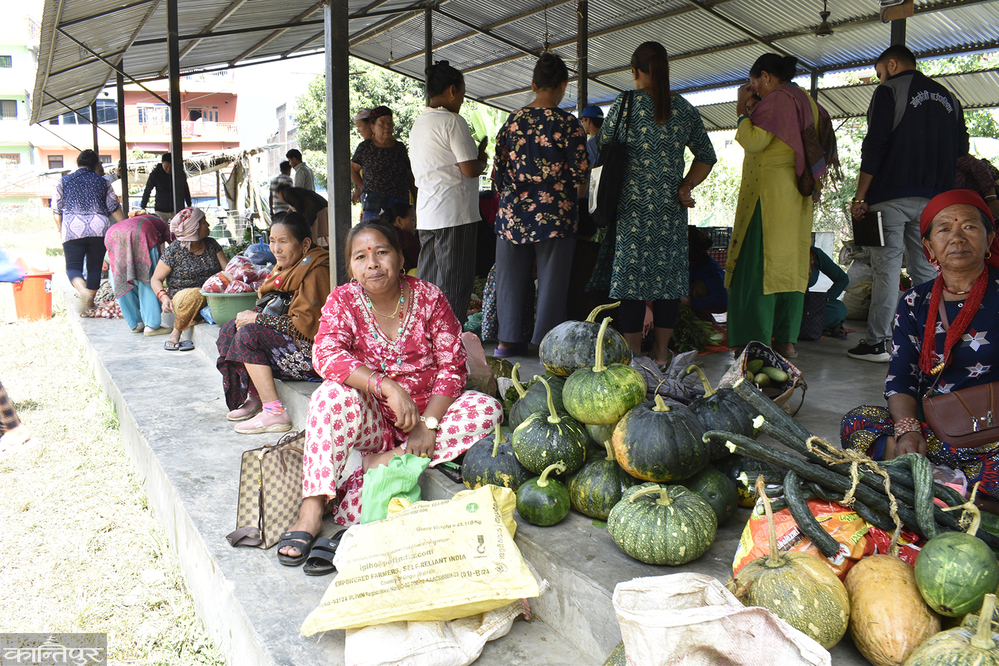
The millet, corn, soybeans, greens, phapar, sisno, herbs found in the forest and forest like tubers, gittha, bhakur, timmur, niguro, pani amla, which are produced by the residents of the Chimkeshwari area, are now being sold at good prices in the market. Sangita Gurung, 47, of Ward No. 5 Labdi, says that they are becoming financially independent after such products, which are fed to livestock and wasted after being consumed, are now being sold at good prices in the market.
With the operation of the market, Sangeeta Gurung of Chimkeshwari has been able to earn an income by selling pickled cucumber worth Rs 50,000, gundruk worth Rs 10,000, mustard greens worth Rs 30,000, wild yam worth Rs 3,000, black pepper worth Rs 5,000, and sisno worth Rs 1,000. At first, she used to consume these products herself and waste them if they were not consumed.
After these products started being sold and distributed easily through the market, she has also expanded her farming and has started earning a good income by working hard in the village.
Suk Bahadur Gurung, 66, of Ward No. 4 Loprang, has also been able to earn a good income by selling the honey he produces at the market. Gurung, who has been keeping bees professionally, used to go from house to house selling one or two maana of honey. However, now that the rural municipality has operated the market, he said that he has sold 140 maana of honey so far.
The rural municipality has allocated a budget of Rs 20 million for the operation of the agricultural program, said Santosh KC, head of the agricultural branch. The rural municipality's agricultural branch operates an agricultural market two days a week to buy and sell locally produced agricultural produce. Farmers sell their produce in person, and if the farmer's produce is not sold, the rural municipality buys and sells it, said the branch head.
The rural municipality has been providing subsidies on meat and milk under the production-based subsidy program. After increasing the subsidy of Rs 2 every year for dairy products, this year the subsidy has been increased to Rs 6 per liter of milk, said the agricultural branch head. He said, "After the rural municipality took over 100 percent responsibility for animal insurance, the number of farmers raising cows and producing milk is increasing." Since the market is managed without intermediaries, the basis has been set for direct contact between farmers and producers and consumption of quality goods at reasonable prices.'
Village council chairman Chuman, who has prioritized programs in education, health, agriculture, tourism and other sectors, has also improved the educational quality of community schools by allocating a budget of 40 million rupees for each fiscal year. Smart boards and smart TVs are used for teaching and learning in every school. The girl student savings account program provides one thousand rupees to each girl student. Chairman Chuman said that the village council is also providing health insurance services worth 20 thousand rupees.

