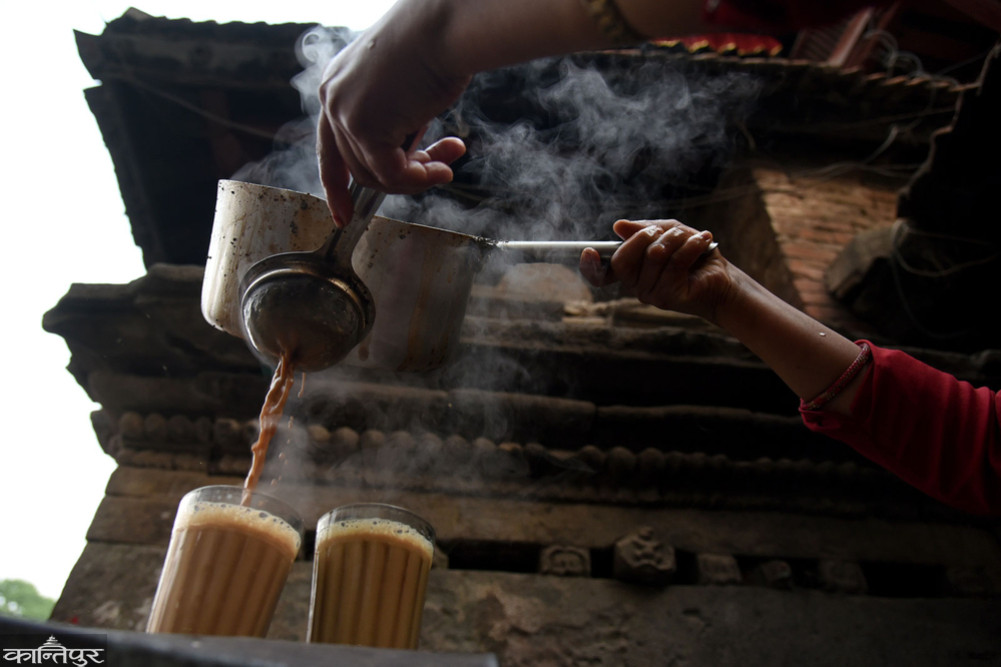
After tea entered human civilization and traditional life, its lifestyle has changed. Tea has made the public sphere dynamic. The chain of social history has also changed.
We use Google Cloud Translation Services. Google requires we provide the following disclaimer relating to use of this service:
This service may contain translations powered by Google. Google disclaims all warranties related to the translations, expressed or implied, including any warranties of accuracy, reliability, and any implied warranties of merchantability, fitness for a particular purpose, and noninfringement.
Telling the story of tea in history, prose, and poetry, historians, writers, and poets have often asked: What is the magic in the aroma and taste of tea that has enchanted the entire world? What is this affinity between people and tea? What kind of creativity and artistry have people created in a cup of tea? How did tea become the second most popular drink in the world after water?
How did tea become a culture of human society? How did tea make a unique mark on politics, religion, trade and social traditions? What was the rough path of the vast global journey of a single tea leaf, ‘Camellia sinensis’, that changed the fate of mankind?
The pages of ancient history, pressed by paperweights, say – the world journey of tea from its birthplace, China, is like a legend. The upward journey of tea, which is blowing the earth from its permanent address, China, is an inanimate force – of the gentle-hearty-sweet embrace of man, of civilization and lifestyle.
Saying this is like repeating the same thing, but it must be said – tea is an integral part of modern life today. Although there is no clear data, it is estimated that – more than 6 billion cups of tea are drunk every day in the world. The economic importance of tea is incalculable.
The statistics-graph says – currently, 6.5 million metric tons of tea are produced annually in more than 50 countries. And, it has supported the livelihood of about 125 million people. From China to Britain, from Africa to Japan, even societies that are completely different from each other have been connected by the warm thread of tea culture.
Legend has it that in 2737 BC, the Chinese emperor Shen Nong discovered tea when he dropped a leaf of ‘Camellia sinensis’ into boiling water. Tea had been used as a medicinal plant for centuries. By the third century, it had become a daily drink, a true part of man and his civilization.
How to grow tea? How to process it? How to drink it? This classic recipe was first published around 350. By the Tang Dynasty (618–907 AD), tea was firmly established in Chinese society. Around this time, tea began to be traded from China to India and Central Asia. In return, the Chinese would buy horses. Hence the name of this route was the ‘T-Horse Road’.
The sea route accelerated tea's global journey. Tea reached Japan around 800. By the 13th century, it had begun to be widely cultivated in Japan. In the 16th century, tea reached Europe through Portuguese traders. In the early 17th century, the Dutch East India Company began transporting tea from Macau to Europe. After the Portuguese princess Catherine of Braganza married King Charles II in 1662, tea became a very popular drink of the British court.
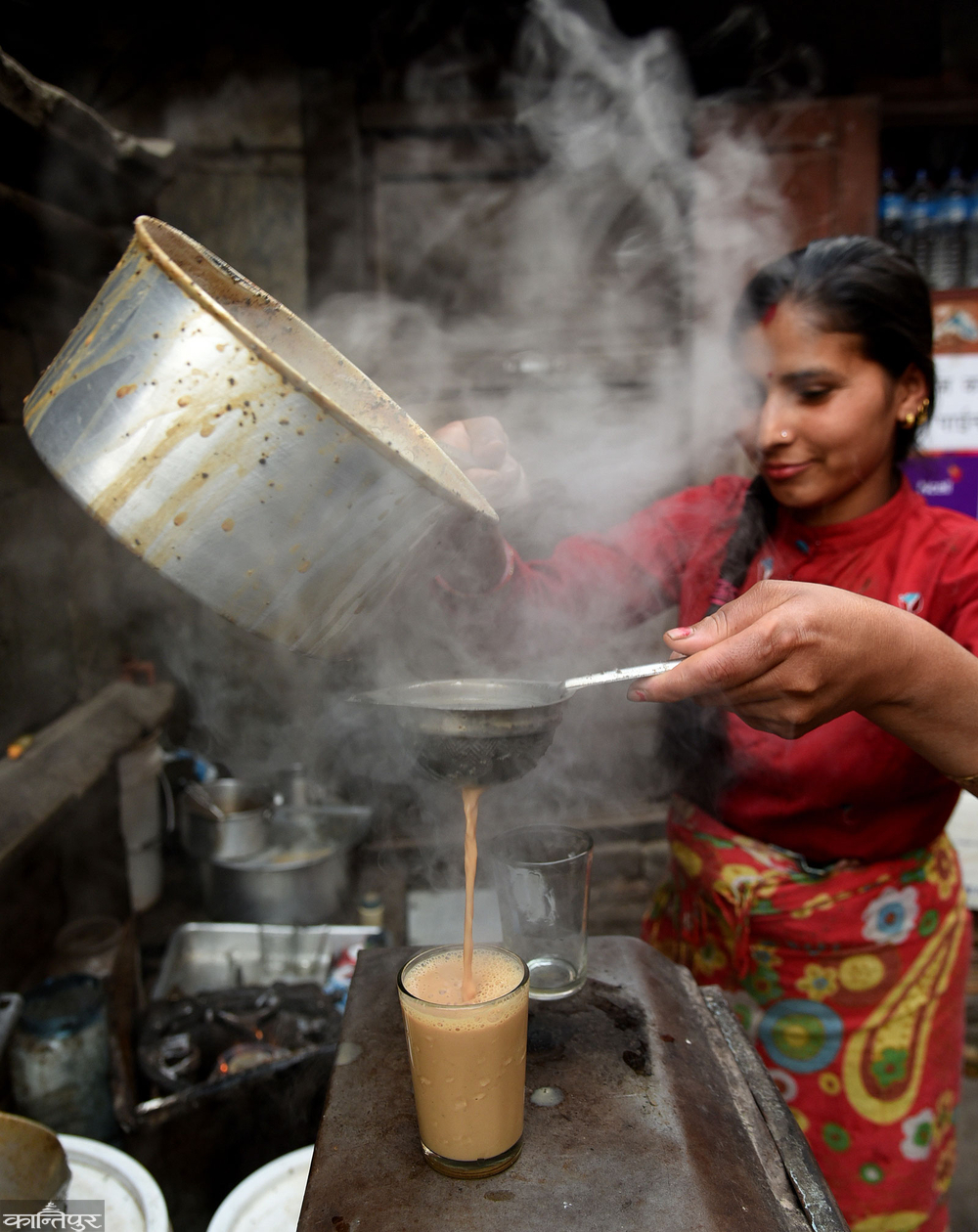
Why did tea, which reached Britain by traveling, become famous? The real reason for this was sugar. At that time, sugar was very rare in Britain. Sugar was a symbol of the nobility. And, when tea was drunk with sugar, tea, which took on a romantic incarnation, became extremely popular. Initially, tea was a luxury item, limited only to the court and the wealthy class. However, it gradually established its empire throughout Europe. By the 18th century, tea became a drink of the common people.
By the 18th and 19th centuries, tea had become a major product of world trade. The demand for Chinese tea in Britain was high, causing Britain to suffer a trade deficit. To make up for this deficit, Britain began to produce opium in India and export it to China. When the illegal opium trade began to negatively affect Chinese society, the government banned opium. In retaliation, Britain launched a military invasion. After two Opium Wars, China was defeated. This war cost China its sovereignty. The tea trade, which had brought prosperity, eventually proved to be very expensive for China.
To break China's monopoly, Britain established tea plantations in Assam, Sri Lanka, and later East Africa. By the early 20th century, tea had become a major part of the British economy. Today, the tea market is worth more than $100 billion annually, with China consuming the most. China consumes 14.5 million tons of tea annually, while India consumes 6 million.
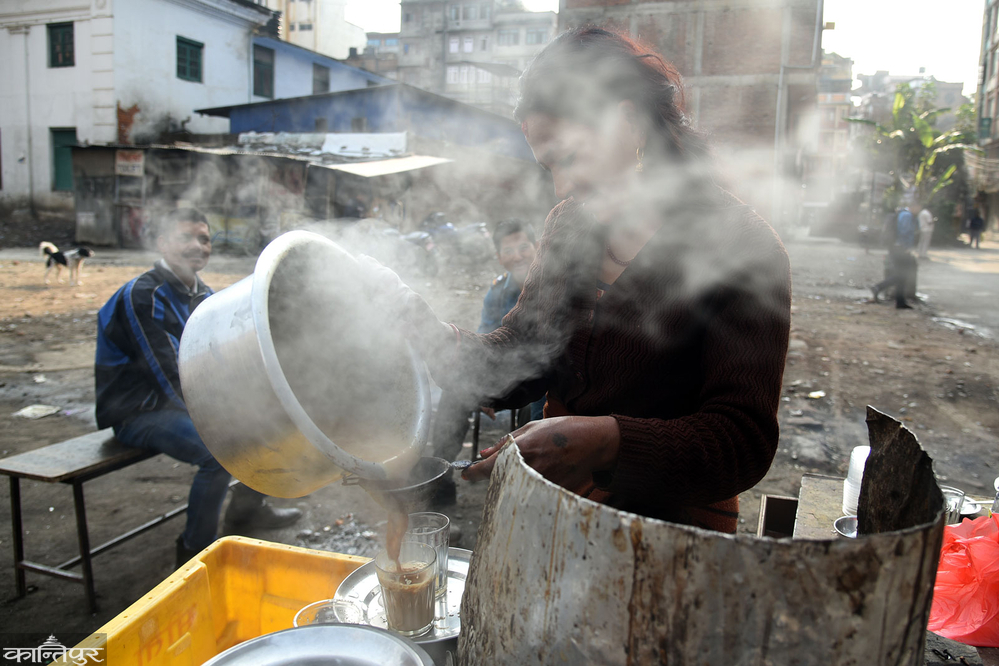
The Classic of Tea, written by the Chinese writer Lu Yu in the 8th century, is considered the first book on tea. Later, tea began to occupy a large place in literature. Tea is mentioned frequently in the novels of Jane Austen and Charles Dickens.
There is an influential 904-page book on the world tour of tea by Dutch scholar George van Driem – ‘The Tale of Tea’, which not only tells the history and origin story of tea in the world, but also tells the story of tea in those distant days of Nepal. The book says – tea plants were grown in Kathmandu around 1820. ‘The Tale of Tea’ discusses Nepal’s place on the world map.
Along with tea, its two names also reached the world – ‘Cha’ and ‘Tea’. Studies say – wherever tea reached by land, it was pronounced ‘Cha’. And, wherever it reached by sea, it was addressed as ‘Tea’.
Tea or ‘chha’ has many pronunciations and sounds in Nepal too – just as tea is pronounced ‘chha’ or ‘chha’ in the Himalayan region, according to Dream’s book, tea is called ‘chha’ or ‘chha’ in China. Dream, who is currently in Thailand, told Kantipur on Friday, ‘The history and culture of Nepal’s tea is related to Darjeeling, Britain and the family of Jung Bahadur Rana. The tea produced in Nepal from the eastern hills of Limbuwan to Sandakphu is of high quality. I find that tea very delicious. Nepali tea is more famous abroad than in Nepal.’
Dream is very happy about the increase in the tea craze in the city. He says, ‘It is a very beautiful aspect that tea culture is becoming famous. The way tea rooms are being built in the city now, it creates a new atmosphere. Currently, wine sales in Europe are down, tea rooms are increasing. It creates a healthy culture in the city.’
Sitting in the courtyard of his house in Sanepa in the cold of the month of Poush, botanist Tirtha Bahadur Shrestha is discussing tea. He explains that tea plants produce special chemicals in their buds to prevent insects and other animals from damaging the young buds. ‘The same special chemicals produced by the plant to protect the buds have become our beverage tea,’ says Shrestha. ‘The leaves containing thousands of polyphenolic compounds, including tannin, which makes the tongue tingle, and caffeine, which causes a slight stimulation, are processed to make various types of tea.’
Shrestha is looking into the window of Nepal’s tea history and culture. In his book ‘Nepal Gatha’, he writes, ‘The Tamang community around Kathmandu has a tradition of picking the lotus buds of the Hinguwa plant and making tea. The first specimen of this plant was collected by Edward Gardner from the forests of Nepal in 1818 and brought to Nathalie Walichka.
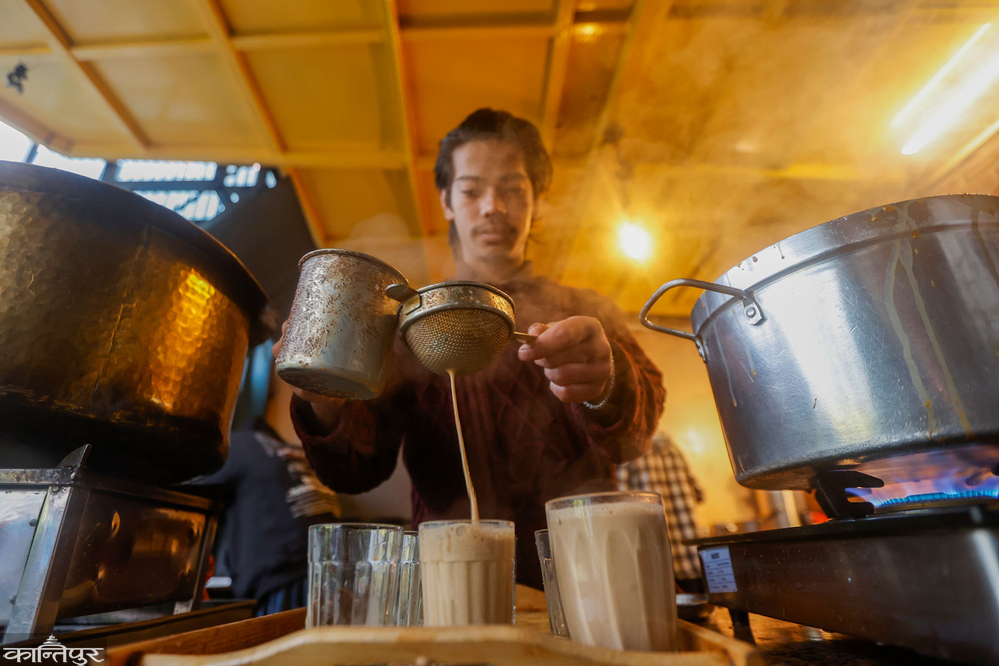
...Our Hinguwa has spread to Sikkim, Bhutan, Assam, Burma and the provinces of southwest China. Its seed oil, which is also used in cosmetics in China, is considered very useful. The custom of making Bhote tea by mixing a type of herb belonging to the Shrikhand family, Nundhiki, and Hinguwa is old. ...A lump or a four-sided brick-like lump made with Hinguwa, Nundhiki, and possibly Chinese tea leaves is called Bhote tea.' In the Himalayan region, Bhote tea is boiled with salt and drunk with a special type of stone, topped with coconut ghee.
When you flip through the diary of Nepal's tea history, two different stories come to mind. The first story says that tea first entered Nepal from Darjeeling to Ilam, then it circled Nepal, meaning that the tea brought to India by the British during the colonial period spread to Nepal.
The second story says that tea entered Nepal directly from China. Writer and editor Kedar Sharma used to tell this second story to another writer and researcher, Kamalmani Dixit. Kedar remembers, ‘Kamalmani used to tell me the history of tea coming directly from China to Nepal. And, at the end, he would say, ‘Kedarji, you should find out the facts about it.’ Kamalmani’s argument takes us back to the days of two centuries ago.
In 1849 BS, Nepal fought a war with Tibet-China. After China stood on Tibet’s side, the Chinese army chased the Nepali army and reached Betravati on the Rasuwa-Nuwakot border. And, to protect the existence of the nation, Nepal made an agreement with China. That agreement is known as the ‘Betravati Treaty’. The second article of the agreement stated that Nepal would send a dignitary delegation to Peking every five years to honor the Chinese emperor and present gifts.
The gifts were sent by the Nepali king himself. And, representatives of the Qazi level would reach Peking via Lhasa carrying gifts. And the Chinese emperor would also return valuable gifts to the Nepali king in return. This took the form of a tradition that continued for one hundred and fifteen years (1963-66 BS). And, the Chinese emperor would send tea to the Nepali king as a gift.
Gyanmani Nepal has written that at that time, along with tea, a silver kettle, bowl, and tea-making pot would also be brought. In 1884 BS, a delegation led by Chautariya Pushkar Shah went from Nepal to Kuti, China. After returning, Gyanmani has mentioned what Chautariya wrote to the then Maharajadhiraj, saying, ‘There is a custom of serving tea here (there). As soon as they arrived, they would make tea and wait on the road. The Qazis who came before them would drink tea. But I didn't.' (Tea Discussion, Arjun Panthi, Kantipur, Koseli).
Writer and editor Kanakmani Dixit sees Kamalmani's argument as strong, namely the history of tea coming to Nepal from China, who has been advocating for 'Nepal Imperial Tea' for the past 15 years. 'As a gift, the Chinese Qing Emperor sent a Puri tea plant to Jung Bahadur Rana. His son-in-law Gajraj Thapa was posted in Ilam, Jung Bahadur sent the plant to his son-in-law. It is said that tea was also planted in Sindhuli while being sent from the valley to Ilam. In this way, tea from China has been planted in the Ilam tea plantation,' says Kanakmani, 'The Chinese emperor sent the plant's most favorite tea plant. Nepalis need to understand its importance. This is a grand thing for the Chinese people and market.'
In Kanakmani's opinion, the tea from 'Ilam Tea Command' should be named 'Nepal Imperial Tea' and distributed to the world, especially China. 'After that, it is impossible to imagine how much the price of this tea per kilo will increase. This is Nepal's historical property, the property of the Nepali people. When Nepal brands the tea sent by the Chinese emperor, our economy will benefit. And, the Chinese will also understand that Nepal has protected the tea selected and sent by the emperor a century and a half ago.'
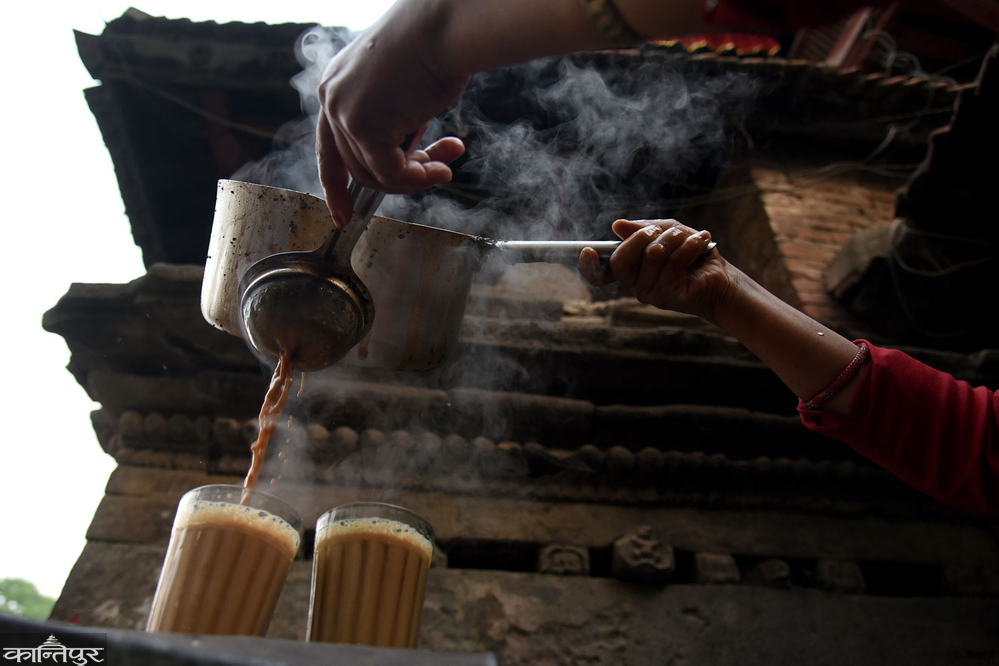
History says that tea was planted in Ilam in 1920. The tea processing factory opened 15 years later in 1935. Two years later, tea cultivation also started in Soktim, a southern part of Ilam. A processing factory was also opened in Soktim in 1940. The first private tea garden is the Budhakaran Tea Garden in Radgadiya Danda, Jhapa, which was established in 2016.
At the government level, the Nepal Tea Development Corporation was established on 23 Asoj 2023. In 2039, King Birendra declared Jhapa, Dhanukuta, Tehrathum, and Ilam as tea areas. On 20 Jestha 2050, the National Tea and Coffee Development Board was established. Currently, processing centers in the Terai and hills are producing CTC and orthodox tea.
Tea has now become a heritage. When we turn the old pages of Nepal's tea culture, we find Bekhanarayan and his brother Jognarayan Dangol, who made the people of Kathmandu taste tea. In memory of Tirtha Bahadur Shrestha, Bekhanarayan was called 'Dharhara Maila' or 'Tilauri Maila' and Jognarayan was called 'Kancha Dai' at that time. ‘The Kathmanduites who were in the company of Lhasa Sahu used to drink Bhote tea,’ says Shrestha, ‘but, after the 2007 revolution, the Nepalis who came from Calcutta adopted the custom of English tea mixed with milk and sugar.’
In fact, Kathmandu had tea shops—a lively ‘location’ that made the city a lively place, creating awareness. And, sitting in a tea shop and chatting happily was the beginning of such a custom and culture—which laid the foundation of the city’s prosperous public sphere.
Before the dawn of democracy, ‘Chiso Estre’ was a special place for tea culture in Kathmandu—Lopton’s Hotel in Dillibazaar, which was a broad public sphere of prosperous consciousness. The old name of Dillibazaar was Maghdol. Later, this area was called ‘Dillibazaar’ after Colonel Dilli Bahadur Basnet. Lopton’s Hotel, located on the slopes of Dillibazaar, had created a very important ‘public space’ that made Nepali intellectual and political consciousness flourish. The long story of this hotel is told in the non-fiction book ‘Dillibazar’s Lieutenant’s Hotel’ by writer Arvind Rimal.
This hotel was opened in 2004. The owner of the hotel was retired Lieutenant Krishna Bahadur Khatri Chhetri. After he opened the hotel, the great poet Laxmi Prasad Devkota named it ‘Lieutenant’s Hotel’. In the vicinity of Devkota, this place became a center of intellectual gathering. Personalities like Janaklal Sharma, Shyamdas Vaishnav, Hridayraj Sharma, Mohan Koirala, Shankar Lamichhane used to come here regularly to drink tea.
‘We used to sit and have tea with Devkota, tea was available for five paisa,’ recalls 92-year-old writer Arvind Rimal from Dillibazar, ‘People from Praja Parishad and Progressive Study Circle would come for tea and snacks. Leaders of the Jayantu Sanskritam movement of 2004 also used to gather here. Personalities like Rahul Sankrityayan, Tanka Prasad Acharya, Rishikesh Shah, Dilliraman Regmi, Kirtinidhi Bista, Yadav Prasad Panta have had Laptan's milk tea, half a cup for five paisa. That was a glorious time.' Rimal's memory keeps repeating - Mahendra Shah's order to 'not go there for tea'.
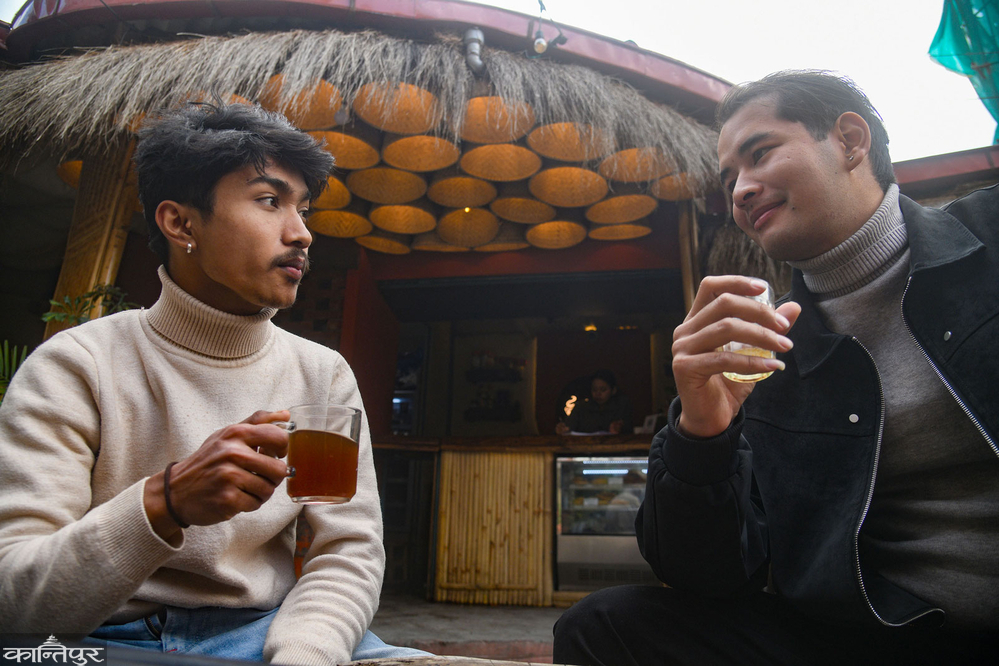
There was a tea shop near Dharahara, which people called 'Dharahara's Maila Sahu's shop'. At that time, there was a buzz in the city - around 2007, BP Koirala used to secretly go there regularly for tea. During the time of Padmashamsher, tea was brewed in every house. Cultural activist Suresh Kiran had said one evening - it was heard that even when guests came to the house, people would go to the shop to buy tea and put it in a pot and bring it home. Even until the 1950s, going to the shop to drink tea was a 'new and modern' culture in Kathmandu. Rimal says, ‘Lapton’s hotel was not just a tea shop – it was a fertile ground for thought, where dreams of freedom and literary consciousness stood together. During the Rana period, drinking tea outside the home was considered a symbol of a citizen’s free thought and behavior. Which was not openly practiced.’
At the same time, there was another tea shop on New Road in Kathmandu. On this subject, writer Arjun Panthi wrote in Kantipur ‘Koseli’, ‘Ratnadhwaj Thapa, 90, of Baneshwor, who worked in the Nepali Army, told me the story of a shop on New Road that opened around 2007. Tea was made on the upper floor of this hotel. There was also a hole through which glasses could be inserted. Those who came to drink tea downstairs would ask for it by pointing their faces towards the hole. Tea was served from above. According to him, ‘Latari tea’ made of milk and milk was made in Indrachowk. The question of who used to come here is unanswered.’
Panthi asked historian Gyanmani Nepal about the 19th century BC. The article titled ‘Tea Drinking Tradition’ published in the ‘Muhurta’ magazine in 2044 has also been discussed. According to Gyanmani, even though there was no legal ban on tea at that time, it was considered an emotional ban.
‘Acharya Dipankar Srivijyan of Vikramshila Mahavihara in India, who had reached Tibet via Nepal, was surprised when he was welcomed with tea when he went to vote with his 35 followers.…Later, the custom of serving tea to the Nepali delegation going to vote also began. In this sense, tea became a beautiful symbol of hospitality,’ Gyanmani writes, ‘Kazi Bhim Malla, who traded with Tibet, introduced the custom of tea. Other merchants during the Malla era are credited with bringing it to the common people. At that time, arrangements were made to prepare tobacco and tea at the headman’s house while sitting in court. After unification, the custom of traveling to China in addition to voting increased.’ (Tea Discussion, Arjun Panthi).
Taranath Sharma Adhikari (80) from Ilam, who started his career as a worker at Kanyam Tea Estate in 2028 and became involved in the suffering of tea farmers throughout his life, discusses Nepal's tea culture through the 'Out Growers Scheme' (Small Farmers Tea Project). He heard from William Robert Bell, a then British citizen, about the successful tea farming practices of Kenya, Uganda and Sri Lanka. The fact that farmers in those countries could earn three times more than traditional subsistence farming and even get bonuses when they planted tea on their own land and sold it to factories inspired him to bring that model to Nepal.
Under Sharma's initiative, around 2033, local leading farmers began planting tea as small farmers for the first time in Nepal with the help of loans from the Agricultural Development Bank. ‘Even when cardamom was destroyed in Ilam because of tea, the farmers were not disappointed and did not seem to be poor,’ Sharma tells the story of tea culture, ‘We in Ilam used to drink tea from the beginning. We had our own tea culture. However, what I have seen in Nepal, tea culture has not expanded. Tea consumption is different in rural society and in the city. We put water in a kettle, put tea leaves in it, and boiled it. This cannot be called tea culture.’
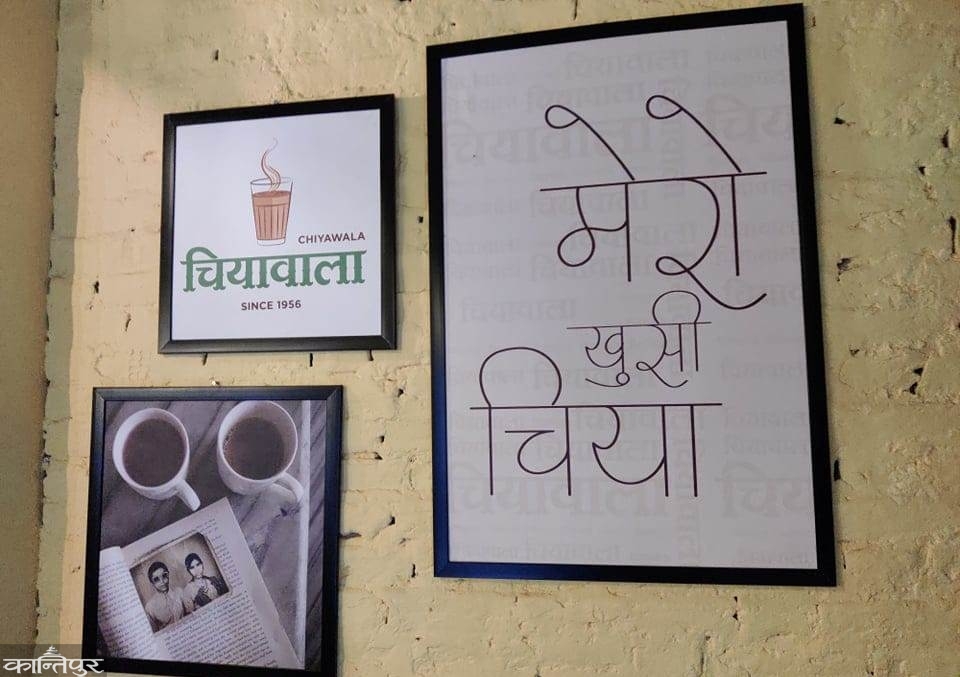
Pravas Gautam, a social history researcher who is studying/researching Kathmandu, has written a long research article titled ‘Tilauri Maila’s Shop: A Case of a ‘Public’ Tea Shop in 1940/1950 Kathmandu’. In his study, it was the Newars from Kathmandu who used to trade in Lhasa who brought Tibetan tea to Kathmandu.
‘They used to drink Tibetan tea. That was the culture in the Himalayan districts that had cultural ties with Tibet. The British first drank the pale tea or milk tea that we drink now. After the Anglo-Nepalese War, the British started living here. They started drinking tea in Nepal along with their lifestyle. It is not known whether Jung Bahadur drank tea or not during his trip to Britain, but he certainly knew about tea. The Rana and Shah dynasties had a tea culture. However, it is not said that all Rana families were taught about it. Before tea culture became widespread in Kathmandu, there was a tea culture in the Terai, more so in the cities bordering India.'
Thus, over long periods of history, a plant from Southeast Asia made a beautiful and meaningful world tour and entered the way of life of people by becoming our 'beloved' tea.
Just as the taste of tea is changing, cities are also changing. Tea culture has also changed in changing cities. After tea entered people's civilization and traditional life, their lifestyle has changed. After tea became a culture of people, it has made the public sphere dynamic. And, gradually, the chain of social history has also changed.