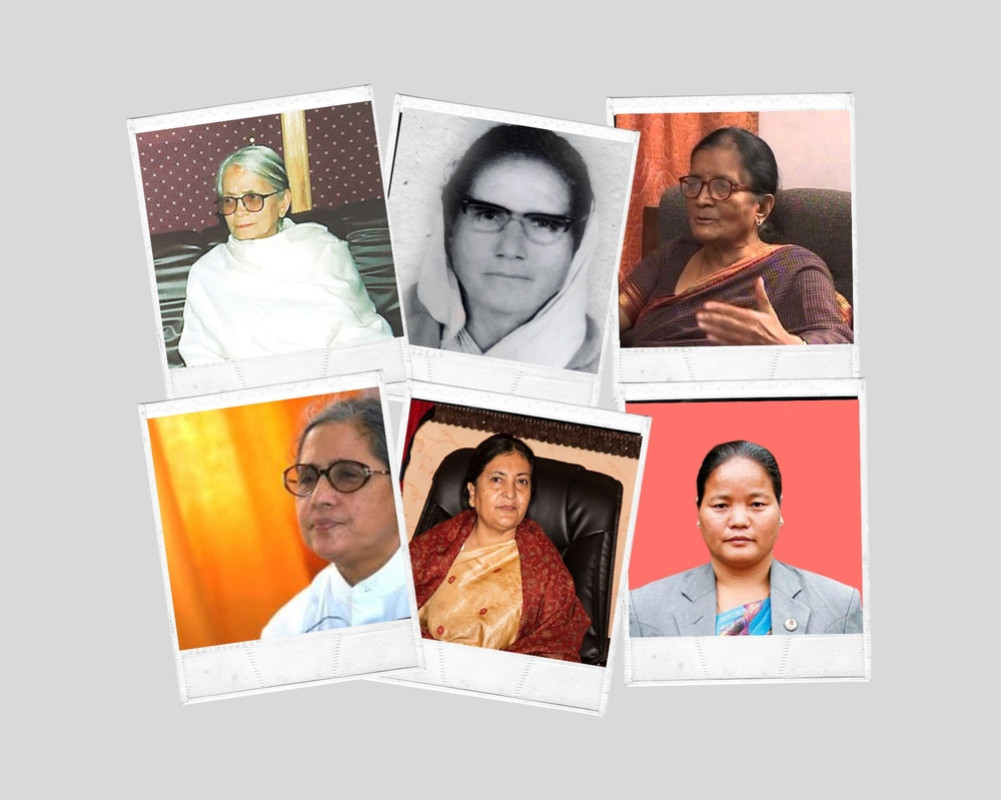
Through continuous struggle, movement and electoral process, Nepali women have established themselves at the center of leadership. Women's participation is becoming crucial in every phase of democracy, democracy and republic.
We use Google Cloud Translation Services. Google requires we provide the following disclaimer relating to use of this service:
This service may contain translations powered by Google. Google disclaims all warranties related to the translations, expressed or implied, including any warranties of accuracy, reliability, and any implied warranties of merchantability, fitness for a particular purpose, and noninfringement.
Nepal's political history has long been male-dominated. But through continuous struggle, movement, and electoral processes, Nepali women have established themselves at the center of leadership. Women's participation has become crucial in every phase of democracy, democracy, and republic.
The women's leadership established through the election has opened the door to inclusion in the political structure and has also taken the women's movement to new heights of success.
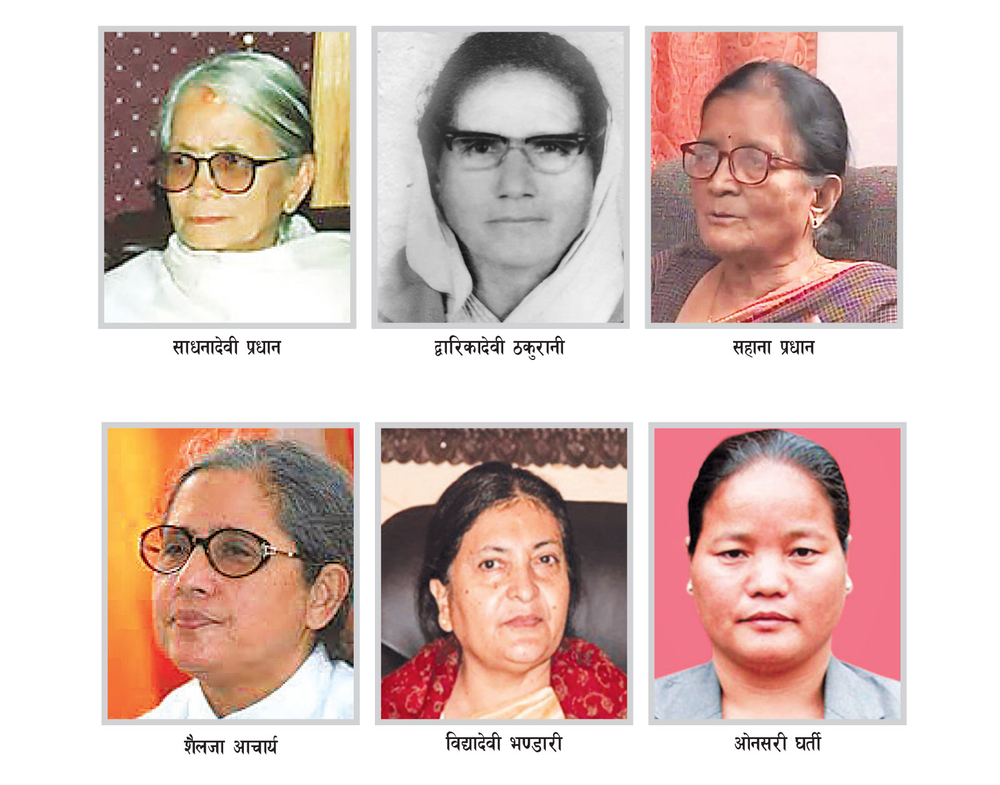
Bidya Devi Bhandari's two terms as the highest constitutional office of the President of Nepal is considered historic for Nepali women. Bhandari, who was elected President for the first time in Kartik 2072 after the proclamation of the constitution, was elected for another term.
She is also the proposer of a special resolution to ensure a minimum of 33 percent female participation at every level of the state, which was presented in the House of Representatives, which was reestablished after the 2062/63 movement. She is the first woman President and has also established herself as a figure who changed social thinking towards women's leadership.
Bhandari's political journey, which emerged from parliamentary politics, began with the by-elections in 2050 BS. In the mid-term elections of 2051 BS and the House of Representatives elections of 2056 BS, she was elected three times consecutively from different constituencies in Kathmandu. Continuous parliamentary practice and experience in party organization led her to the highest constitutional office. After assuming the responsibility of two terms as President, she has been seen active in politics again.
It is believed that the organized political activism of women in Nepal began with the establishment of the 'Nepal Women's Association' in 2004 BS. Mangala Devi Singh is credited with organizing women in the movement against the Rana regime and the expansion of democratic consciousness. As the president of the underground established Women's Association, she made women active in political movements. Her role in the 2007 BS revolution was decisive. In 2017 BS, she was arrested while protesting after the hijacking of the parliamentary system and was forced to spend five years in prison. Even after that, she remained active until the migration, satyagraha, and the people's movement of 2046 BS.
Although the first election was held in 2004, women in Nepal only gained the right to vote and stand as candidates in the Kathmandu Municipality election on 17 Bhadra 2010. In this election, Sadhana Devi Pradhan was elected as a ward member in Kathmandu Municipality. And, she went down in history as the first elected woman representative of Nepal.
The first general election of 2015 took women's political history to another level. Dwarika Devi Thakurani, a candidate from the Nepali Congress, won and became Nepal's first directly elected woman MP. She also became the first woman minister to be included in the Council of Ministers by becoming a deputy minister in BP Koirala's cabinet.
After the implementation of the Panchayat system in 2017, the role of women in the movement against autocracy became even more challenging. During this period, Shailaja Acharya emerged as a strong leader. She led the resistance against monarchy and autocracy by displaying a black flag on the military platform celebrating Democracy Day on Falgun 7, 2017. In the 2048 general election, she was elected as a member of the House of Representatives and became the Minister of Agriculture and Land Conservation .
Ashtalakshmi Shakya is known as a leading female leader in the Nepali communist movement. Shakya, who spent 11 years underground, held all the responsibilities within the CPN-UML, from the organization to the government. She also succeeded in becoming the first female Chief Minister of Nepal. She has created history by becoming the first female Chief Minister of Bagmati Province.
Nanimaiya Dahal is a famous leader of the Panchayat period. After the referendum of 2037, she became a candidate from Kathmandu in the National Panchayat elections held on 27 Baisakh 2038. She was 32 years old when she won the National Panchayat elections.
In 2054, the local election law was changed to make it mandatory for each ward to have at least one female member. More than 40,000 women people's representatives were elected nationwide at once. Politician Binda Pandey has written in the book 'Nepali Mahilarokoro Andolan Ek Satyada' (A Century of the Historical Movement of Nepali Women).
Onsari Gharti of Rolpa became Nepal's first female Speaker in Asoj 2072. Taking over the post of Speaker at the age of 38 is considered a significant achievement in Nepali parliamentary history. Earlier, Congress leader Chitralekha Yadav had served as the acting Speaker in the re-established House of Representatives. Women's participation has increased significantly since the political changes of 2062/63. According to the Parliament Secretariat, 107 women were represented in the 2079 BS elections through direct and proportional representation.