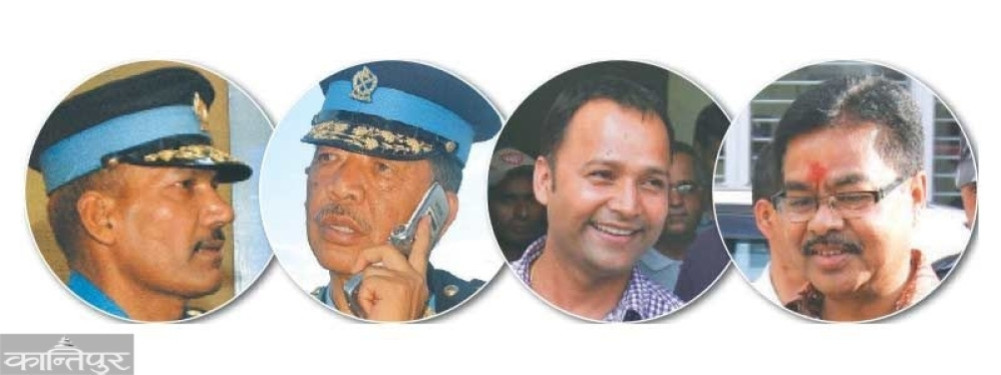
The then Home Ministers Krishna Prasad Sitaula, Vamdev Gautam and Bhim Rawal, the then Secretaries Umesh Prasad Mainali and Govind Kusum were under suspicion but were not dragged into the investigation.
We use Google Cloud Translation Services. Google requires we provide the following disclaimer relating to use of this service:
This service may contain translations powered by Google. Google disclaims all warranties related to the translations, expressed or implied, including any warranties of accuracy, reliability, and any implied warranties of merchantability, fitness for a particular purpose, and noninfringement.
The corruption scandal that has tarnished Nepal's international image is infamous - the 'Sudan scandal'. During the period from 2063 to 2067, the investigation of the corruption case related to the purchase of armored vehicles worth about 29 million rupees for the Nepal Police was kept under pressure and influence.
Because of this, political and administrative people under the guise of power were not dragged into the investigation.
The then three home ministers Krishna Prasad Sitaula, Wamdev Gautam and Bhim Rawal and the then two secretaries Umesh Prasad Mainali and Govind Kusum were seen under suspicion in this scandal related to the purchase of armored vehicles including Thotra 'Armed Personal Carrier' (APC) which were bought at a cost of Rs.
The sub-committee formed by the State System Committee under the Legislative Parliament at that time prepared a report with the suggestion that the political and administrative leadership in the Home Ministry of that period should also be brought under the scope of investigation. The committee sent the report to the Abuse of Authority Investigation Commission. At that time the authority was under the leadership of secretary Bhagwati Kafle as there were no officers. When the case was investigated and reached the court, only the police personnel and the contractor were made defendants and the rest were acquitted.
Girija Prasad Koirala was the prime minister and Sitaula was the home minister and Mainali was the secretary after the 2062/63 mass movement. The Inspector General of Police was Om Vikram Rana. In the guise of Prime Minister Koirala, his daughter Sujata and his son-in-law, a Bangladeshi citizen, Ruvel Chaudhary, were seen as 'behind-the-scenes players' who were self-interested in the purchase. Ruvel is also a suspect linked to illegal 'VoIP call bypass' in Nepal. In this too, he was outside the investigation under the guise of his mother-in-law.
The administrative and political leadership was involved in the game of irregularity by buying old APCs for the Nepal Police. In the same game, the high-ranking officer of the police awarded the contract for the purchase of APC to the British company Assured Risk and its owner, Michael Ryder, by spending money from the police welfare fund and paying in installments. After that, to suit 'political interest', the then Inspector General Om Vikram Rana signed a purchase agreement for four APCs for around 29 million rupees through Shambhu Bharti, a Nepalese citizen who was Michael's local representative. During the Rana's time, the Home Minister was Sitaula and the Home Secretary was Mainali. After Mainali, Kusum became the secretary and after Sitaula, Gautam and Rawal became home ministers respectively. Pushpa Kamal Dahal of Maoist and Madhav Kumar Nepal of UML became Prime Minister respectively.
After Rana, Hem Bahadur Gurung and Rameshchand Thakuri came to the leadership of the police, respectively, installments were paid for the purchase of APC. During the same period, the rusted APC reached Darfur in Sudan. The secret of the scam was revealed when the APC did not run. But the authority focused its investigation only on the level of police and contractors. After the investigation reached its final stage, the then IGP Thakuri was transferred as security adviser to the Prime Minister and AIG Rabindra Pratap Shah was promoted to Inspector General.
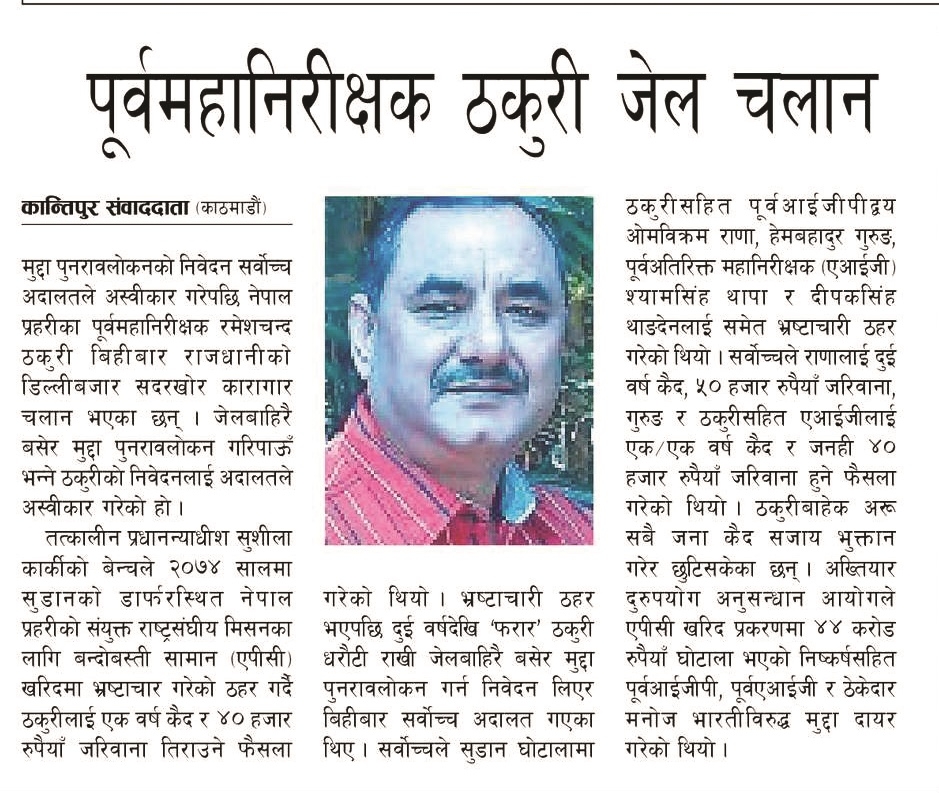
On 24th June 2068, the Authority filed a corruption case against 37 people including three ex-IGP Rana, Gurung and Chand, 34 policemen, 2 contractors and an APC supplier company with a sum of Rs. There was a debate at that time that the authorities had given immunity to the players behind it. Closing the case in about 8 months after the case was filed, on February 1, 2068, the bench of the then chairman Gauri Bahadur Karki and members Omprakash Mishra and Kedar Prasad Chalise found three former IGPs, British contractors and their Nepalese agents guilty and sentenced them to imprisonment and punishment and acquitted the rest of the police.
Special Judge sentenced Rana to two years in prison and a fine of 176 million, Gurung to 2 years in prison and a fine of 648 million 70 thousand and Thakuri to 2 years in prison and a fine of 485 million 44 thousand. Bharti was fined 142.2 million 8000 and sentenced to 1 year in prison for imposing a fine of 280.4 million against the rider for assured risk. Police and agent Bharti went to the Supreme Court against the special verdict and conviction.
On 17 Baisakh 2074, the bench of the then Chief Justice (now Prime Minister) Sushila Karki and Bishwambhar Shrestha (later retired from the Chief Justice) upheld the special verdict in the case of the contractor and ended the case by heavily reducing the imprisonment and fine against the three IGPs. The Supreme Court had sentenced former IGP Rana to a fine of 50,000 and 1 year in prison and in the case of Gurung and Thakuri, the same sentence of 40,000 and 1 year in prison.
After acquitting the then AIG Thapa and Shrestha equally 1 year imprisonment and 40000 fine and SSP Rana 6 months imprisonment and 30000 fine and Bharti's special verdict. After the verdict of the Supreme Court, the convicted police and the contractor have been released after paying their sentences. But the political and administrative persons who are the symbolic characters of this scam of 14 years ago are still outside the scope of investigation.