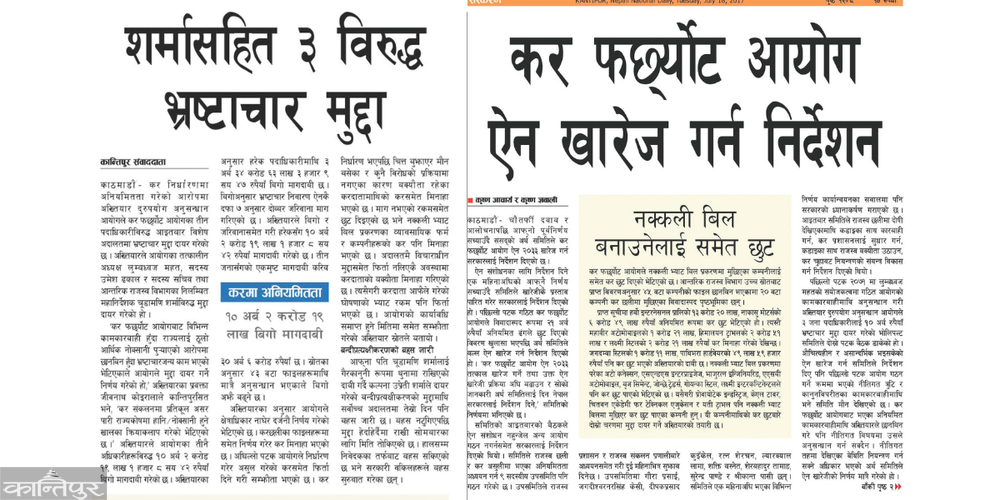
30.52 billion rupees were deducted from the commission for arrears of 40.83 billion rupees, out of which only 9.54 billion rupees came to the state treasury, due to the deduction, about 69 percent of the revenue was lost from the state treasury and only 31 percent was earned.
We use Google Cloud Translation Services. Google requires we provide the following disclaimer relating to use of this service:
This service may contain translations powered by Google. Google disclaims all warranties related to the translations, expressed or implied, including any warranties of accuracy, reliability, and any implied warranties of merchantability, fitness for a particular purpose, and noninfringement.
Among those filed by the Abuse of Authority Investigation Commission, the biggest and most famous tax evasion commission corruption case has not been resolved yet. This case, which reached the Supreme Court from the Commission through the Special Court, has now returned to the Special Court.
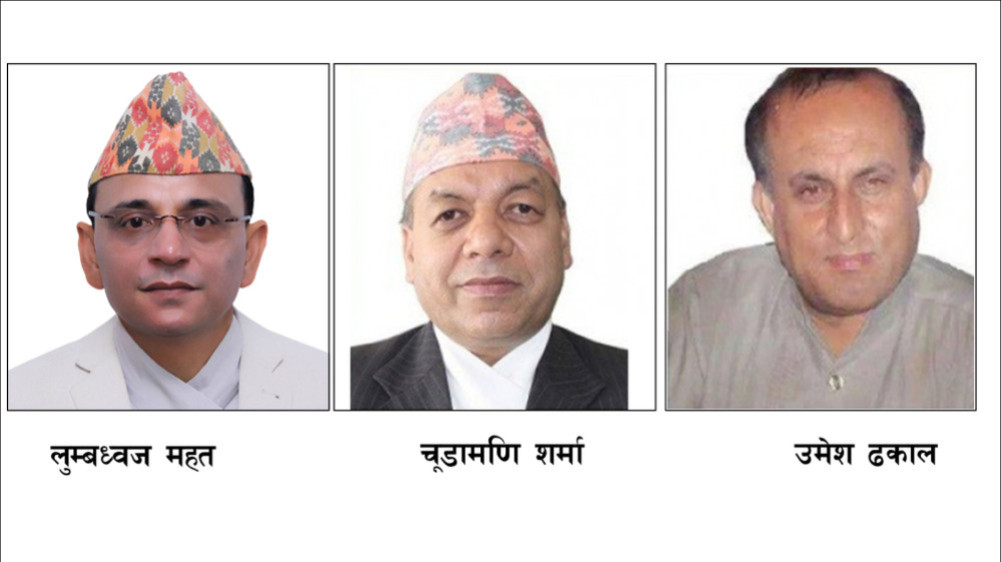
In the case filed by the Authority, on May 14, 2080, the Special Court convicted the then Chairman of the Commission, Lumbhadwaj Mahat, Member Umesh Dhakal and the then Director General of Internal Revenue Department, Chudamani Sharma, who worked as Member Secretary. On May 25, 2080, a special court imposed a fine on them.
in which each was sentenced to nine years in prison with a fine of 2.52 billion bigos and an additional 4.10 billion fines. The convicts appealed to the Supreme Court in July 2082. Along with this, a case of direct detention was also registered. By that time, the authority had also gone to the Supreme Court saying that the fines and fines set by the special court were low. After the verdict of the special court, all three were sent to prison. A year later they were allowed to sit outside and fight the case.
On June 24, the Supreme Court overturned the decision of the special court in the case against the tax evasion commission officials. A bench of Justices Saranga Subedi and Tek Prasad Dhungana overturned the decision of the special court against the commission's chairman Mahat, member Dhakal and director general of the Internal Revenue Department Sharma, who worked in the capacity of member secretary.
Commission officials were sentenced to 9 years in prison. Mahat, the chairman of the commission, was sentenced to one more month in prison. Dissatisfied with the decision, the Abuse of Authority Investigation Commission went to the Supreme Court. With the decision of the Supreme Court, the officials of the commission have been acquitted. However, depending on the action taken by the special court, it will be decided whether they will be punished or not.
This was the issue
In the year 2071, then Finance Minister Ram Sharan Mahat formed the Tax Evasion Commission. Chartered Accountant Dhakal was a member and then Director General of Internal Revenue Department Sharma was Member Secretary in the commission formed under the coordination of Lumbhadwaj Mahat, who is also a Chartered Accountant. Director General Sharma himself worked as a member secretary while there was a legal arrangement to be the joint secretary appointed by the director general of the internal revenue department. The Commission was empowered to clear tax arrears up to the financial year 2069/70. Out of 1,726 petitions received in the
commission, 1,069 petitions were acted upon and an agreement was reached. Of the 40 billion 83 billion rupees arrears filed, 30 billion 52 billion rupees were amortized. Of that, only 9 billion 54 crore rupees came to the state treasury. About 69 percent of the revenue was lost from the state exchequer and only 31 percent of the revenue was generated due to the sale.
This confirms that officials of the Tax Evasion Commission are involved in serious financial irregularities. The commission formed in the name of tax evasion has been found to have committed "irregularities" of around 21 billion rupees. The officials of the commission have decided to collect only 9.54 billion rupees out of 30.52 billion rupees.
Tax evasion Commission's brahmaloot
Revenue that should have been collected by the government but not yet due is considered to be arrears. Officials of the commission, which was formed in principle to collect maximum 'dues' and give only nominal discounts, gave more than 90 percent discount to private companies and collected nominal dues. If the tax payer does not pay the tax on time, the arrears remain for a long time. The tax settlement commission is formed with the aim of collecting the taxes fixed by the state rather than the arrears of years. It was for this purpose that the Tax Exemption Commission was formed under the auspices of Mahat. But the commission was found to have given some symbolic concessions and agreed to levy a large amount of tax. An investigation was started against the commission itself, calling it a big robbery of the state treasury.
While it is considered natural to have arrears when a tax dispute is ongoing in the administrative review, revenue tribunal or court by questioning the assessment of tax, it is negligent to not collect tax by the taxpayer without any reason. It was confirmed that the officials of the commission themselves have ignored the fact that they should be strict in order to collect revenue of that nature.
After that, an investigation was started on the serious charge of ``VAT minaha'' of Rs. The officials of the commission exempted the businessmen who did not register with the state treasury after taking the amount of VAT paid by the government and service recipients in various constructions. How serious is this situation if a consumer who buys a garment worth 100 rupees has paid 13 rupees as VAT to the trader. The officials of the commission waived the same 13 percent VAT that the traders pocketed for filing with the state treasury. Revenue administration experts say that such chaos in revenue administration is unimaginable.
21 billion 'loot' for tax evasion
But the officials of the commission said that due to the nominal tax imposed on some businessmen, the government has to return the money to them. Officials of the Tax Evasion Commission argued that the commissions did justice to businessmen when tax administrators were arbitrarily assessed. The then chairman of the commission, Mahat, opined that the tax payers, who were in trouble due to the erroneous decision of the staff, got relief.
Dhakal, the then member of the commission, opined that concessions were given by the commission due to unreasonable tax assessment by the tax administrators. Member Secretary of the Commission and Director General of Internal Revenue Department Chudamani Sharma claimed that the Commission did not do any controversial work. The Public Accounts Committee of the Parliament decided to investigate the 21 billion tax evasion.
In June 2078, the Abuse of Authority Investigation Commission filed a corruption case of more than one billion against officials of the Tax Evasion Commission including Chudamani Sharma. The Commission filed a case in a special court with a corruption fine of 1 billion 33 lakh 20 thousand 385 rupees. In which a case was filed against Commission Chairman Lumbhadwaj Mahat and two members Umesh Prasad Dhakal along with Sharma. Sharma was Director General of Internal Revenue Department at that time.
The Government of Nepal has formed a committee to conduct tax evasion in accordance with the notified order published in the Nepal Gazette on 22nd January 2071 and the Tax Evasion Commission Act, 2033. The committee investigated the corruption by going outside the jurisdiction and fraudulently entering into tax avoidance agreements with the taxpayers and leaking a large amount of revenue to the Government of Nepal. According to the
commission, during the investigation, it was confirmed that the officials of the tax rebate commission had agreed to give tax rebates based on mutual discussions and arbitrarily given one billion 33 lakh 20 thousand 385 rupees in arrears.
The commission has found that the defendants who are the officials of the commission have acted in bad faith by harming the state and not performing their duties with good intentions in accordance with Section 17 of the Tax Fraud Commission Act, 2033.
What is the Tax Fraud Commission?
The Tax Fraction Commission is a judicial body formed to resolve tax-related problems or disputes. Various types of disputes arise between the revenue administration and the taxpayer regarding tax assessment and the taxpayer applies to administrative review, revenue tribunal, Supreme Court and other judicial bodies for their resolution. Thus, the seriousness of the issue of tax arrears, abnormal and unusual tax assessment cannot be addressed with only concessions and facilities, so the state forms a tax relief commission from time to time.
It seems that a total of 12 tax avoidance commissions have been formed after the Tax Evasion Commission Act 2033. According to this, the government, by the decision of 22 January 2071, published a notice in the gazette and established the Tax Evasion Commission. There was a dispute in the execution of the work done by the Commission and 21 billion was embezzled. However, the case has returned to the special court.