According to the 2020 report of ”The Vegan Society”, the global vegetarian population has exceeded 79 million. It has also been described as the green wave of human civilization.
We use Google Cloud Translation Services. Google requires we provide the following disclaimer relating to use of this service:
This service may contain translations powered by Google. Google disclaims all warranties related to the translations, expressed or implied, including any warranties of accuracy, reliability, and any implied warranties of merchantability, fitness for a particular purpose, and noninfringement.
Westerners often use a phrase to say that you should not take more trouble than necessary to do what you like - don't buy a restaurant just because you like the food. Usually people don't even think about going against this proverb. Because, no one is always ready to take more trouble for a little pleasure.
However, Kalyan Silwal of Lalitpur Lele turned out to be the exact opposite in this matter. As the saying goes, he bought the restaurant after he liked the food! If you go to 'Vegan House' in Jhamsikhel, you can order Silwal's favorite food and eat there. Thus, there is a funny story about how he ran a vegan restaurant for three years.
Silwal, who was once an "omnivorous" who eats fish, meat, curd and milk, reached a point in his life and became a vegan, that is, a person who does not eat anything that comes from animals. During the lockdown, he used to feed dogs and calves on the streets. It may be because of his regular habit of feeding Dholahiti's cattle by sitting in Sunakoti, when passing by Dholahiti, the cattle started to look at him as if they knew him and when he got close, they fell in love with him.
'Animals have so much understanding, now I thought that I should not eat anything that has been taken out by causing them suffering' Silwal says, 'That's why I became a vegan.' He used to regularly go and eat at the recently opened vegan restaurant 'Siya' in Tintak Jhamsikhel.
Fish-meat and curd-milk were not available, so there were not many customers. Since it was not possible to continue running at a loss, Siya's owner Niru Gurung decided to either sell it or close it down. After knowing this, Silwal was surrounded by doubts that even a single vegan restaurant in Lalitpur would be closed. And Silwal himself bought it. And by changing the name and some decorations, he has been running a vegan restaurant.
Silwal, a tourism businessman by profession, can't live by taking care of restaurants all the time. So he made Archana Bhurtel, an animal welfare activist who loves animals and feeds street dogs morning and night, a business partner. Now there is no obstacle for Kalyan to confidently run a restaurant and take time to go for a walk.
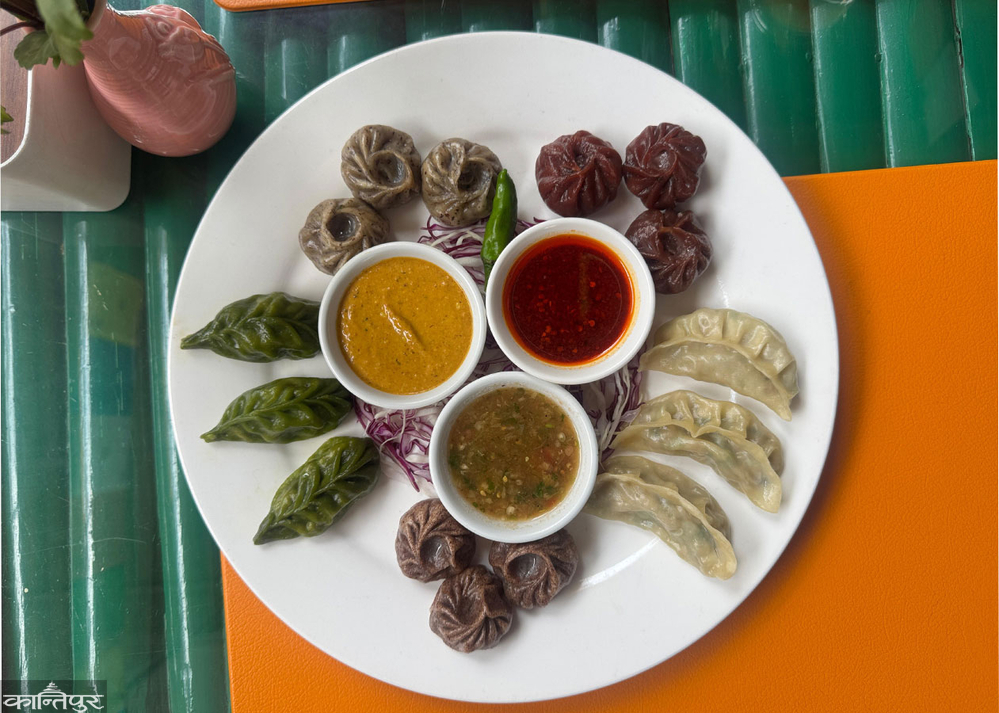
because the vegan house is overseen and operated by Bhurtel, where at the beginning, the customers turn their noses up when they don't see the dishes they like on the menu, but later, they raise their eyebrows in surprise when they taste everything from seitan (vegan meat) and vis (vegan fish) to vegan curd and milk.
"In the beginning, the customers were worried about what to eat here, not only fish-meat and curd-milk, but also ghee and honey," says Silwal, "but, after tasting the food, they expressed their happiness about how delicious it was." After the number of happy customers increased and they started coming regularly, now Vegan House has reached the point of 'break even' (business that raises investment).
``It's great to see people eating contentedly,'' Silwal and Bhurtel both have the same experience, ``Seeing them believe that you can eat desserts without fish-meat and yogurt-milk, it feels like your efforts to spread the vegan lifestyle have been successful.'' The practice of eating 'diet', which means pure vegetarian food, has increased, which is considered as veganism, which means not eating food derived from animals. Vegans eat seitan (a dish that looks and tastes like meat made from sprouted legumes) if they want to eat meat.
When they crave milk, they extract coconut, soybean or local almond milk and eat it, and if necessary, they also make kheer from it. Due to such speculative facilities, the number of people who eat vegan food and later become purely vegan has experienced the well-being.
It was a completely different time when the vegan lifestyle, which is now spreading so rapidly in Western society, began. At that time, vegan was an unheard of word for people, much less its meaning. Samu Yonjan, the owner of Nepal's first vegan restaurant 'Lobbing Heart', had a hard time explaining this to people two decades ago. Over the years, many times customers have left his restaurant table without eating anything.
They wanted to smoke. Yojana used to fold her hands and say - 'Sir, this is not sold here.' Even meat and cigarettes, she also folded her hands and said 'No'. When those who looked calm, asked, 'You can't even eat curd, milk and ghee?' What kind of restaurant has this person opened to serve food? Samu, on the other hand, was busy reminding her about what vegan food is and what is available here.
No one needs to remind anyone that people who do not eat fish and meat but eat curd and milk are called vegetarians. Some people even consider fish and eggs as vegetarian food. However, Samu realized that there is a situation where everyone should understand that not eating any animal products is 'pure vegetarianism' when she opened a chamena house named Mayalu Hriday, which is 'lobbying heart' as 'pure vegetarian'.
Samu stopped eating any food that is cruelly prepared by causing suffering to animals and decided to open a restaurant by herself after not being able to go out to eat. Then she opened a vegan restaurant, which is considered pure vegetarian in Buddhist terms, because it is a place where many devotees come. Since the Nepalese did not understand much, she made the restaurant a place for tourists to see if the whites would understand. In Thamel, customers did not suffer during the season.
The core philosophy of the vegan lifestyle is cruelty-free food. Vegans do not eat animals because of the violence and cruelty involved in killing animals for meat or suffering milking, honey extraction or egg extraction. They do not prefer to include animals in their diet as fruits, grains and vegetables provide enough nutrition and make many dishes. Vegans have grown all over the world in the last decade.
According to the 2020 report of 'The Vegan Society', the global vegetarian population has exceeded 79 million. It has also been described as the green wave of human civilization. Human compassion is running out, people who are getting angry have also increased with the awareness that animals should not be involved in food even for their own health .

