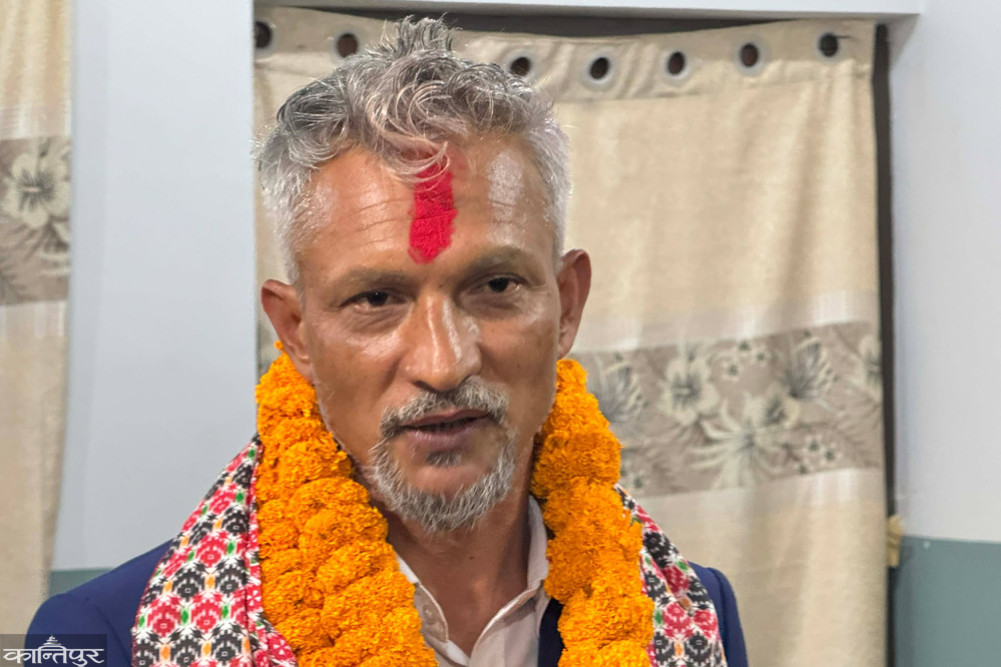
Uttam Prasad Poudel of the Rashtriya Swayamsevak Sangh (RSS) has made a leap from Kaski-2, considered a stronghold of the UML, to politics after leaving the media.
We use Google Cloud Translation Services. Google requires we provide the following disclaimer relating to use of this service:
This service may contain translations powered by Google. Google disclaims all warranties related to the translations, expressed or implied, including any warranties of accuracy, reliability, and any implied warranties of merchantability, fitness for a particular purpose, and noninfringement.
History has changed this time in Kaski Constituency No. 2, which has been known as the impregnable fortress of UML for decades. Former media personality Uttam Prasad Poudel from the National Independent Party (NISP) not only defeated his closest competitor, the vote share he brought has forced the old political forces to do serious self-examination.
Out of the total 52,519 votes cast, Poudel received 31,911 votes, which is 60 percent of the total votes cast. His closest competitor Rashmi Acharya of UML received 7,493 votes. Poudel has made his way to parliament with four times more votes than Acharya.
Such a one-sided victory, which is rare in Nepal's electoral history, sent a clear message that the storm of the NISP has arrived in Kaski. 52,519 votes were cast in this constituency, which has 84,134 registered voters. Out of the votes cast, 1,844 were invalid, leaving Poudel's victory one-sided. In this constituency, where 17 candidates, including 12 parties and 5 independents, are in the fray, Madhav Prasad Bastola of the Nepali Congress received 6,500 votes, Hemjung Gurung of the RPP received 1,643 votes, Hem Bahadur Thapa of the NCP received 1,276 votes, and Kushal Gurung of the Ujjain Nepal Party received 1,201 votes. Poudel alone received more votes than all the candidates of all the established parties combined. The surge in support of Poudel in this constituency, which is considered a stronghold of the UML, clearly reflects the citizens' disillusionment with the working style of the old parties.
The story of Uttam Prasad Poudel, 44, a native of Deurali in Rupa Rural Municipality of Kaski, enters politics from the foundation of journalism. After working at Machhapuchhre FM, Pokhara FM, and Sunaulo FM, he joined television journalism. As the Gandaki bureau chief of the 'News 24' television program 'Sidha Kura Janata Sanga', he saw the anomalies, corruption and injustices of society from close quarters through the eyes of the camera. After Ravi Lamichhane left television and entered politics, Poudel also followed him and supported the RSVP campaign.
Poudel had been publicly defending Lamichhane against various cases filed against him. 'I had raised my voice against injustices through journalism, now I will go to Parliament and start making laws to solve those problems,' he said after his victory.
The election journey was not easy for him at first. Considered a confidant of RSVP President Ravi Lamichhane, there was a whirlwind of dissatisfaction within the party after he got the ticket. The presidents of 11 wards of Pokhara metropolis had submitted a memorandum to the party expressing their disagreement with his candidacy. When Poudel, who passed the 12th standard, was accused of ‘getting a ticket based on access’, he gave an answer from the election field. ‘This result has shown that citizens were looking for change after the Gen-G movement,’ he said while reacting after the victory.
Politics was not a new topic for him. His father Chiranjivi Prasad Upadhyay was the former chairman of Rupa Village Panchayat in Kaski and was an active figure in social and educational development. His mother had filed her candidacy from Kaski Constituency No. 2 from the Rashtriya Janata Parishad in the 2051 BS mid-term elections. Due to the political and social environment at home, he had become aware of public service from a young age.
His victory is a reflection of the Nepali political landscape that has changed after the Gen-G movement. The trend of young voters rejecting the faces of traditional parties and choosing new faces was clearly seen in Kaski in this election. He has made good governance, the rule of law and the creation of a corruption-free society his main agenda. His election agenda was that the state should invest specifically for radical changes in the education and health sectors. Immediately after winning, Poudel explained his victory as a beautiful aspect of the democratic system. He said, ‘In this complex situation, I will work according to the mandate given by the Gen-G movement and this election. I am committed to spending the next 5 years in favor of the common Nepali citizen and Nepal.’
Poudel, who has made good governance and the creation of a corruption-free society his main agenda, will now face a test on the rostrum of Parliament, where he will have to find answers to the questions he raised as a journalist through policy formulation.