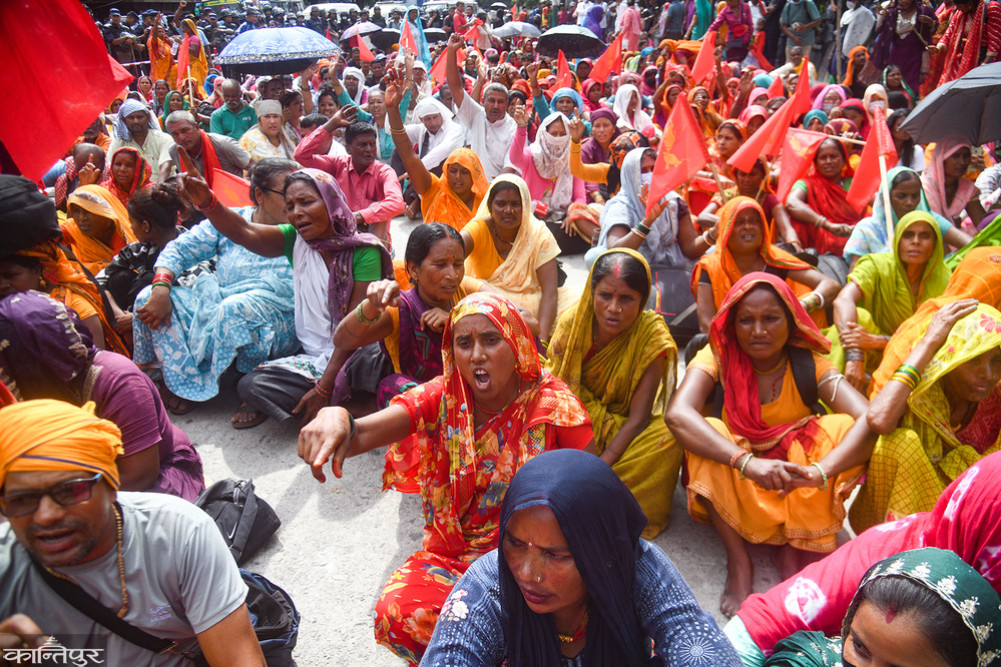
Despite paying installments for years, microfinance victims from across the country have arrived in Kathmandu demanding justice, complaining that their loans have not decreased, they have lost their farmland, and have been displaced.
We use Google Cloud Translation Services. Google requires we provide the following disclaimer relating to use of this service:
This service may contain translations powered by Google. Google disclaims all warranties related to the translations, expressed or implied, including any warranties of accuracy, reliability, and any implied warranties of merchantability, fitness for a particular purpose, and noninfringement.
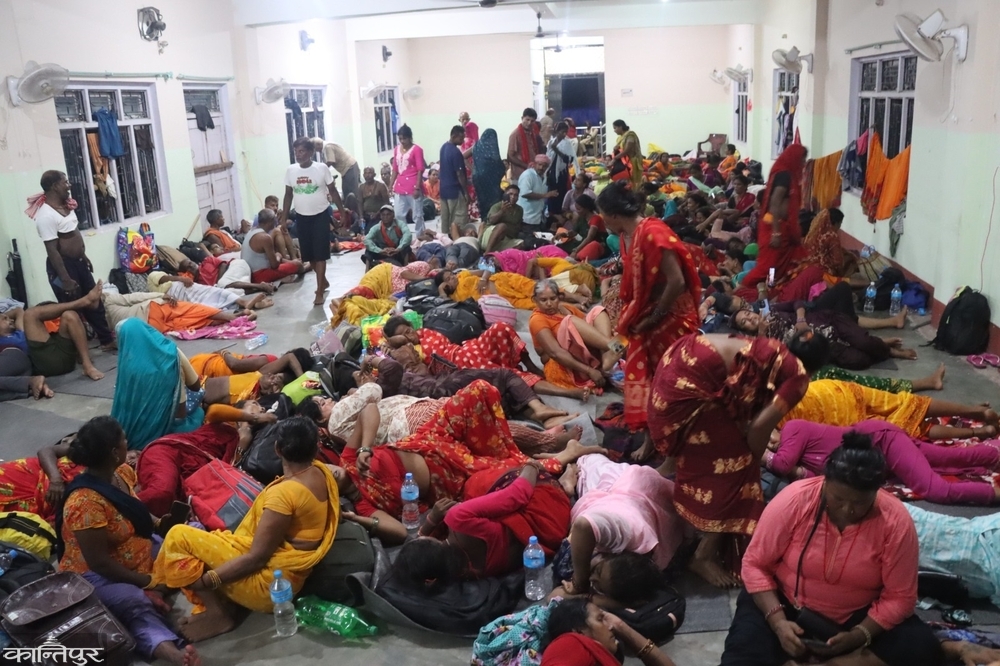
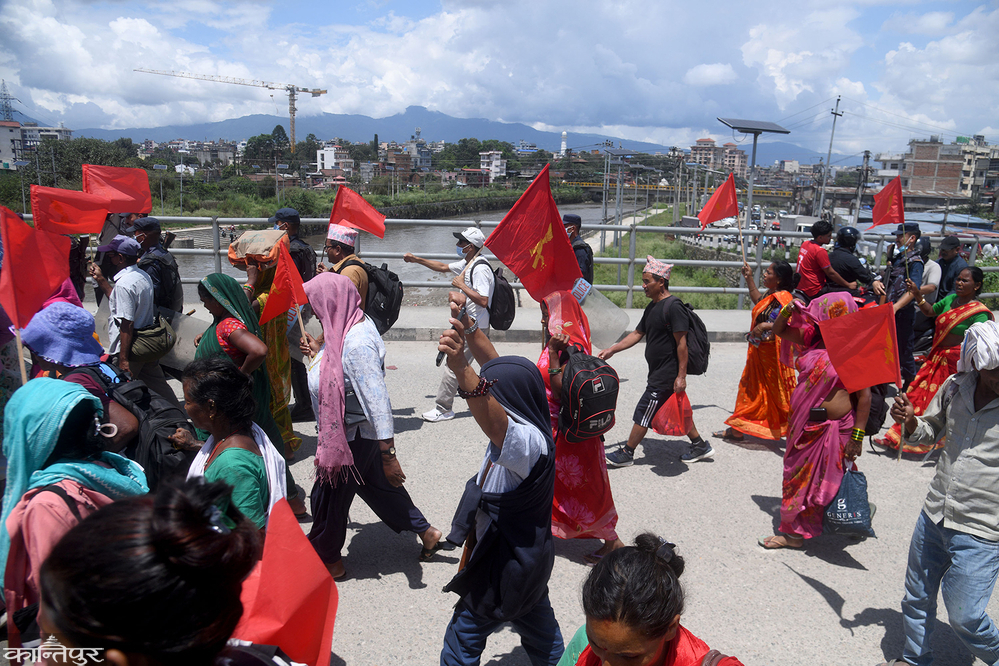
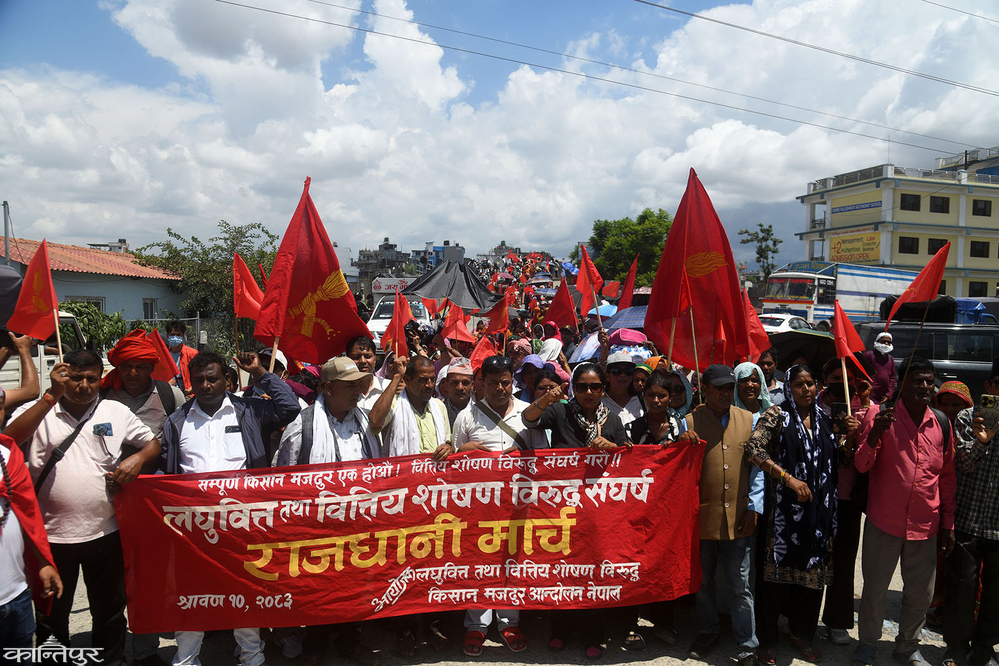
The long line of microfinance victims was holding a corner assembly on the road at Shantibatika in Ratnapark, Kathmandu, under the blazing sun on Sunday. Victims from across the country, from east to west, had arrived in Kathmandu on Saturday night, pleading for justice. “We spent the whole night inside the vehicle. So far, we have been surviving on bhujiya,” said Rabida Khatun, who looked restless at Shantibatika, showing a packet of bhujiya. “If we can get justice by staying hungry for a few days, we are even ready to go without water.”
They had reached Shantibatika on foot from Balkhu at 1 p.m. on Sunday to participate in the program organized by the Farmers and Workers Movement Against Microfinance and Financial Exploitation, Nepal. “We had planned to hold the corner assembly near Bhadrakali, but for various reasons, we couldn’t move forward,” said Laxmi Ghimire, an activist against microfinance exploitation, during the corner assembly at Shantibatika.
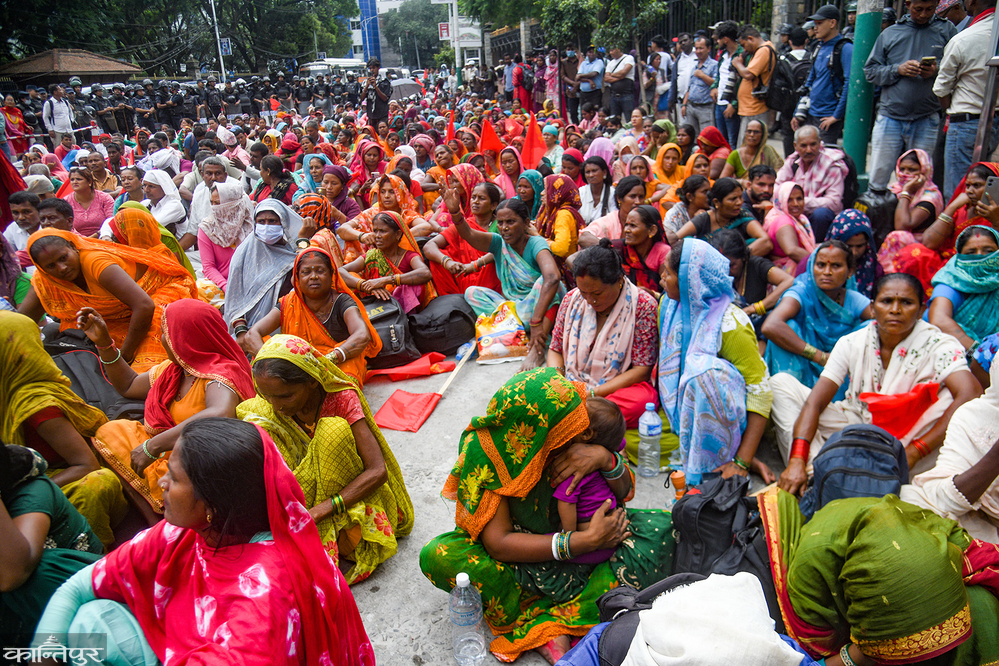
For 37-year-old Reenadevi Mandal of Dhanusha, one thing has been troubling her for years—debt. Even after paying off the principal and interest, her family has not been able to free itself from the financial web of microfinance. “Four years ago, I took a loan of 400,000 rupees from a microfinance institution by mortgaging property for my daughter’s wedding. At first, I regularly paid monthly installments of 15,000 to 20,000 rupees. Suddenly, my husband, who was abroad, had an accident,” she said. “After he lost his job, he couldn’t send money. Then, letters with increasing pressure from the cooperative started arriving.”
One day, she checked the remaining amount to be paid. It turned out to be more than the original loan. “Even after paying so much, the microfinance institution now shows that I still owe 470,000 rupees. They have already deducted the 80,000 rupees I had in savings. Now the bank has sent a letter saying it will auction my land,” she said.
Seventy-year-old Dohara Khatun of Mahottari, sitting cross-legged on the street, took out a bundle of letters from her bag—warnings sent by the microfinance institution—and showed them, saying, “Microfinance has ruined us.” She did not fully understand Nepali. In Maithili, with tears in her eyes, she began to recount the injustice microfinance had inflicted on her family.
Her family had 12 kattha of land. To build a house and for her daughter’s wedding and other needs, they initially mortgaged land and took a loan of 600,000 rupees from a moneylender and microfinance institution. “Because of the meter interest and compound interest, we could never escape,” she said.
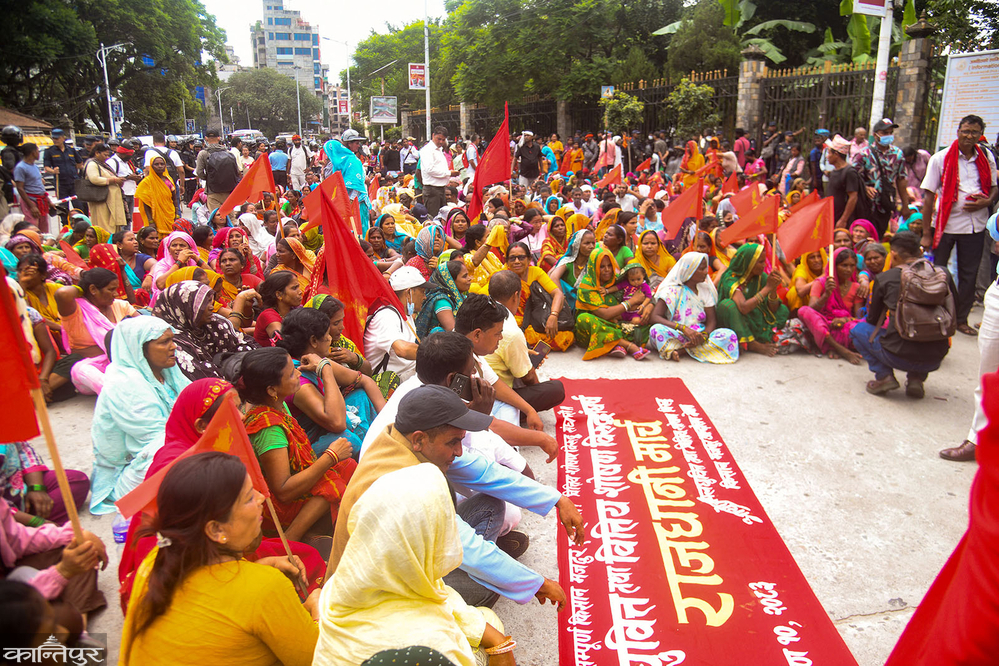
The loan that started at 600,000 rupees was increased to 1.1 million rupees through paperwork. Unable to repay the loan, they lost all 12 kattha of land forever. “We were evicted from our home. Now we have neither a house nor land. Because of fear and stress from the debt, my sons had to flee. One of my sons is now being treated at a hospital in Kathmandu, and we don’t even have money for his medicine,” she said. She added that the moneylenders are now threatening to take their lives if they don’t pay. As a result, she said, they spend every night in fear.
Rabida Khatun of Sarlahi also took out letters from the cooperative from her bag and showed them. Five years ago, due to family problems, she had taken a loan of 600,000 rupees from a cooperative in Lalbandi. “The interest and installments were so high that I paid 25,000 rupees every month for a year. But no matter how much I paid, it was never enough; instead, the amount kept increasing,” she said.
The story of Mukima Khatun of Malangwa-4, Sarlahi, is similar.
Her family also fell into the trap of loans taken to build a house and meet household needs. Four years ago, she took a loan of 1.5 million rupees from a moneylender and transferred her land into the moneylender’s name. “That amount increased to 5.5 million rupees. But the land was never returned,” she said. To pay the moneylender, she took loans from four cooperatives. But even after paying those, it was never enough. “Even my son who went abroad sent a lot of money. Now, if we don’t pay, we get threats that they will bring my son back from abroad and never let him go again,” she said.
During the corner assembly, the blazing sun was suddenly interrupted by rain. Some victims started using umbrellas, while others looked for shelter. However, the police did not allow them to continue their protest. “We are not allowed to stay here at Shantibatika now; they are on the footpath here. When we talked to the Home Secretary and the CDO, they just pointed fingers at each other and avoided responsibility,” said activist Ghimire.
Even though the country has adopted federalism, many citizens have not been able to access even basic banking services because the financial system has not been reformed accordingly, says economist and former Executive Director of Nepal Rastra Bank, Nar Bahadur Thapa. In the past, there were development banks and finance companies in each district and region across the country. They provided financial services to small and medium-sized entrepreneurs or borrowers. After Nepal Rastra Bank reduced the number of development banks and finance companies, the citizens who were being served by them were left out of financial access. In the past, microfinance and cooperatives had fulfilled the financial needs of many citizens. After malpractices increased, Nepal Rastra Bank tightened regulations on microfinance. Problems also arose in the cooperative sector.
Thapa says that because commercial banks and microfinance institutions have not been able to cover the “missing middle,” a large number of citizens have had to rely on moneylenders or traditional lenders for financial services. “If, like the three tiers of federalism, the financial system had also envisioned provincial and local-level banks and financial institutions, citizens in those areas would have received effective financial services,” he said. “To bring the currently excluded groups into the financial system, it is essential to reform the current financial structure.”
In December 2022, Nepal Rastra Bank’s “Financial Literacy Baseline Survey” showed that nearly 72 percent of the adult population in the country had to rely on moneylenders, family, or friends for savings or loans. While the government claims that financial literacy has increased and financial access has expanded, the survey report showed that the majority of the adult population did not have access to the formal banking system. By then, branches of commercial banks had reached all 752 local levels, and now every municipality has a branch.
Although the government’s goal is to expand banking services nationwide to end the compulsion for citizens to take high-interest loans from moneylenders, the survey pointed out that the reality of financial access is still very weak. The survey also showed that about 45 percent of people use savings and loans through collective groups (informal groups). “Even now, a large number (45.54 percent) of people are using collective savings and loans,” the survey report stated. The report showed that overall national financial literacy among Nepalis is 57.9 percent. Experts say this situation has not improved much even now.