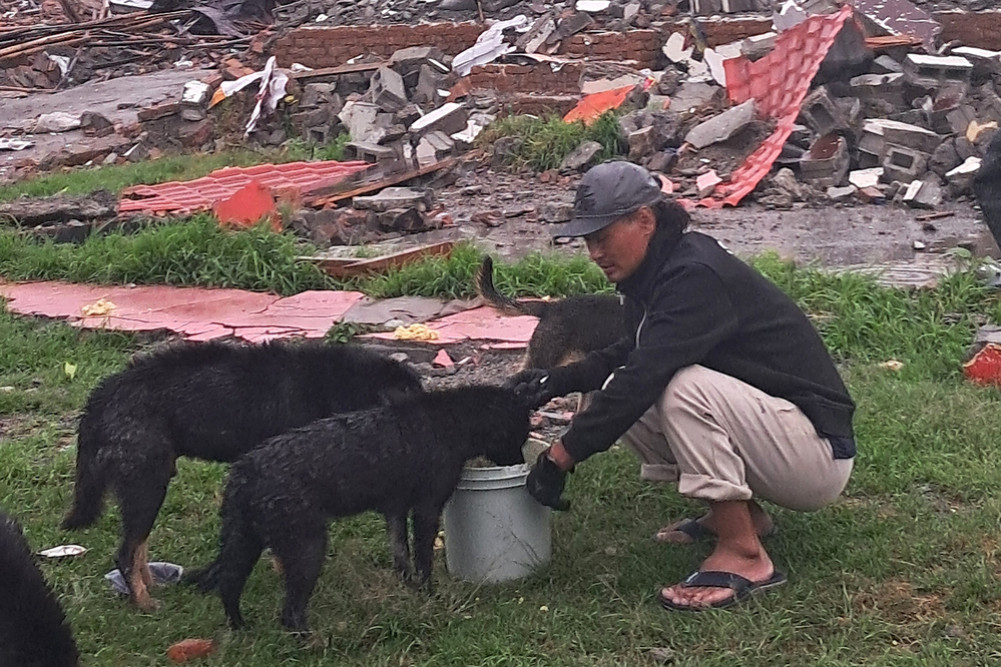
Hundreds of families were displaced when riverside settlements in the Kathmandu Valley were demolished. The government made some arrangements for them - food, temporary shelter, and assurances of rehabilitation. However, rescuing the animals in the settlements was not part of the government's plan.
We use Google Cloud Translation Services. Google requires we provide the following disclaimer relating to use of this service:
This service may contain translations powered by Google. Google disclaims all warranties related to the translations, expressed or implied, including any warranties of accuracy, reliability, and any implied warranties of merchantability, fitness for a particular purpose, and noninfringement.
It had been raining on and off along the banks of the Balkhu River all day. Where there had been houses a few days ago, only collapsed walls, scattered rubble, and empty land were left. Ganesh Shrestha and Rajiv Rai got out of the Snehaj Care van and started clapping.
'Fuchche, Khaire, Govinde, Seti - come on,' they called, 'Come on, kids.'
Behind the rubble, dogs started barking under the zinc sheeting on the bank of the river. Some came running, jumped, and pretended to recognize them. Ganesh and Rajiv had been reaching there every day since the bulldozers were deployed to clear the slums. However, some dogs stood at a distance. Some started barking at the van. Earlier, they had seen the same van when they came to get vaccinated on behalf of the Kathmandu Metropolitan City. They still had that memory.
Ganesh, who has been working at Snehaj Care for eight years, knew which animals would come and which would not. He even remembered the names of the animals that had lived with the settlers for years and had named them. They kept separate food for the dogs that were scared and moved away. 'They would eat only when they felt safe after they knew we were gone,' he said.
Since April 12, the government has been running a campaign to remove riverside settlements in Thapathali, Balkhu, Balaju, Manohara, Gairigaun and Shankhamul in Kathmandu. 'Unorganized settlements' along the river banks of the valley are being removed, displacing hundreds of families. The government has made some arrangements for the people - food, temporary shelter and assurances of rehabilitation. However, rescuing the animals was not part of the government's plan.
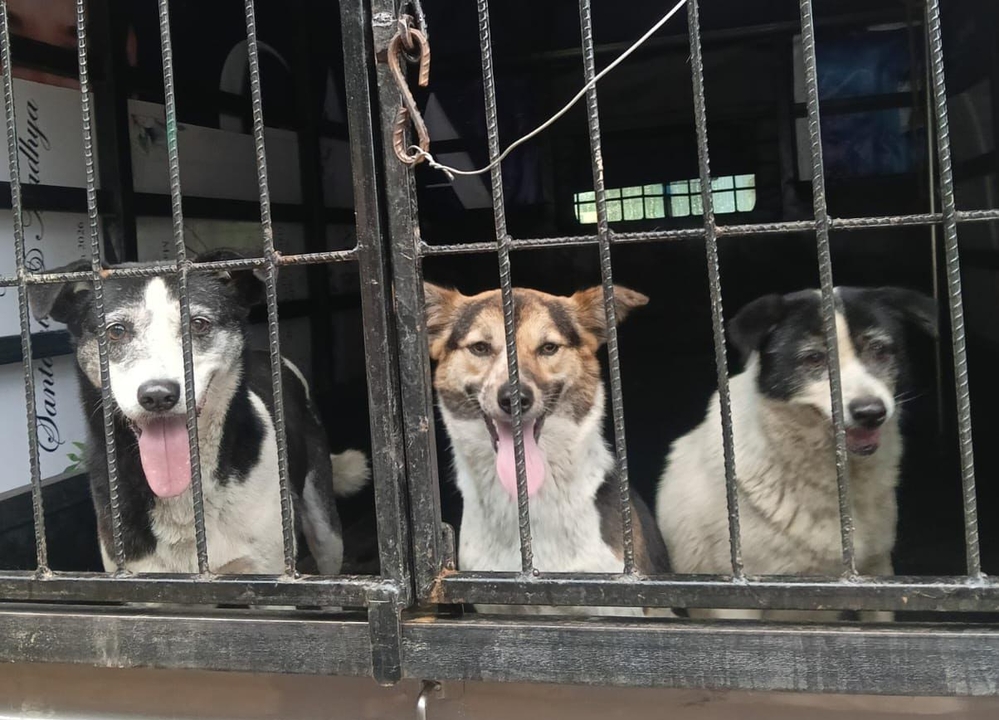
Two organizations named Snehaj's Care and Animal Nepal are struggling to care for animals. They are feeding hundreds of animals every day. They are rescuing injured and abandoned animals and sheltering animals whose owners have been forced to abandon them. However, both organizations are working within their own limited capacity without government support. They themselves are not sure how long they can sustain this work.
Although these two organizations have rescued dozens of animals and taken them to shelters, more than 350 animals are still stranded in the rubble. These organizations can feed them, but they are not able to provide shelter. When asked about the displaced animals, Kathmandu Metropolitan City spokesperson Naveen Manandhar replied bluntly - 'There are no such animals. The government has no plan for them, and no one is making a plan.'
000
Lal Bikram Prasai was one of the brave men who did not want to return the stray dog to the streets. He had never planned to adopt a dog. His neighbor had a dog - Rocky. The neighbor was leaving him when he went to the UK. Prasai, who lived in Devinagar Basti, Baneshwor, Kathmandu Metropolitan City-10, did not want to let Rocky reach the streets. This was about 10-11 years ago. Rocky is now 17 years old. He has become completely blind and the wound in his ear after the surgery has not healed.
On the evening of 13th of Baisakh, Prasai received information from the metropolis that his house would be demolished the next day. He had only 24 hours. 'Where will we go in 24 hours?' he asked.
Prasai has a health problem that makes it difficult for him to walk . His wife is also sick . They kept their belongings with friends and moved into a small room at their in-laws . The two of them could barely fit there . They have a small grocery store in Baneshwor, so they are forced to live nearby . The sick wife also cannot walk long distances . They are still looking for a room .
Prasai was carrying Rocky in his arms when he brought him to the Animal Nepal treatment center . Rocky was scared, trembling . Prasai's eyes were teary .
'I love him very much . But, it has come to such a situation that now I can't do anything for him,' he said .
Even after that, he keeps going to meet Rocky . But he has not even thought about taking her back home. 'Housewives in Kathmandu do not give rooms to people with dogs,' he said. Keeping a blind or elderly dog is even more difficult.'
Prasai's situation is not unusual. Displaced families across the valley are faced with the same difficult choice - finding a room or keeping an animal.
000
Sneha's Care and Animal Nepal were not given formal information before the eviction campaign began. When the dozers first started in Thapathali, they received the news from locals, not from government agencies. The circular from the Prime Minister's Office and the Animal Services Department arrived in Balkhu just a day before the eviction.
'But, the circular is not a plan,' says Radha Gurung, Animal Nepal's program head.
Since then, both organizations have been visiting eight locations daily. Snehaj's Care is feeding around 250 to 300 dogs daily. Animal Nepal is also running a systematic rescue campaign along with food distribution with the help of local volunteer networks. So far, Animal Nepal has rescued 29 dogs, 11 cats, 2 chickens, 16 chicks and 1 rabbit. The largest number has been rescued from Thapathali. Snehaj's Care has rescued 19 dogs and 2 cats separately. Their number is still increasing.
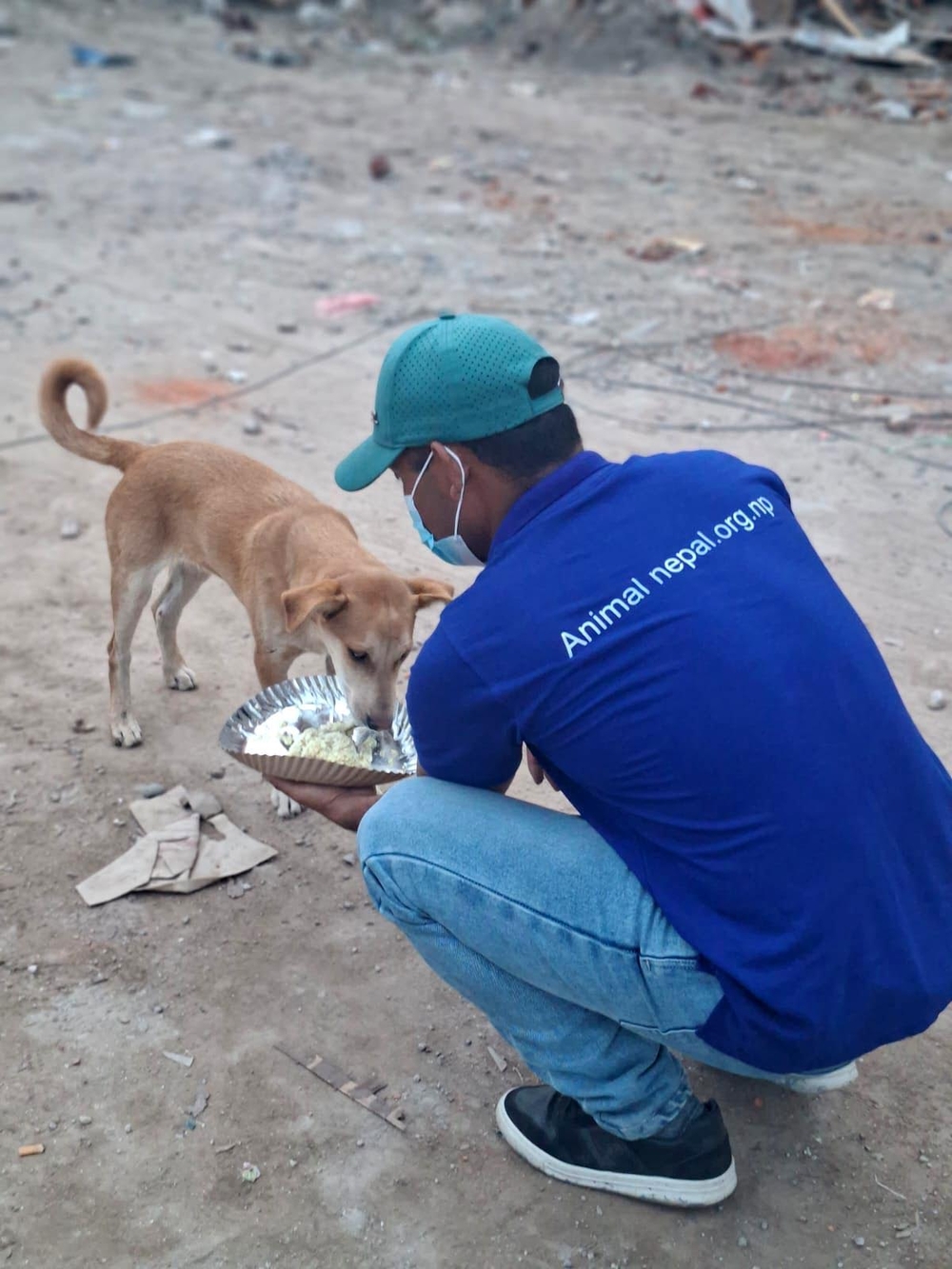
These animals were raised at home. They had names, were known, and loved. However, the displaced family had to hand them over to the organization when they could not find a place to keep them. There was a Japanese Spitz named Pugu. There was a Labrador named Luna who had just given birth to a baby and a husky named Maya. People were bringing the animals on scooters, on foot, and in drums. A man who could not keep his dog named Google donated Rs 5,000 for its care before abandoning it.
'People were coming to us and begging us to take it in. There were also pigs and cows. Not just dogs,' said Sneha Shrestha, founder of Sneha's Care.
The injured animals were in critical condition. One of the puppies had a broken leg and required a complex surgery. A dog brought from Thapathali had a broken collarbone. 'We were not allowed to enter the demolition area, so we cannot say for sure that these injuries are due to the dozer. But, they are similar to injuries caused by debris,' said Gurung.
The decision to bring the animal to a shelter or leave it there is made by a veterinarian. Minor injuries are given first aid and then left there. Animals that are seriously injured or in a state of non-life-threatening condition are rescued. Some animals did not survive . Animal Nepal's team is also managing the dead animals .
Both organizations were under pressure even before this crisis. Sneha's Care's technical team had to handle both the rescue and the shelter for the first two days, which delayed the management of medicine for other animals . They had also put out a public call for volunteers . The food drive is being run through individual donations .
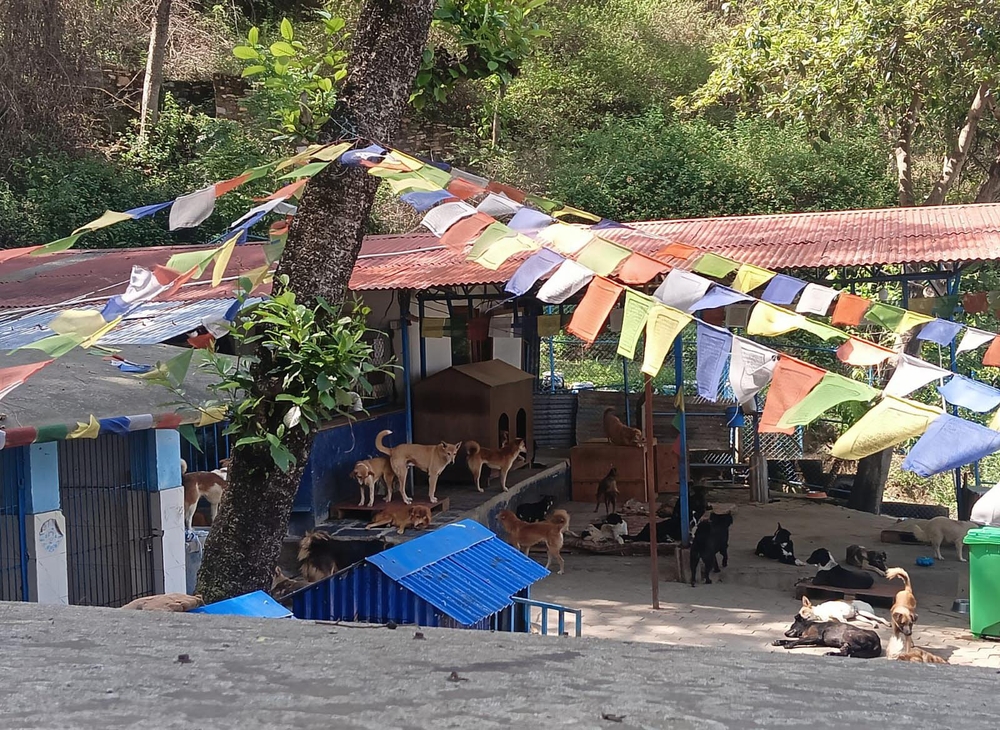
Animal Nepal's Chobhar Treatment Center already had 120 dogs . After the settlement was removed, 29 more have arrived . New animals are initially kept in isolation . Only after a 14-day quarantine, if they are certified healthy, are they moved to the shelter in Dukuchhap . Cats, chickens and rabbits are kept in the office and temporary protection homes . The displaced community living in the Kirtipur camp on the Tribhuvan University campus has also brought their animals with them . Animal Nepal is also providing sterilization and other animal health services there, as it is close to the Chobhar center.
Most of the animals are unlikely to return to their owners. 'So far, only one owner has said he will try to get his dog back,' Gurung said. 'All the others are struggling to pay the rent.'
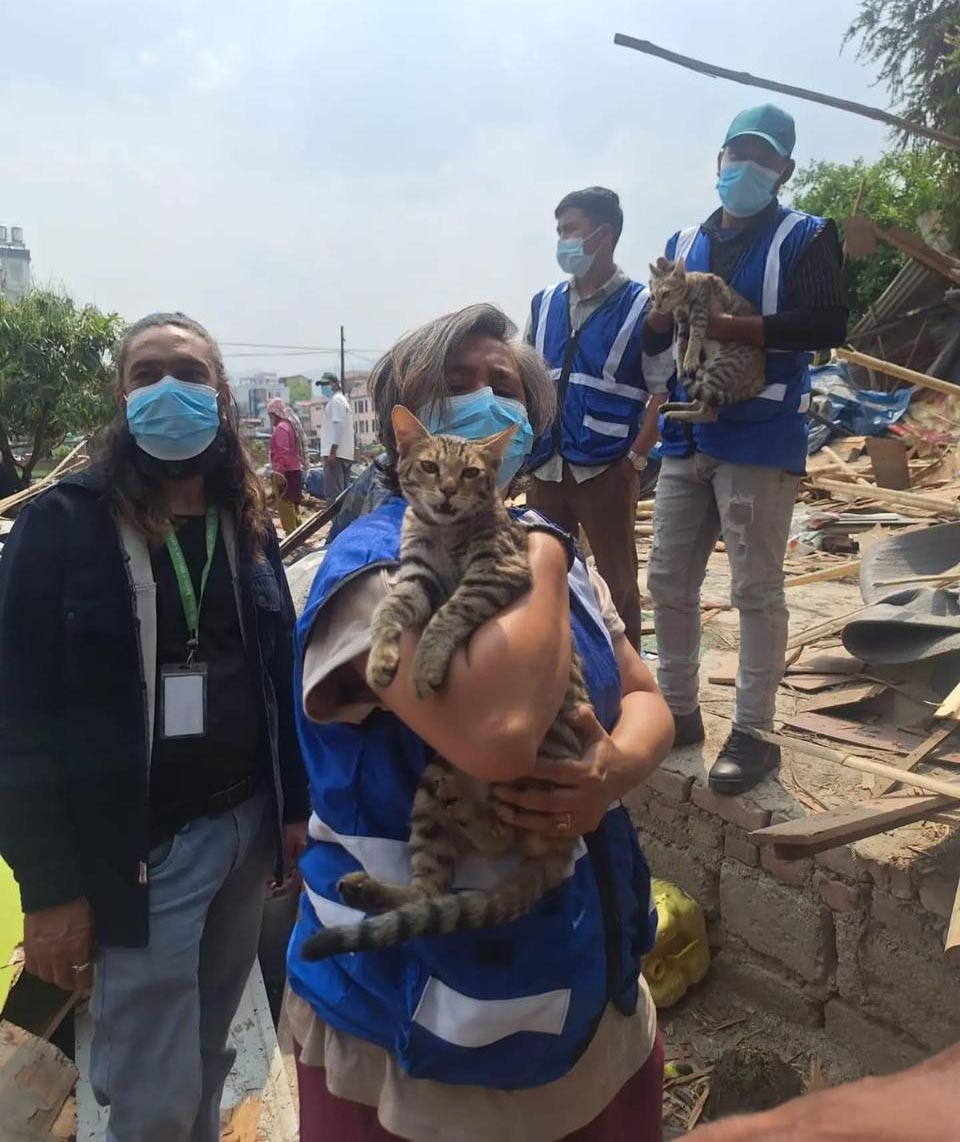
Both organizations have sent formal letters to the Department of Animal Services, the Ministry of Agriculture and the Kathmandu Metropolitan City to formulate a government plan for the displaced animals. 'The Nepal government has not provided any assistance,' Sneha said. 'The only assistance they have provided is not to stop us from visiting the site.'
000
If the government does not look into it, who will take care of the animals left in the rubble after the volunteers were unable to carry out their work?
According to Gyanu Gautam, an associate professor at the Kathmandu School of Law and an animal rights activist, the problem is not just the government's inaction, but the existing law itself has made the government more responsible.
Nepal does not yet have a comprehensive animal welfare act . However, the National Penal Code has a separate chapter on crimes related to animals and birds . Section 290 prohibits cruelty to animals . According to Gautam, the government has committed indirect cruelty by displacing the shelter, food and people who care for animals .
'Even if the government did not commit a direct crime, the food, shelter and life of the animals were at risk,' he said, 'This can be considered a crime against animals . If animals die in the dozer campaign, the law prohibiting killing animals in public places also applies .'
He also pointed to the broader obligations of the constitution . The constitution of Nepal calls the country a welfare state . 'A welfare state is not only about humans, but also about the welfare of all living and non-living beings, including rivers, forests, birds and animals,' he said .
He added, 'The government only thought about the management of squatters. It did not think about the management of land, animals and other living beings. Ensuring welfare is a constitutional obligation and the government should argue that it did not act accordingly.'
According to him, the solution lies at two levels. The 753 local levels of Nepal have the constitutional right to make laws related to animal welfare, but most of them have not. A comprehensive animal welfare act is needed at the federal level. In addition, an 'Animal Protection Officer' should be appointed at the local level, who should take legal responsibility for the records and welfare of animals in their area.
'If such a structure were in place, the local governments of Kathmandu, Bhaktapur and Lalitpur would be legally obliged to provide shelter and food to the displaced animals immediately,' he said. 'Now they do not feel responsible, because there is no law to hold them accountable.'
000
Food distribution was stopped after heavy rains in Balkhu. Food cannot be eaten after being soaked in water. The team stood in the light rain, watching the animals return to the ruins. Ganesh and Rajiv have been walking for 16-18 hours a day since the start of the evacuation, calling out the names of these animals that no one else remembers.
'The animals that have their owners are surviving,' Rajiv said, looking at the dog that was disappearing behind the collapsed wall, 'but the rest don't know where their people have gone.'