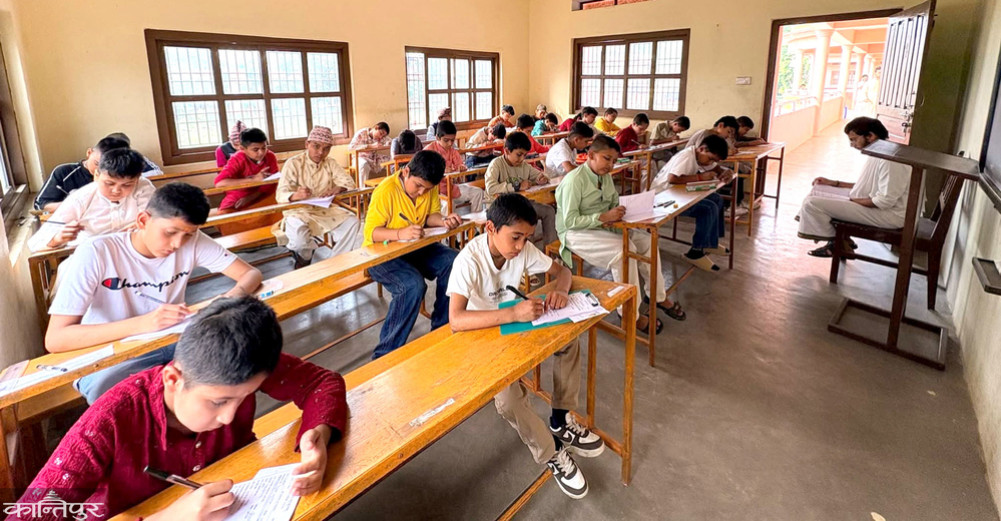
Currently, about 25,000 students are studying Sanskrit across the country. There are 15 to 20,000 students in about 500 Gurukuls, while an additional 4,000 students are studying at the Shastri (undergraduate) and Acharya (postgraduate) levels in colleges affiliated with and affiliated to Nepal Sanskrit University.
We use Google Cloud Translation Services. Google requires we provide the following disclaimer relating to use of this service:
This service may contain translations powered by Google. Google disclaims all warranties related to the translations, expressed or implied, including any warranties of accuracy, reliability, and any implied warranties of merchantability, fitness for a particular purpose, and noninfringement.
The number of students studying in Gurukuls in Nepal has started increasing gradually. With the increase in student enrollment, an important question has arisen, is Sanskrit language really making a strong comeback?
According to Guru Prasad Subedi, a professor at Nepal Sanskrit University in Dang, about 25,000 students are currently studying Sanskrit across the country. There are about 500 Gurukuls operating across the country. Of these, 300 are registered and 200 are unregistered. According to Professor Subedi, 15 to 20,000 students are studying in these Gurukuls. Similarly, an additional 4,943 students are studying at Shastri (undergraduate) and Acharya (postgraduate) levels in the colleges affiliated and affiliated to Nepal Sanskrit University, informed Giriraj Sharma, the head of administration at Sanskrit University.
About 1,000 students are currently studying Sanskrit in Mahesh Sanskrit Gurukul, Parmananda Sanskrit Gurukul and Gargi Kanya Gurukul in the Devghat area spread across Tanahun and Chitwan. Professor Subedi said that his experience of student life is different.
‘After the restoration of democracy in 2046 BS, it was once difficult to find students to study Sanskrit,’ he said, ‘but now the situation has changed. Students studying Sanskrit are increasing.’ This year, 300 students participated in the entrance exam opened for only 25 seats from classes 6 to 12 at Harihar Sannyas Ashram in Devghat. 200 people participated in the entrance exam of Mahesh Sanskrit Gurukul in Devghat, out of which 33 students have been admitted for the new academic session. Subedi said that this indicates the increasing attraction of students and parents.
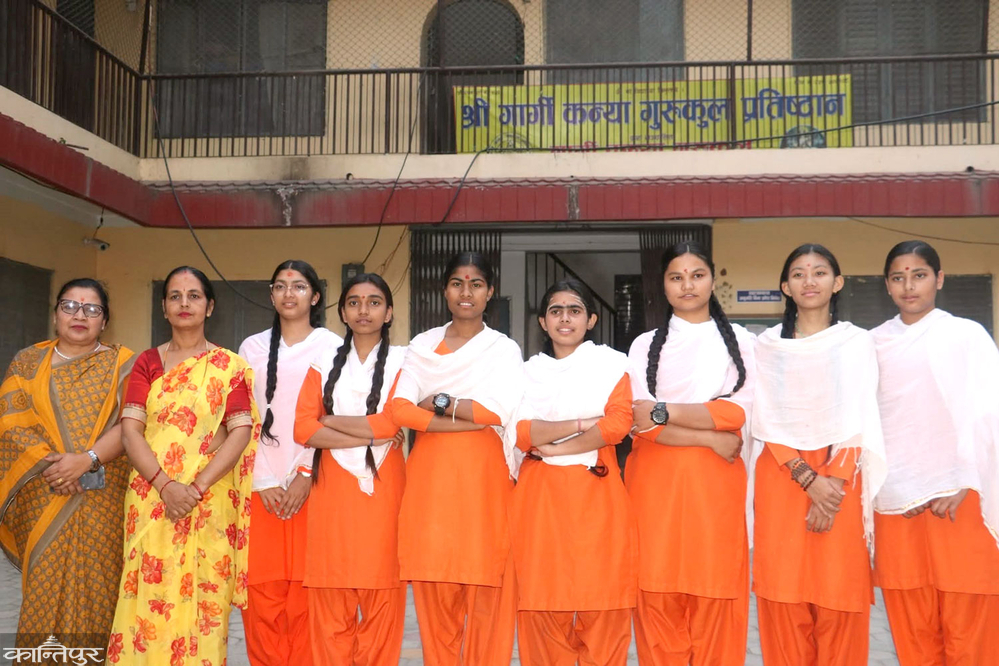
Around 1,000 students are currently studying Sanskrit in Mahesh Sanskrit Gurukul, Parmananda Sanskrit Gurukul and Gargi Kanya Gurukul in the Devghat area spread across Tanahun and Chitwan. Similarly, 21 out of 43 participants participated in the entrance exam held on 7th Baisakh of Gargi Kanya Gurukul located in Bharatpur-1, Chitwan. The principal of this Gurukul, Goda Subedi, said that the number of girl students has been continuously increasing for the past few years. In the past, there were 70-75 girl students in this Gurukul, which is attended by girls from Brahmin, Dalit and tribal communities. She said that this year, the total number of students will be 100.
Achyut Prasad Lamichhane, principal of the Valmiki Vidyapeeth (Campus) located on Exhibition Road in Kathmandu, an affiliated campus of Nepal Sanskrit University, also has a similar experience. ‘Two decades ago, there were barely 3-400 students on the campus,’ he said. ‘Now, when the number has increased significantly, many students have to be turned away because the quota is not met.’
1,088 students are currently enrolled in the Valmiki Campus in various faculties. This number is more than the budget and capacity of the campus. In the fiscal year 2082/83, the Ministry of Education received a total of Rs 2082/83. Out of this, Rs 1.4 billion has been allocated for the 12 affiliated and 19 affiliated campuses under Nepal Sanskrit University, according to the ministry. Ambika Adhikari, the accounting officer of Nepal Sanskrit University, said that the university has a budget shortage because it has to pay pensions to former employees. She says, “The university has to spend about 18 million rupees annually on pensions.”
Ghanshyam Sigdel, deputy administrator of Valmiki Vidyapeeth, said that the attraction to Sanskrit education has increased because it is linked to livelihood. “People skilled in yoga get jobs in villages, while people who know Karmakand (religious rituals) have increased in demand even abroad,” he said. Now the range of people learning Sanskrit has also widened. Along with the youth, those who have retired from government and private services are also attracted to Sanskrit. “Many have children abroad, they keep going abroad to visit them,” says Sigdel. “After going to Karmakand, they don’t have to sit idle even abroad.” According to campus data, 142 people have been admitted to the initial class of Karmakand this year alone.
The Jayatu Sanskritam movement was not against Sanskrit, but it gradually changed the educational priorities. As modern education was promoted, the influence of Sanskrit gradually began to decline. But not everyone has the same understanding. Naveen Pokharel, 23, an Acharya level student, said he studied Sanskrit to learn culture and discipline. “I came from a priestly family, so I chose this subject and I am continuing with it,” he said. Rusbin Adhikari, who is studying at Harihar Sannyas Ashram, said he chose Sanskrit because his family’s financial situation was weak. Somat Chalise, who is studying Shastri in Valmiki Philosophy, said he chose this subject because he saw the potential of Eastern philosophy and career.
Buddhi Kumal, who is now teaching Sanskrit grammar after completing his Acharya degree, says that the tribal and tribal communities are also attracted to Sanskrit education because they can study other modern subjects along with Sanskrit. He says that free education and housing have also played a role in increasing the attraction towards Sanskrit. Yogi Dayanath Magar said that he chose Sanskrit for employment. While working at the Yogi Naraharinath Library in Kathmandu's Pashupati area, he found it difficult to manage and catalog Sanskrit texts. When Sanskrit became mandatory for this work, he began formal studies. He is currently a professor of Sanskrit literature at Tribhuvan University.
The attraction to Sanskrit has been seen after a long time. Students of the Tindhara Sanskrit Hostel in Kathmandu had started the 'Jayatu Sanskritam' movement against the Rana regime on 1 Ashadha 2004. This was the first organized student movement in Nepal. The students had protested demanding that they be able to study modern subjects like English, science, mathematics and geography along with Sanskrit. While the children of the common people during the Rana regime were not able to get modern education. The Jayatu Sanskritam movement was not against Sanskrit, yet it gradually changed educational priorities. As modern education was promoted, the influence of Sanskrit gradually began to decline.
According to Nirmal Mani Adhikari, head of the Department of Language and Mass Communication at Kathmandu University and a Sanskrit scholar, the downward journey of Sanskrit became even more rapid after the implementation of the National Education System Plan in 2028 BS. ‘That plan did not eliminate Sanskrit, but the purpose of education was defined as being in line with modern needs. This gradually led to Sanskrit education being overlooked,’ he said. This plan prioritized science, technology and technical training.
Although practical aspects seem to have played some role in the attraction towards Sanskrit, Lamichhane, Principal of Valmiki Vidyapeeth, believes that the political changes in neighboring India played a major decisive role. Then, those who were receiving government facilities (free food and accommodation) and were studying Sanskrit also turned to modern education. Even though the Panchayat system was abolished through a mass movement in 2046 BS, the situation of Sanskrit education did not improve. Identity politics and the Maoist armed conflict that began in 2052 BS pushed Sanskrit further backward. Those who engaged in identity politics targeted this issue by linking it to Brahmanism. Adhikari recalls that there were incidents of attacks on Sanskrit teachers and disruption of examinations in some places during the conflict.
However, in 2077 BS, when the then Education Minister Girirajmani Pokharel decided to make Sanskrit a subject from grade 1, it gained attention again. Some educationists opposed the decision of the then Maoist Center leader Pokharel. Educational activists argued that this subject would be a burden for young children. Krishna Pokharel, an officer of the School Education Division of the Ministry of Education, said that Sanskrit was included as an optional subject in the school-level curriculum after 2077 BS. Until 2057 BS, Sanskrit was a compulsory subject from grades 6 to 8.
Maheshraj Pant, a historian at the Revision Board, said that the 'economic aspect' was the main factor in the downward journey of Sanskrit. According to him, there was no opportunity to earn sustainable income by studying Sanskrit, which is why students were not attracted to this subject. 'Those who studied Sanskrit may not have become unemployed, but many had to struggle a lot to earn a living. Which discouraged new students from entering this field,' he said. He said that no language will gain wider recognition unless those in power use and promote it.
Historically, Sanskrit dominated the Indian subcontinent until the 11th and 12th centuries. Then, Persian gained priority during the Mughal rule, and English from the 18th century onwards. All this was the effect of the transformation of power. Although the practical side seems to have done some work in the attraction towards Sanskrit, Lamichhane, principal of Valmiki Vidyapeeth, believes that the political changes in neighboring India played a major decisive role. After Narendra Modi and the BJP came to power in 2014, they have been emphasizing the revival of Hindu identity and Sanskrit. He said that this has had an impact in Nepal as well.
‘Along with Modi, Uttar Pradesh Chief Minister Yogi Adityanath has also shown special interest in promoting Hindu tradition and Sanskrit education,’ he said. Navraj Kattel, member-secretary of Jayatu Sanskritam, an organization active in the revival of Sanskrit in Nepal, also agrees with this. “It is true that the rise of the BJP in India has increased interest in Sanskrit in Nepal as well,” he said.
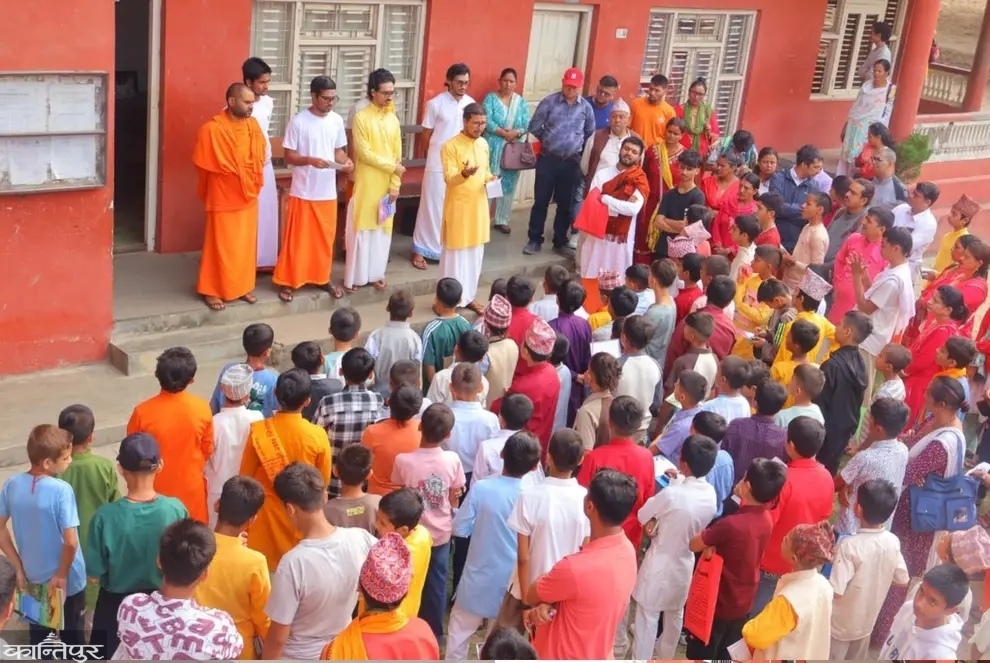
Its impact is also starting to be seen in Nepal. On Chaitra 13, 108 Batuk and Buddhist monks chanted Sanskrit mantras during the swearing-in of Prime Minister Balendra Shah, reflecting the Vedic tradition. Prime Minister Shah also used Sanskrit verses while extending his greetings on the occasion of the New Year.
Some political analysts have linked the swearing-in ceremony to the BJP tradition. However, Santosh Giri of the Prime Minister’s Secretariat rejected this and said, “The Prime Minister is only following the cultural practice that he believes in.”
During the swearing-in of the MPs, Khushbu Oli of the RPP also took the oath in Sanskrit. Khushbu, who studied Sanskrit in school, said that her goal is to preserve and promote the language. “There is no need to take it politically,” she said. Some have commented that the oath of office of the Prime Minister taken in accordance with the Vedic method is against the spirit of the secular constitution.
Political analyst Geja Sharma Wagle, however, does not agree with this. Wagle argues that since religion is a personal matter, the state should not interfere in it. ‘The state does not have its own religion, but citizens have complete freedom to practice their religion and culture,’ he said. ‘It is the responsibility of the state to respect and protect personal beliefs.’ Wagle said that since religion, Sanskrit language and culture are different things, they should not be seen in the same basket.
Sanskrit is also attracting increasing attention from foreigners. Prakash Sapkota, a teacher at Valmiki Campus, said that 23 students from countries including China, America, Russia, and Thailand have been enrolled. Sanskrit is also attracting increasing attention from foreigners. Prakash Sapkota, a teacher at Valmiki Campus, said that 23 students from countries including China, America, Russia and Thailand have been admitted. The campus admits foreign students in March and September every year. Sapkota said that the worldwide discussion of yoga and the search for spiritual peace have attracted foreigners to Sanskrit education. ‘After getting material comforts and facilities, Westerners come to study Sanskrit in search of inner peace,’ he said. He said that recently, as yoga and naturopathy have started gaining recognition as medical practices in Western countries, even those involved in those fields are eager to learn Sanskrit.
Niranjan Kafle, an associate professor at Ashoka University in India, said that the interest in Sanskrit should be understood realistically. ‘There are definitely a number of people who want to study Sanskrit. But this should be understood realistically. Only a limited number of people from a large population actively study Sanskrit. It has not become a matter of interest to the common man like other modern languages,’ he said. He said that the Sanskrit language has also attracted those interested in the history, philosophy, literature, and religion of South Asia.
Most of the children studying Sanskrit are from remote and economically disadvantaged families. They are attracted by the facilities of free education and housing. Subedi, the principal of Gargi Kanya Gurukul, says, “In some cases, students are enrolling without understanding the importance of Sanskrit. Most students come to enroll because it is not expensive. Gurukuls with boarding and lodging facilities have become the best option for parents who cannot afford to educate their children in the city.”
Most Sanskrit schools in Devghat claim that they run on donations from donors and do not receive government support. However, Krishna Pokharel, an official at the Ministry of Education, said that this claim is not true. According to him, although they initially opened on their own resources, some Gurukuls have since pressured the government for budget allocation. Pokharel says, “The Gurukuls run under the Ministry of Education are given an annual government grant of up to Rs 5 lakh based on the number of students.”
Despite increased access to Sanskrit, the problem of caste discrimination and exclusion in society has not gone away. Acharya Krishna Damai, who recites Bhagavad Katha, says that discrimination still exists in Gurukuls. ‘Even today, it is not easy for the Dalit community to study rituals while revealing their caste while sitting in a Gurukul,’ he said. Damai, who completed his studies from Dang to Acharya with the help of various people, now recites stories professionally.
Despite increased access to Sanskrit, the problem of caste discrimination and exclusion in society has not gone away. Acharya Krishna Damai, who recites Bhagavad Gita, says that discrimination still exists in Gurukuls. Despite working as a storyteller, he feels that discrimination has not left him. ‘If I had had the opportunity to specialize in other genres of Sanskrit, I would have gone into teaching or academia. Becoming a storyteller was the biggest success for me when there were no other opportunities,’ he said. Imanath Chalise, principal of Yogi Narharinath Sanskrit Gurukul in Bageshwori, Chitwan, said that 35 students, including Dalits and tribals, are currently studying Sanskrit in his Gurukul. Although Dalit students were taught rituals in the past, the Gurukul has now given priority to ethics and astrology because of their limited practical use.
‘We cannot just teach, the society should also accept the worship and rituals performed by the Dalit community,’ said Chalise, ‘The education we provide should become the path to the future and livelihood of the students. That is why we have stopped teaching rituals to non-Brahmin students for the last few years.’ According to Yogi Dayanath Magar, it is still difficult for communities other than Brahmins to study rituals in Sanskrit. He says that until some time ago, even the Kshetri community had to struggle to study rituals.
For a long time, Sanskrit was limited to rituals in Nepal, which narrowed its intellectual scope. Historian Pant said that Sanskrit should not be limited to rituals only and that it should be meaningfully revived by considering its history. For this, he argues that Sanskrit should not be studied in a separate way according to the original curriculum and intellectual tradition, not by linking it with modern education. Jayatu Sanskritam member-secretary Navraj Kattel said that rituals have saved Sanskrit in difficult times. His analysis is that people's interest in it is due to the possibility of earning a living from worship. However, he emphasizes that Sanskrit is a storehouse of knowledge such as philosophy, mathematics, astrology, language, medicine and politics.
Kattel also expressed concern about the quality of Sanskrit education. Nowadays, 'storytelling' has become an attractive profession for those who have studied Sanskrit, but he said that the question of whether there is depth in the interpretation they give is equally important. He says, 'Detailed explanations of Vedanta philosophy are rarely heard these days, sometimes the interpretation is only superficial.' Devmani Bhattarai, head of the Theology Department at Valmiki Campus, also agrees with Kattel's argument. Dividing the narrators into three categories, Bhattarai says, 'There are very few upper-class narrators. "Second and third-rate narrators often misinterpret the core essence of religion while narrating stories." Bhattarai believes that this problem is due to a superficial understanding of religious philosophy.