The history of Gurkha Lahure was written and publicized. But thinking that the world should also understand Lahureni's desires, dreams, experiences and struggles, Sujana started researching the same.
We use Google Cloud Translation Services. Google requires we provide the following disclaimer relating to use of this service:
This service may contain translations powered by Google. Google disclaims all warranties related to the translations, expressed or implied, including any warranties of accuracy, reliability, and any implied warranties of merchantability, fitness for a particular purpose, and noninfringement.
When the grandmothers of the village talked about their husbands fighting in the World War, a young Sujana Thapa listened intently. Her heart was touched by the tearful stories of grandmothers' responsibilities, worries and loneliness when their grandfathers went to war.
The history of Gorkha Lahure was written and publicized. But thinking that the world should also understand the desires, dreams, experiences and struggles buried in Lahureni's mind, she started researching it. There, through research, she launched a campaign to introduce Lahure of the Gurkha platoon and his anonymous wife Lahureni to the world through digital media.
Satyavati-8 Bharse Ghar, she has started a campaign to introduce her ancestral village Bharse and Bharseli to the world through Creative Arts Initiative Pvt.
'I grew up listening to the stories of baje and baje. After acquiring knowledge during studies, I thought that we can preserve such things through social science research, we can bring them to others through storytelling or digital archiving,' she says, 'The biggest thing is that I have worked on it for research archive studies for future generations.'
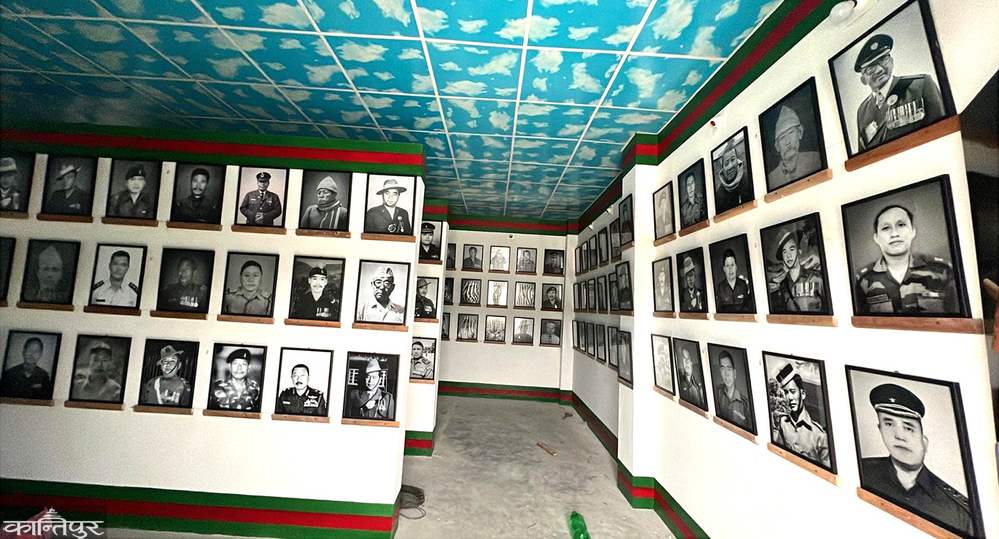
Her study of Gorkha soldiers' wives started in 2018. She started meeting with the Gorkha military families of Dharan, Gorkha, Pokhara, Baglung, Varse (Gulmi) and Butwal. This research journey lasted until 2020. In 2018, Lahureni's story exhibition, which started in Kathmandu, Butwal and Gulmi under the name of 'Varseli's Gorkhas from Stories to Portraits', took the form of 'Gorkha Women: An Echo in the Story' at the Kathmandu Art Council in November last year after long research and study. The same exhibition introduced him to the 'disclosure' of the anonymous Lahureni. In the
exhibition, the families of past and present Gorkha soldiers, artists, journalists and people associated with different fields viewed the photos, videos, their stories and the clothes, ornaments and other things related to the wives of the Gorkha soldiers.
'Gorkha has a history of 200 years. By putting my mind to it, I was able to come up with an authentic project. I interviewed more than 50 people over the age of 70. The next generation won't be able to do that,' she says, remembering her achievements after her hard work, 'I did a great job researching and archiving it digitally. It felt very great to go from village to village and make the exhibition successful with a small budget and a small team. According to Sujana, these objects are not just materials, they are witnesses of the struggle and love of these women. To break the story, their family background became better due to Gurkha recruitment. He said that if he himself was not from Baje Lahure, he would have stayed in the village and would not have been able to understand and think about this situation after studying in the city.
'If it wasn't for Baje Lahure, our migration wouldn't have happened, if it wasn't for this background, we would have stayed in the village', she says, 'Socio-economic knowledge increased after the Gorkha recruitment, but the work of digital archiving, research, book writing was a little less, but it was not enough . Because of that, it was very difficult for me to do that research.' She did not work with any big plan for studying this historical fact. He says that he worked on the money he collected while working on other projects and asked his brothers for help. She says, "After running out of funds, I again worked on other projects". There were many bumps in the middle. Even those who said they would help first came and hesitated. But it was successful with great struggle.'
She did not limit the story of the anonymous Lahureni to the exhibition, but also entered it in the literature festival held in Pokhara last year. In the 'Lahureni's Katha Vyatha' session, the speaker said that the Lahureni's who became Lahureni's self-confidence in the midst of bombs, bullets and explosions have always been in the shadows since the World War. He believes that this has also created a debate.
Thinking that only a one-time exhibition or debate will not bring it to life, she has also played a role in the establishment of Gorkha Gallery in ancient Thalo Varse, and has documented all her studies. His father, Bom Bahadur Thapa, who is a retired officer of the Nepal government, helped him in that.
Having gained experience as a radio presenter in various works related to art and film, Sujana was interested in the field of art.
"I am interested not only in painting, but also in its various parts: performative arts, visual art, music, film, theater," she says, "besides that, I also like a bit of adventurous work ." Reading and collecting books are also my interests.'
His life has not been easy. Concealing the pain of losing her mother at a young age, she made a basis for dealing with responsibilities and problems and building a life.
"As I took on a big responsibility in the age of 17/18, I learned how to tackle various obstacles, how to handle the family, how to accept the family responsibilities and move forward with other responsibilities," she says.

