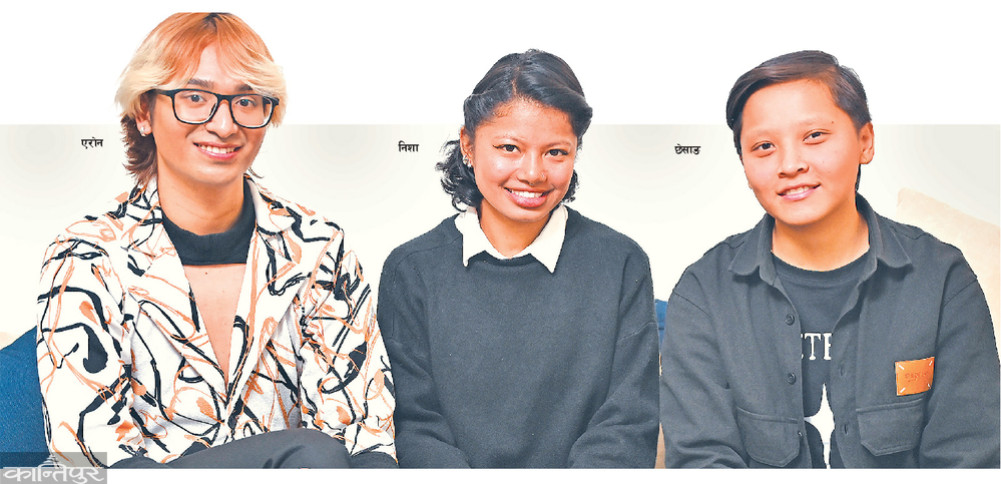
Aron, Chhesang and Nisha, who have different identities in the society, are not confined inside the house, they accept themselves and are moving forward in the society with strong confidence, however, they say that the situation is still challenging due to the traditional values of the house, society's marriage and children.
We use Google Cloud Translation Services. Google requires we provide the following disclaimer relating to use of this service:
This service may contain translations powered by Google. Google disclaims all warranties related to the translations, expressed or implied, including any warranties of accuracy, reliability, and any implied warranties of merchantability, fitness for a particular purpose, and noninfringement.
Aaron Tandukar has taken a very difficult journey to make his mark as a make-up artist and dancer. His school days were more like a nightmare for him. He is bullied by his friends, beaten for no reason and sometimes even gets sick from being beaten.
At that time there was neither the support of the teachers, nor the courage to share these pains with the parents. That sad childhood experience where even the teachers came close and tried to touch his private parts had a serious impact on his studies. After reading
plus two, Aron, who kept himself hidden, joined various organizations. From there, he began to recognize his gender identity. "I realized that I was different. I realized that I am not the only one, there are many like me,' says Aron now, proud of his identity. Make-up and dress-up have given her freedom these days.
Chhesang Ghising is doing graduation from Patan Multiple College. Along with being a student, he is also the Program Officer of Queer Youth Group. During his school days, Chhesang was confused about his identity. Although she felt comfortable in a group of boys, she felt awkward when society tried to cast her as a girl.
"There was no access to the internet at that time, so it was not possible to get enough information," she says. After finishing class 10, she decided to cut short her case and identify herself. Today Chhesang is known as a strong activist for the LGBTQ+ community.
Nisha Chauhan, a graduate student from Padmakanya Campus, sees her identity as a 'human' first. Although she thought she liked boys as a teenager, over time she realized she was bisexual.
'I don't want to associate love with gender,' she says, 'I don't think that my life partner should be a boy or a girl.' She now sees love according to a person's qualities and feelings. Aron readily accepted his identity.
'I didn't have to say it was this or that. Everyone knew because of my behavior," he says, "I used to openly share everything with my sister." One day, Aaron's father saw the video on his mobile phone and asked, "What is this gay?"
On this occasion, Aron shared all the stories he experienced during his childhood and school. After explaining everything to the family, his father only asked one question, 'Are you going to get married or not?' Aaron said he was not interested in immediate marriage. But in the family, the matter of 'proceeding the lineage' often arises. "Daddy and mommy love to play with their grandchildren, but how do I explain this?" he says.
Chhesang insisted on shortening the case after completing her 10th class. After convincing Mami for a long time, he gave the money. I went to cut the case. While cutting the case, my eyes teared up involuntarily. It is difficult to accept yourself," he remembers.
Our society sees having 'one son and one daughter' as a happy family. She was afraid that her identity would break the image of that 'happy family'. But when Chhesang shared her story with her parents, the family openly supported her.
Nisha takes her identity as confidence. She says, 'I am not interested in what others think.' Her parents have also given her full support, but the question of marriage and children comes up again and again.
'Are you going to get married, are you going to have children, are you going to continue the family line?' She says, 'I think the reason for the objection to same-sex marriage is because they don't want to have children.' It highlights the challenge of accepting different identities and the need to change society's perspective.
Aaron was tormented by the negative views of the society since school. It felt bad when people called me using a hokey word. 'Loneliness used to bother me more deeply at night,' he remembers, 'Why did I become like this? If I was straight, I could have made mummy and daddy feel proud, they don't have to walk with their heads bowed.' He still remembers being deeply hurt by the comment, "Is it a girl?" "That question caused me frustration and anxiety for a while," he says. He says that this is also the reason why depression and anxiety problems are widespread in the LGBTQ+ community.
'In our community, making love and finding a life partner is very challenging. So we should give priority to self-growth,” he suggests. According to him, straight people get a chance to build a family and move forward in life easily, but the path is not easy for the gender minority community.
Nisha is hurt by society's derogatory words. "No one can imagine how we feel when we are called that way," she says. She points out that mental problems are also caused by having to stress about what others say while living in society. "I'm happy that same-sex marriage is legal, but it's still a challenge because our society is slow," she says.
Aaron, Chhesang and Nisha's experiences highlight that mental health challenges in the LGBTQ+ community are exacerbated by social attitudes and prejudice. These problems can be reduced if the society can easily accept their identity and provide equal opportunities and respect. They say that there is a need to create an environment of self-development and positive support with mental health as a priority.