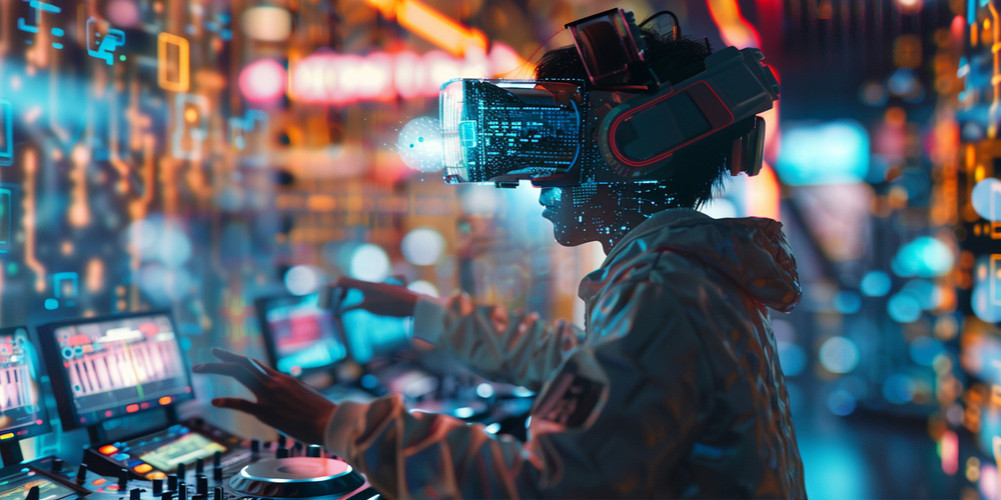
Nowadays, AI tools are used in Nepali films not only from concept, screenplay, pre-production, production, and post-production, but also in poster designing and marketing.
We use Google Cloud Translation Services. Google requires we provide the following disclaimer relating to use of this service:
This service may contain translations powered by Google. Google disclaims all warranties related to the translations, expressed or implied, including any warranties of accuracy, reliability, and any implied warranties of merchantability, fitness for a particular purpose, and noninfringement.
Recently, the use of AI in the film industry has also become a topic of discussion and debate. From the beginning of cinema to its release, the help of AI is becoming natural all over the world.
The use of AI is not new in Hollywood. It is making impossible tasks possible on screen. A very famous example is the film 'Indiana Jones and the Dial of Destiny'. In the film, the 80-year-old actor Harrison Ford is shown to be 40 years younger with the help of AI technology.
Similarly, in the film 'Top Gun: Maverick', the old voice of actor Val Kilmer, who lost his voice due to throat cancer, was recreated through AI. Although there are many such examples in Hollywood, this level of use is not being done in Nepal. However, Nepali filmmakers are also gradually starting to rely on the help of AI.
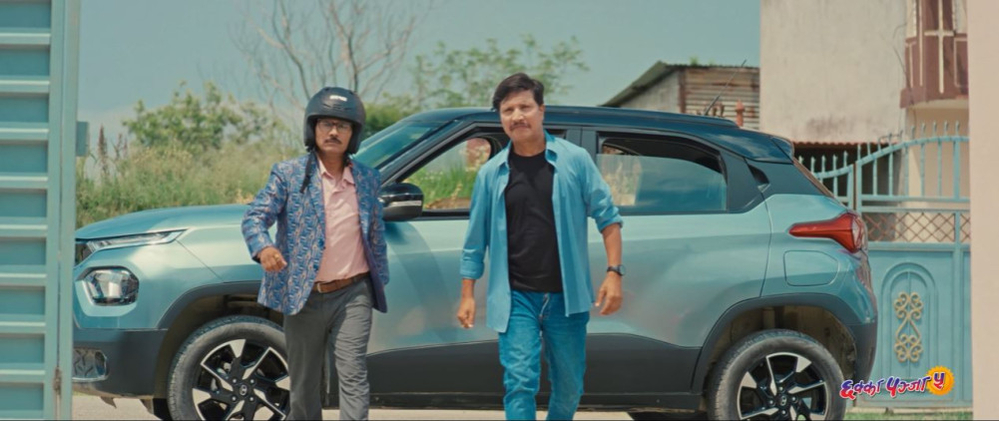
'Avatar' director James Cameron had called 'AI' 'scary' just a few months ago. Cameron, who is also the director of the 'Stability AI' company, had said that AI can only provide limited creative benefits. In an interview with CBS News, he said that computers are replacing artists, saying, 'I don't want computers to do the work that I take pride in when I work with artists. I don't want to replace artists. I love working with them.' In a scene from the film 'Chhakka Panja 5' released last year, Deepak Raj Giri had to look youthful and attractive in a photo. Director Deepashree Niraula used 'Artificial Intelligence' (AI) instead of makeup for this. Niraula says that the effort to make Giri look young in the photo is a small but meaningful step of technology in Nepali cinema.
AI tools are now being used in Nepali films not only from concept, screenplay, pre-production, production and post-production but also in poster designing and marketing. AI tools were also used in the pre-production of Vasant Niraula's film 'Panch Pandav', which is currently in the process of shooting. Director Niraula took the help of AI to imagine how a complex scene would look while making a story board.
He says that AI has given him a clear blueprint to depict imaginary scenes, such as heaven. 'No one knows what heaven is like, everyone can only guess.' However, while working with AI, it gave us a reference that was within a certain limit. This made it much easier to explain to the VFX team,' he says. He has experience that AI has been effective in VFX as well. ‘Sometimes the language we say and the language AI understands may not match, but it is very convenient for reference,’ he says.
Is AI now just an opportunity or a challenge of losing jobs along with creativity? This is a matter of interest and concern among filmmakers. Director Naveen Subba presents an example of the widespread use of AI worldwide, saying, ‘Recently in China, when an actor left while working on a series, the work was completed by ‘swiping’ the face of another actor through AI. In America, there is currently a big debate about its ethical use and creativity.’
Subba himself recently used AI for ‘stimulation’ during script writing. He has experience that the options provided by AI help in generating new ideas when trying to view a scene from different angles. ‘However, the ability to decide which of those options is right and which is not should be with the director himself,’ he says.
Filmmaker Binod Poudel is making maximum use of AI in ‘marketing’ more than making. The marketing plan for his upcoming film ‘Roll Number One’ has been prepared through AI. According to Poudel, it even includes a schedule of which areas to focus on and when to release the poster. Similarly, he has experience of AI being used to clarify the voice by removing unnecessary sounds in ‘sync sound’.
Writer and director Vikas Subedi considers AI as an ‘idea generator’ or a ‘starting point’ of the story. He has taken it as a friend, who helps new writers to clear their confusion and improve their ideas. Writer and director Vikas Subedi considers AI as an ‘idea generator’ or a ‘starting point’ of the story.
Film writer Samipyaraj Timalsena uses AI to gain ‘theoretical understanding’, ‘roadmap’ and suggestions on which path to take the story or scene. However, he has experienced that the suggestions given by AI are artificial and lack originality or organicity. ‘Although it is used in technical works like VFX and animation, it does not contribute much to writing,’ he says, ‘because to make the creation organic, the writer has to return to his own original process.’
Director Ganeshdev Pandey’s experience is somewhat different. He prefers to write the stories of his films himself and considers the most beautiful part of filmmaking to be immersed in imagination and playing with the characters. He says that he does not use AI for original creations. ‘Instead, I only use it to select words, refine the language, or ‘pitch’ the story to someone after writing,’ he says. Director Upendra Subba says he has no knowledge of how to use AI. ‘I haven’t even used it yet. So I don’t have experience with it. It hasn’t been needed yet. I’ll use it the day it’s needed,’ he says.
There are occasional discussions in Nepal about how to use AI tools. Despite the growing interest in AI, NIF President KP Pathak, realizing that there is still confusion about which software and system to use, organized a 5-day workshop to explain the use of AI in pre-production, production, and post-production of films. Pathak himself says he is taking advantage of AI to break scripts, find treatment, and find conflict elements.
AI: Now the need
AI has simplified the complex process of filmmaking. According to director Naveen Subba, AI can do the 'script breakdown' done by film assistants in a few seconds. This allows AI to create 'visual references' of characters, locations and costumes instead of having to sketch out what the director has in mind. It makes it easier to communicate your thoughts clearly with the DOP and designers. According to director KP Pathak, AI has also saved time. 'The time it took to search for data on the Internet for days is now available in a few seconds, which can be modified later,' he says.
Looking at the technological journey of Nepali cinema, AI seems like a natural development. Writer Vikas Subedi says that this is a new step, just like writing a script by hand yesterday and later transferring it to Microsoft Word. ‘Today we are in a phase where AI has simplified even the editing and visual effects work in post-production,’ he says. According to producer Vinod Poudel, what used to take a human being 5 minutes yesterday can now be done in 1 minute with AI’s command, which allows the remaining time to be spent on other creative work.
Poster designer Royal Bhimsen, however, says that since he has a background in digital painting, he does not rely entirely on AI but uses it only as a supporting medium.
Although AI can help improve work or look for references, Royal says that posters made entirely with AI lack originality and long-term value. ‘Because anyone can easily identify such works.’ Therefore, instead of being completely dependent on technology, the artist should keep AI under his control, give commands and use it as an assistant,’ he says.
The crisis of originality
Some filmmakers worry that the use of units will lead to loss of originality. Filmmaker Subba explains this from a different perspective. According to him, the biggest problem with AI lies in its source. Subba had done research for his new film through AI. However, the reference to the information given to him was his own film ‘Numaphung’. ‘Whatever references AI takes, they are mostly Western or Hollywood-centric. AI does not have enough information about the cultural nuances of Nepali cinema or Asian cinema,’ he says. ‘It seems that it should be thought about while writing scripts because it prioritizes the Western perspective.’
However, according to Deepashree Niraula, the audience is now very knowledgeable about technology and has started to assume ‘this is AI’ as soon as they see a scene. He believes that showing too many 'fake' things will lead to a loss of credibility for the audience.
Similarly, Ganeshdev Pandey says that there is uncertainty about who will own and create the rights to things created by AI in the future.
Fear of displacement
‘Will AI displace humans?’ This question is currently being asked by filmmakers. In Hollywood and the global market, there is a serious debate about the challenges and moral crisis caused by the use of AI. In the 'Hollywood strike' held in 2023, writers and artists demanded strict regulation, saying that AI could take away their originality, identity and jobs.
The main concern of the artists was that their faces and voices would be digitally used without their permission to create 'AI digital twins' and that there would be no need for real people in the future. This has added to the legal complexity of intellectual property rights and who controls someone's 'digital existence'.
Using films and scripts from around the world to train AI without their permission is seen as 'creative theft'. New Hollywood agreements have ensured that what AI writes can no longer be considered 'source material' and that humans must receive full credit and remuneration for the creation. The debate is now not limited to 'AI taking over', but rather how to preserve the 'cultural and moral value' of cinema by keeping technology under human control. This has led to the creation of new roles such as 'AI ethics officers' in major studios.
In Nepal, since that kind of crisis has not yet occurred, the debate is not at that level. Its impact on the music sector is now starting to be seen in Nepal. According to director KP Pathak, there is a risk of losing the jobs of writers, translators and technicians in the future. ‘The easy availability of AI can make people ‘lazy’ and even those who do not have real ability can easily write with the help of AI,’ he says.
Naveen Subba confirms that AI is threatening the jobs of some people in pre-production. Writer Samipyaraj also assesses that the use of AI has increased the ‘risk of losing jobs’ of singers and musicians in the music sector and that it will have a big impact on the technical sector in Nepal sooner or later. ‘However, since writing requires human sensitivity and originality, it does not affect writers as much as other genres,’ he believes.
However, Vikas Subedi has a different opinion on this. ‘There was a similar fear during the industrial revolution, but when AI or robots do ordinary tasks, people start searching for ‘advanced consciousness’ and innovate,’ he says. Binod Poudel also believes that AI will facilitate work and make people more self-reliant rather than taking away someone’s work. Director Niraula, on the other hand, argues that AI can be seen as a technology rather than destroying human creativity. Comparing AI to a calculator, he says, ‘Earlier we used to calculate on paper, later we started using a calculator.’ AI is also a technology that we must follow. Just as pressing a calculator does not change our creativity, AI does not reduce our creation, but rather builds it up. Therefore, there is no fear of losing jobs.’