Directed by Jenny Sunuwar, this 'absurd' style play has neither dialogue nor music. There are two characters, whose physical behavior raises questions about women's violence, women's issues and women's empowerment.
We use Google Cloud Translation Services. Google requires we provide the following disclaimer relating to use of this service:
This service may contain translations powered by Google. Google disclaims all warranties related to the translations, expressed or implied, including any warranties of accuracy, reliability, and any implied warranties of merchantability, fitness for a particular purpose, and noninfringement.
“Hey Shamba, how many man?” the red-clad character asks the white-robed character. There are many reasons behind the question of Englishing the famous dialogue of the Bollywood film 'Sholay'.
Here another character is oppressed by a character wearing men's shoes. The repressed character's voice is small, but the questioner's voice is loud. The character keeps asking, 'How many men' means how many men? Another character answers, 'Man, woman, human.' ;
The situation of women in the patriarchal society is shown through this single dialogue-scene of the play 'The Stronger', which is being staged at the workplace of Theater Village, Lalitpur, Thasikhel, Nepal.
A character in red is seen pointing a gun at a female character in white. How does a powerful man try to suppress a powerless woman? How are women's voices suppressed? The play has shown the bitter reality of Nepali society. The scene also shows how difficult it is for patriarchal society, thinking and masculinity to accept women's existence.
When the answer comes in the sense that 'women are human too', the male character does not seem ready to accept it. The character's question is centered around men only. This scene satirizes the patriarchy that cannot accept women as human beings. Also, the aspect that women are ready to fight for their existence in a male-dominated social structure is also presented here. Whenever the questioning character does not acknowledge the existence of women out loud, then and then the character says in a strong voice, 'Woman, human.'
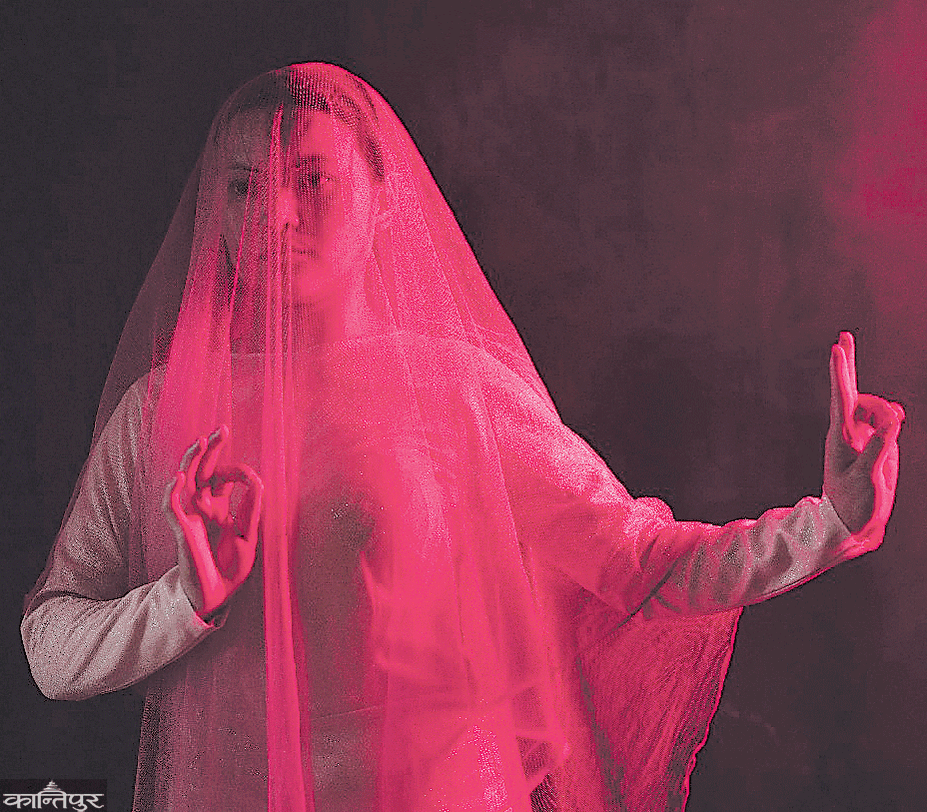
Directed by Jenny Sunuwar, this play is presented in 'absurd' style. There is neither dialogue nor music in the play. Here are just the views. There are two characters, through their physical movements questions of women's issues, women's violence and women's empowerment are raised. While raising these questions, the play also exposes the patriarchal society and structure. There is another powerful scene in the play where the actors keep singing:
Talatuli Batuli, what a beautiful doll
both eyes gazelli, how beautiful doll
Not too small, not too big
Yellow and thin, what a beautiful butterfly
This poem written by poet Madhav Prasad Ghimire is used satirically in that scene of the play. While reciting this poem, one of the characters wraps his body in a red silk scarf. Another character wearing a shoe slowly begins to move his hand over the character's body. The sari-clad character retorts, but the character gets more excited and tries to dominate her.
A character dressed in a sari screams and shouts. However, the male character keeps on exploiting her, doing violence to her. This scene shows the women who are subjected to violence by men, and the countermeasures against it. This scene speaks to how violence and exploitation in a patriarchal society are held by men, the abuse they do to women. Also, through the use of poetry, how men abuse women as puppets, their view of women is expressed in this poem.
The two characters seen in this play, based on physical theatrical performance, represent the body and the soul. The character dressed in red is the body, and the one dressed in white is the soul. Various issues continue to cause conflict between the two. As the conflict continues, the sides these two take clearly show where they stand on Nepali society, women's issues and patriarchy. So sometimes one character here becomes a man and another becomes a woman. Sometimes a character shows the Nepali society while another shows the inconsistencies within it. In another scene of the
play, the aesthetic approach is also struck. At the beginning of the play, two characters walk on the stage. Both are wearing high heeled shoes. The two make up while looking at each other. After finishing the makeup, they look at themselves in the mirror. Again, in a moment, the same makeup and clothes are messed up.
Sometimes these two become hesitant to fall under the standards of beauty created by society and sometimes they stand against it. One has to watch 'The Stronger' to realize the irony of breaking beauty standards. Because this drama does not give a message on big issues, but makes you feel the complex issues.
'The Stronger' is a Swedish play written in 1889 by August Strindberg. Catching the essence of this play, Jenny covers the topics of power, identity and women. This play questions the expected traditional roles historically assigned to women and criticizes the established norms of power, beauty and influence as defined by society.

