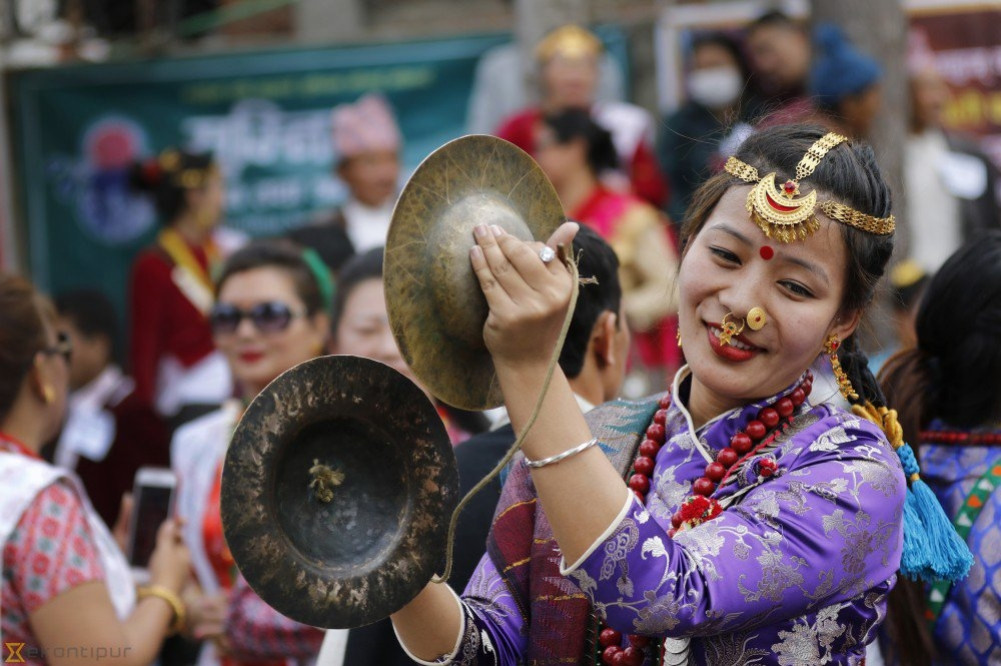
Songs, folk songs, dirges, and musical instruments are the rhythms of Nepali society from birth to death. From moments of sorrow to days of celebration, Nepali life remains musical.
We use Google Cloud Translation Services. Google requires we provide the following disclaimer relating to use of this service:
This service may contain translations powered by Google. Google disclaims all warranties related to the translations, expressed or implied, including any warranties of accuracy, reliability, and any implied warranties of merchantability, fitness for a particular purpose, and noninfringement.
All the creators, known and unknown, have dedicated their lives to music. Folk music is forever grateful to those greats. While 'others' only play songs in clubs and discos, 'those who turn elsewhere' visit their homelands in search of our folk tales and myths.
The audience who wandered to the cinema hall in search of their homeland will find in the musical film ‘Jari 2 – Song of Chhabrung’ – the rhythm of Chhabrung, the glory of Limbu life, the melody of history mixed in Chhabrung – the ahaan, stories and legends.
The Limbus of eastern Nepal live their lives in happiness and joy playing the Chhabrung, who are prosperous – with cultural rhythms. How magnificent are they with the rhythm of Chhabrung and the tradition of Chhabrung? That story is told – ‘Jari 2’.
Nepali life is musical. Just like Chhabrung dance is a traditional folk dance, where Limbu life and folklore are alive. Chhabrung is danced during weddings, celebrations, happiness. The sacred wish of those who dance Chhabrung is – that no bad omen should come to the family, that natural disasters should not hurt, that diseases should be destroyed, that misfortune should never happen. Therefore, Chhyabrung is a unique cultural practice and prayer.
The Limbu musicians who used to play Chhyabrung, who ruled the state long ago, should be famous, but perhaps their memories are lost in the Nepali mind. Chhyabrung is hung on the main pillar of the house. It is said that Chhyabrung always protects the house from ghosts and disasters.
Traditional music is in the way of life, beliefs, relationships, and memories. It is the symbol of the Nepali soul, which remembers its ancestors by taking a ride on a memory ship. Traditional music is the beat of rituals, rituals, festivals, or relationships.
The musical heritage of the customs, costumes, and language and culture of various ethnic groups from the Himalayas to the Terai is traditional music, a very close part of Nepali life.
Songs, folk songs, dirges and musical instruments are the garlands of the beautiful Nepali common flower garden from birth to death. From days of sorrow and hardship to days of celebration and joy, Nepali life continues to be filled with music. Since ancient times, from Mahakali to Mechi, in rituals, seasons, and religious functions, we have had various folk songs and folk instruments, which are sung and played from festivals to farewells.
Each of our communities and cultures has its own musical instruments, through which the traditional music played is the traditional music – the folk music. In fact, Nepali daily life is characterized by our native folk instruments, which have been awakening society for ages - dholak, madal, nagara, murli, bansuri, tabla, sahanai, narasinga, damaha, damru, chyabrung, sarangi, binayo, arbaaz, murchunga, dhyangro, jhyali, karnal, khainjadi, tamko, tungna, panchai, ektare, naykhin, mujura, khin, damfu, tungna, hudka...
Folk songs, bhajan kirtan, juhari songs, festival songs, seasonal songs, heroic songs, chutka, balan, magal songs, sorathi, maruni, ghatu, rodhi, dohori, hakpare-khyali, sangini, deusi-bhaili, malashree, asare, bhadaure, chanchari, ramlila, krishnacharitra, ratayuli, dhananach, sakela, silok, bahramasa, deuda, jhyaure tell long stories of our lives, struggles and livelihoods.
In the book ‘Sangeet Parikrama’, music researcher Ramsharan Darnal has written, ‘No matter how exhausted a Nepali is, as soon as he hears the sound waves of a song echoing somewhere, he is ready to sing a song. Hearing the sound of a drum somewhere, they start reciting his verses. That is why Nepali life is full of music – from dawn to dusk. Nepal is a meeting place for music all year round, where festivals of songs, instruments and dances are held from village to city.
Just as the Limbus dance the Chhabrung during the joys and celebrations of life, similarly Newa music is directly linked to life, the lifestyle of the Newa community is full of music. Just as during pregnancy, prayers are offered to wish for the health of the child who is about to see the world in the future, musical instruments are played during the prayers. Musical instruments are also played at weddings, Jangko (old man's funeral), and at death. However, it is different – the tune of the musical instrument (Naykhin musical instrument) played when the funeral procession and the lighting of the firecracker are performed at the death.
The bajai is also played in the big festivals of Newa culture (Indrajatra, Biskajatra, Rato Matsyendranathko jatra, Pahanchaha (horse festival). Ritu maye (songs) means that six types of songs are sung in six seasons, such as Malashree in Dashain, Dhanashree in horse festival. ‘In one village of the Jyapu community of Newa, there are two guthis. One is a social guthi, the other is a musical guthi. The musical guthi teaches musical instruments. Here, no Jyapu boy can become a member of the Jyapu community without learning a musical instrument,’ says culture researcher Suresh Kiran.
That is why Newa has folk songs in its daily life, which are always connected to agricultural work – whether it is while planting rice or while plowing, separate songs are sung.
In the absence of media, the Gandharvas who go from village to village singing Karkha have also preserved our music, melodies And the instrument. His livelihood and life are his 'own' language, which he sang while playing the sarangi like a flute. He sang - his own cold, pain, sorrow, and grief, which also conveyed the courage and heroism of Nepali society through songs and poetry. He sang history and stories to the tune of the sarangi.
Our life is incomplete without music. Just as the Chhyabrung is in the Limbu community, the Binayo instrument has the same special respect in the Rai community. While grinding millet and corn in a mill or pounding rice in a mortar or making alcohol, the Binayo continues to play. Pragati Rai, the author of the novel 'Thangra', which tells the identity of the Rais, has a unique feeling with Binayo - bathing openly in the dark with hot water mixed with alcohol, drinking a glass of alcohol at once, and playing Binayo for hours until midnight.
'The deeper the memory of the beloved was, Playing the tunes of the Binayo continuously was a golden moment,' says Pragati, 'Tribals spend their lives in agriculture. What do they do in their free time when they go to graze their animals? Cut the Malingo and make a musical instrument. They make it in the same way - Madal, Binayo, Chari-Baja.'
Pragati feels the joy of playing the Binayo in the forest while shepherding and listening to it is wonderful in life. 'The Binayo has a mellower sound than the flute, so women started playing it inside the house. Be it morning or evening - the Binayo would continue to be played.'
Binayo is a Kirati musical instrument and developed in the primitive era - Kirati music. This folk music has its own special glory. There are many evidences of this, one of which is the use of the Arna horn as a musical instrument. The Khaling, Kulung, Thulung, Bayung and other Rais have kept the use of this musical instrument alive, which the Khaling Rais call 'Bhwam'. says.
Mundum scholar Bhogiraj Chamling's study shows that the 'Bhwam' instrument is called the 'Neku' instrument in the Newar society of the Kathmandu Valley, which is made from the horn of the Arna. 'This similarity in the Newar and Rai cultures of using the horn of the Arna as an instrument reveals the fact that the Kiratis of eastern Nepal had a connection with the Kathmandu Valley in ancient times, and their ancestors were in the Kathmandu Valley. It also indicates that the Newars and Kiratis were of the same lineage in ancient times,' says Bhogiraj.
Kirati Mundumi music was not developed for entertainment, but to make labor easier and adapt to nature. Therefore, Kirati Mundumi music imitates labor and imitates nature. Bhogiraj gives a lecture with examples of Kirati music -
One - An example of imitation of nature: According to Mundum, humans became monks by learning from the bird Mabumi Kupumi (the carrion is ripe). And, The first human dham was Harkbung. The Kirat Rais are considered to be the descendants of Harkbung. Considering birds as the first dhams means imitating the art of singing from birds.
Not only singing, but also the rhythms of the instruments are learned from birds. When a dham is concerned about the peace and security of the family or to guide the dead, a rhythm of the dhol is played, which is called Dhobi tal.
Dhobi tal is a rhythm played by imitating the movements of the dhol bird on the ground. Thus, both Kirati singing and instrumental music are influenced by birds and imitate the birds. Archaeological studies also show that this is a fact.
Two - An example of labor imitation: When dancing Sakela Sili, the Kiratis perform dances from cutting ashes to producing and consuming grain. Similarly, they perform dances depicting hunting. The rhythm of the ker (dhol) is also played separately with this dance performance related to labor. It means imitating labor and creating rhythms accordingly.
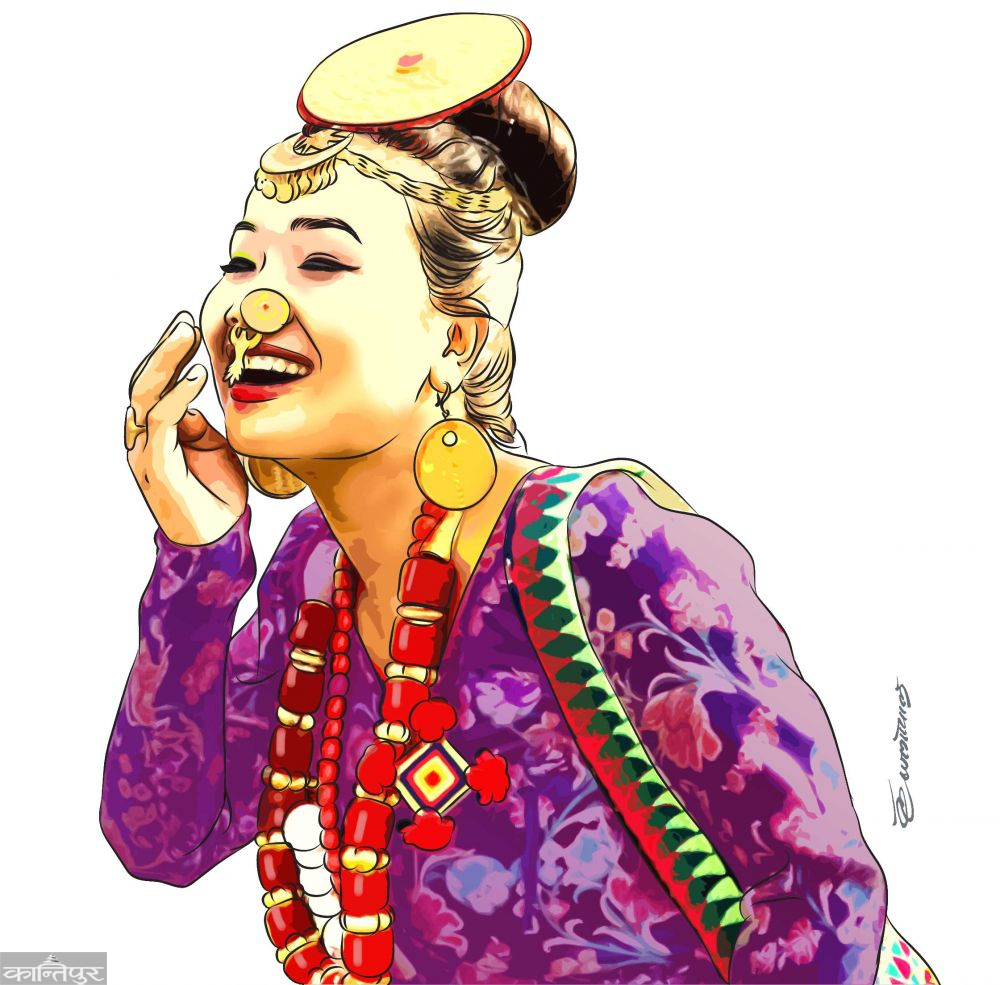
In Kirati Mundumi music, the drum is played in imitation of labor, and the drum (drum) is played in imitation of nature, imitating the movements of the Dhobi bird. Based on this, it can be said that Kirati music was developed for livelihood and life. Therefore, from the perspective of Kirati Mundumi music, it was not ‘art for art’s sake’, but ‘art for life’.
After discussing Mundumi music, let us remember the Sherpas of the Himalayan region. The entire life of a Sherpa is musical – from birth to death, who find themselves in the tunes of folk songs and folk instruments – they sing, play, dance. And, all the rituals of life are performed in the rhythm of music – from happiness to sorrow, they play songs (mantras) and instruments. In the book ‘Sangeet Parikrama’, Darnal writes, ‘Music has been a pillar in the culture and life of Nepalis living in the Himalayan region.’
Humla-based writer Kunsang Chiso remembers the Himalayan ‘Syabru’ in Kathmandu. ‘Syabru’ is an important part of the indigenous peoples of the Himalayan region. Syabru is danced/sung in groups in a circle. ‘Syabru songs address/worship nature, but do not use musical instruments. The tradition of dancing/singing in groups reflects the style of living in a community. This song describes creation, nature and life,’ says Kunsang.
Each country’s language, culture and geography play a profound role in its identity. And, original and unique music is born from human-natural collaboration.
In the opinion of critic and music connoisseur Gurung Sushant, Nepal is a rich source of indigenous music as it is a multicultural country. ‘Different cultural festivals, historical footprints and economic politics are involved in the creation of instruments, rhythms and vocal sounds of indigenous music. They are hidden. In particular, understanding the folk music of different communities in Nepal means not only understanding those communities closely, but also touching the original history of Nepal.
The folk music of a community not only exchanges joys and sorrows and philosophies within its own community, but also communicates with other communities within the country,' says Sushant, 'The instruments and rhythms invented by one community may be contributing to the lives of other communities. The reason is that the instruments and melodies popular in a community are not born in a hurry.
Music and instruments born in the course of historical necessity, common effort, and cultural journey carry a collective philosophy.' Therefore, preserving folk music in the capitalist era where individuals live fragmented lives within themselves also means realizing that we are 'us'. The music of the Himalayas, the hills, and the Terai is intertwined with the steps of the people living there.
The Nepali territory from Taplejung to Darchula is extremely prosperous- Folk music. Darnal has written, ‘Many traditional songs, ritual songs, religious songs, songs of fairs, songs of Jatras, songs that express joy and sorrow, are being sung by the people.’
In the opinion of lyricist and poet Biplav Pratik, who is fascinated by music, folk music is that which presents its identity, history and tradition with original instruments, melodies and rhythms. Folk music is mixed with the social, religious and cultural practices of the community and its journey from generation to generation to contemporary society is sequential, melody is dominant, not word. ‘However, as an exception, sometimes words come into it in a vocal form. It has carried the tune, melody and collective voice on its shoulders from generation to generation,’ says Pratik.
In his understanding, from the government that is trapped in its own system It does not seem that there is a concrete focus and encouragement for art, literature, theater, sports and music. Therefore, the local community should protect folk music. They remember the creators who saved folk music and give examples of revolutions over folk-modern songs.
One – The things that the previous government did not pay attention to have come out very loudly. Time is a witness to that. Therefore, the work of a few dedicated names is enough. In terms of archiving folk songs and folk music, as far as I remember, the efforts of Premdev Giri and Jhuma Limbu in the form of Tulsi Day and musical campaigns are commendable.
If possible, it would be a virtuous act if the industrialists' organizations identified such issues and did their best. The protection of art that has been stained by any government has never been sustainable in the world and cannot be.
Two – There are many examples of modern songs based on folk music. Those songs touch the hearts of the listeners and they give them a different identity. They make. In Nepal, certain songs composed by Natikaji, Gopal Yonjan, Narayan Gopal, Fatteman, Deep Shrestha, Bulu Mukarung, Nhayu Bajracharya and Suresh Adhikari etc. are examples of that.
Some songs composed by SD Burman of Hindustan are also examples of that. Among English songs, Led Zeppelin's 'Kashmir', Rolling Stone's 'Paint It Black' and Beatles' 'Norwegian Wood' can also be taken as examples, but they created music with a passion for Eastern classical or the music of a particular country.
Lyricist/poet Shravan Mukarung always feels that traditional songs and music have been distorted. 'Our traditional songs and music should be researched, protected and promoted. Friends involved in the field of creative songs and music should use it properly after obtaining permission. Unfortunately, now they are distorted by making them look like their own original creations or by modifying them. We find that folk music is being used,' he says, 'On the one hand, doing so is punishable, on the other hand, their creativity is also questioned.'
How to preserve or archive folk instruments, songs and dances? There is a debate from time to time. Only by preserving the style, method and influence of folk music can our cultural heritage remain rich. May the flowers of folk music bloom for ages.
00000
'Let folk music resonate in discos and bars too'
 Jhuma Limbu, folk music activist, musician and singer
On 21 Bhadra, there was a concert by 'Jhuma Limbu and the Folk Band' at the LOD Club in Thamel, Kathmandu. Has folk music now become mainstream? Has the day come when people will come and buy tickets to listen to folk music?
What is Raithane? Such a concert was organized to let the Sahariya know. When the concert was held at LOD, the largest club in Nepal, it attracted a lot of attention. Why do people listen to only disco music in big bars and clubs? They also want them to listen to our Raithane songs. Tickets are selling fast. The idea that we should be sensitive to this Raithane music, that this is our music, has started to grow among people.
Just like people choose Raithane food because it is our local music, people have started looking for Raithane music. Whatever is ours, that local property has not been coming out for a long time, it has been a decade at most. It must have been after the people's movement of the 60s at most. I now feel that Raithane music is in the mainstream.
Now the day has come when I can eat rice by singing songs, it was not that long ago. Often when I talk to analysts, I hear them say, 'Our Raithane music is in a crisis, facing crisis, it is difficult to come out.' That They don't know. Don't worry too much. We are working.
The Raithane Sangeet Yatra is taking place in other cities besides Kathmandu, what is your objective?
The Raithane band aims to promote cultural identity through musical tours. The band will reach various cities and villages and perform local folk music - Hakpare, Palam, Chhyabrung, Ghatu, Sorathi, Deuda, Maruni, and other music and dance. This tour connects the music of the village and the city. We also hope to bring culture and music to the new generation. The Raithane tour will stand as a bridge to connect the music and culture of the village and the city.
How are the Raithane dialects, songs, and music connected to the life of the people?
Just as the Raithane language is determined by the topography of the place, music is also related to and influenced by the topography. The original place of the Limbus is somewhere very steep, with huge rocks. There are mountains and plains somewhere. If we look at the notation of our Hakpare, the influence of those places can be found in its musical structure. It is easy to know from the structure of the Limbu language and what kind of place these people live.
Like in other languages, when calling someone from all four directions, from below, above Art is culture, patriotism. Everyone should understand that a civilization moves forward when many cultures come together. Patriotism is connected to geography, climate, and soil. Culture and language are all connected.
Earlier, there was a thing called folk songs or folk music, but when you say patriotism, it encompasses everything. Not only folk encompasses, patriotism encompasses everything. However, there is no line separating folk and patriotism. We still need to find locality. There is music, but where is Nepali music? Searching for it is disappointing.
The language is ours, but music belongs to others. We have lost patriotism, lost our identity and our own things. My big dream is to see Nepali music standing on the world stage by creating its own original identity. That day will come, but we do not know our own culture. It means that people who know it should come.
Why did Nepali patriot instruments not enter the mainstream?
There are instruments in Nepal that are equal to the number of languages and ethnic groups. However, these instruments were limited to ethnic and regional forms. There are many instruments, but they are not recognized. Instruments other than Newari could not become professional. On the contrary, the Magar community has spread throughout Nepal. If only a dozen of Nepali instruments were brought into the mainstream, how high would Nepali music have reached?
How much has the meaning of traditional music expanded? What is the musical literacy of Nepalis?
We did not have ‘music education’. Classical-folk-traditional music should be taught in the course. But we never did that. But fortunately, jazz schools were opened in our time, and it also became a place where musicians from all over the world could meet. Since there was no ‘music education’, we did not take our language, songs, and instruments seriously. Recently, after ‘ethnic music’ was started in Kathmandu University, some bands are being born due to its influence. We are just at the beginning. The country has seen the results of this campaign since it started. We have to wait 50/60 years. We are in the initial stage now.
What are you working on with folk songs and music?
I am doing a lot. An album is coming soon. Earlier I worked in many languages, Tamang or Limbu. Now I am working in Nepali language