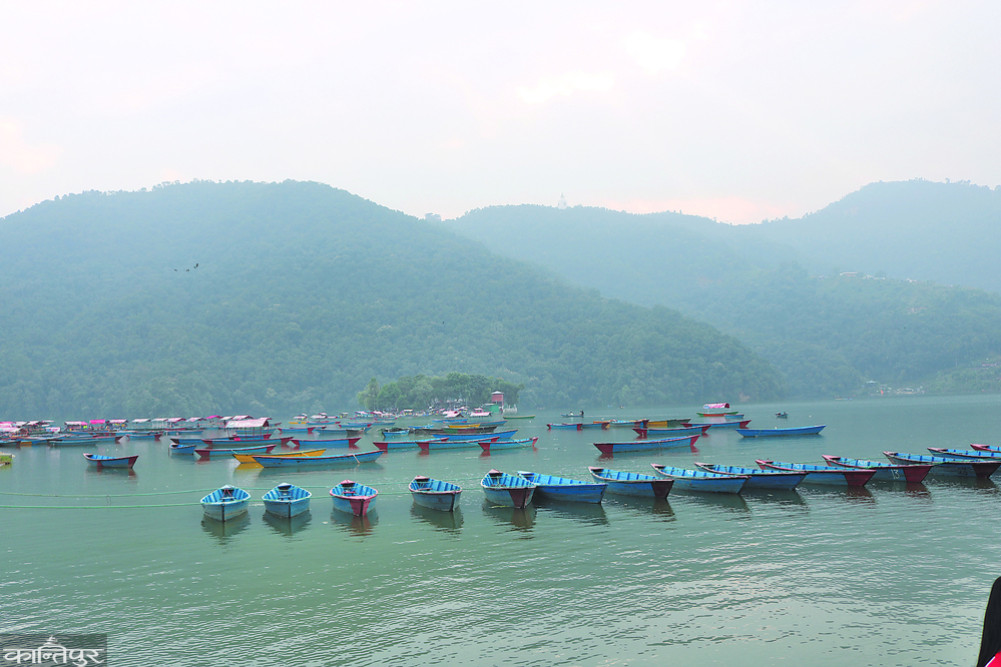
The boat business, which started by drilling holes in Simalka wood according to religious rituals and local needs, started commercial travel in the 2050s.
We use Google Cloud Translation Services. Google requires we provide the following disclaimer relating to use of this service:
This service may contain translations powered by Google. Google disclaims all warranties related to the translations, expressed or implied, including any warranties of accuracy, reliability, and any implied warranties of merchantability, fitness for a particular purpose, and noninfringement.
Pokhara is the main tourist city of Nepal. The natural beauty here, the panoramic view of Taltalaiya and the Himalayan range is constantly attracting tourists. The ferry business has added a distinct attraction to Pokhara, which is also known as the city of Taltalaiya.
The ferry operating in Pokhara has a distinct history. Although the boat journey here, which started by making a hole in the Simalka wood, reached aluminum and motorboats, wooden boats are still popular in most of the lakes here. The history of ferry operation in Pokhara's Phewatal is believed to have started from the middle of the 20th century. The beginning of ferry operations in Phewatal is linked to religious and local needs. Especially the practice of using a boat to reach the Talbarahi temple in the middle of the lake has started.
82-year-old Mehrman Shrestha, a resident of Dikopatan, Lakeside, Pokhara Metropolitan City-6, recalled the past and told that the ferry has been operating since 1950. Although Pokhara is a city of lakes, ferries are operated commercially in the big lakes Phewa and Begnas. In history, the first ferry was operated in Fewatal. "We don't know the exact time when the boat started to operate," Meyerman said, "we estimated that time based on the activities we experienced and the stories told by our grandfathers."
He told that there is no option to go by boat to visit the Barahi temple in the middle of Phewatal. "Earlier, the importance of the boat was religious, now it has started to be seen as a tourist along with religion," he said. He said that Pokhara's ferry business is ahead in terms of religion and tourism.
According to the locals, in the beginning, the residents here used simple wooden boats for their religious rituals and needs. Not only visiting the temple, but the locals used to come and go by boat. Even children used to go/come to school by boat. Gradually the use of boats started to increase. The number of tourists coming to see the lake was increasing. According to local residents, when the Phewatal area began to develop as a tourist destination in the 1950s, boat operations began to expand commercially.
Baburam Giri, president of Phewa boat business association, narrated the experience of his own father making a boat by drilling holes in simal wood around the year 2021/22. We have seen directly that my father built and operated a boat. We have gained experience," he said, "After the increase in the use of boats, the organization was registered and started operating professionally in the year 2052." Now there are 8 ghats on Fewa shore. 800 boats ply daily from all these ghats. Boats registered with the committee are operated individually. "Even if the boat belongs to an individual, we allow it to be operated collectively," he said.
In the year 2051, an employee of the Fisheries Development Committee taught that two pieces of wood can be joined together to make a boat, and then he started making a big boat by joining the two, Giri said. He said that before the organization was registered, a small boat made of wood was being operated, but recently, big boats were also being operated.
After the 1970s, with the arrival of foreign tourists in Pokhara, local Shantimaya Pahari says that the ferry operation in Fewatal was established as a tourism business. The natural beauty of the lake, the religious importance of the Talbarahi temple and the view of the surrounding mountains made Dunga Sayer popular. Nowadays, the colorful boats and pedal boats in Phewatal have become the main attractions for tourists. The ferry business has also played an important role in the livelihood of the local community. A single family runs up to 5 boats daily in Phewatal.
Boat driver Vimala Gurung said that she was earning her living from the boat. "There is a risk," she says. Lately, the land has been encroached upon. The size of the lake is decreasing. Because of this, the ferry committee has not been able to increase or decrease the number of ferries. Chairman Giri said that the addition of boats has been banned because the water will be covered when there are boats across the lake.
In the same way, boats have been operating in Begnas lake since 2038. In the year 2052, the Begnas Dunga Business Committee was formed and started to run regularly. There are currently 381 boats operating in Begnas Lake in Pokhara metropolis. 8 aluminum motorboats and pedal boats are also operated. According to the chairman of the committee, Ravi Kandel, three motorboats were kept in 055.
President Kandel said that although a new motorboat was put in last year at a cost of 50 million, it was not put into operation because of permission from the metropolis. There are 381 share members in this committee. Everyone has invested. The boatmen became angry after the local government stopped it. Hotels, businesses are also drying up. He said that the number of tourists has decreased recently as the big boat is not operational in the lake.
More tourists come here on holidays and Saturdays. "A plant here has to wait 15 to 19 days to get its turn," he added. Now 20 to 25 boats are regularly operating in this lake daily. Boats are not operated commercially in Rupa Lake near Begnas. 11 boats are used for fishing while one is kept for rescue. Also, the boat committee has been operating one rescue boat (motorboat) in Begnas and Phewa lakes.
Buddhi Bahadur Nepali, founder president of Phewa Dunga Business Association, said that Pokhara's dunga is a tradition. He said that the safety policy has also been tightened recently to address the problems of boatmen. "Now life jackets have been made mandatory," he said, "we have deployed a disaster rescue team at the lake side."
It is said that the boat business in the lake of Pokhara is also supporting the tourist attraction. Along with opportunities, challenges have also been added to the ferry business here. Pomnarayan Shrestha, a tourism businessman from Pokhara, said that he took the boat accident as a challenge.
'Deterioration of water quality in the lake, pollution and loss of biological diversity are the main challenges faced by the boat business here,' he said, 'disorganized business, protection of natural resources, technical problems, government policies and taxes, risk of accidents can be considered as challenges. .'
If the number of boats plying on the lake and its management are not properly regulated, there may be accidents and environmental damage. Suvas Adhikari said.
'Lack of boat operating equipment, maintenance costs and lack of skilled manpower are the challenges here,' he said, 'Tourism promotion, creation of local jobs, development of sustainable tourism, kayaking, paddle boat and culture and tradition promotion, international It is necessary to advance the publicity as an opportunity It is necessary to create a special policy for this. Life jackets, trained staff and emergency rescue must be arranged with strict adherence to safety standards.
The use of digital technology i.e. online booking system and a platform for taking tourists' feedback, community participation i.e. developing a sense of ownership by involving the local community in the business and developing a sense of ownership in the sustainable and effective management of the challenges faced by the boat business here should not be delayed anymore.