The Guardian reports that the trend of incorporating AI into the business and use of war and weapons has gone far ahead of international regulatory efforts.
We use Google Cloud Translation Services. Google requires we provide the following disclaimer relating to use of this service:
This service may contain translations powered by Google. Google disclaims all warranties related to the translations, expressed or implied, including any warranties of accuracy, reliability, and any implied warranties of merchantability, fitness for a particular purpose, and noninfringement.
As the Russia-Ukraine war enters its fifth year, Britain has announced that it will provide Ukraine with 120,000 drones. These drones are equipped with cutting-edge AI technology, according to international media. British Defense Minister John Healy announced this aid package before a meeting of the ‘Ukraine Defense Contact Group’ held in Germany on Wednesday.
This package includes drones that can carry out long-range attacks, spy, transport necessary supplies or medicine to the battlefield, and can be used at sea. Most of these drones are manufactured by British companies, according to BBC journalist Ottilie Michel. Russia also announced in 2014 that it would make 30 percent of its military force automated or autonomous by 2025. These events show how the AI arms race is expanding in the world.
New York Times journalists Shira Frenkel, Paul Mosur, and Adam Satriano have reported extensively on the increasing competition for military dominance in AI as tensions between different countries around the world escalate. According to the report, the next war will be between software and machines, not between people. “Countries are already preparing their technological capabilities to counter drones and algorithms against algorithms,” the report said. The report suggests that countries are now stockpiling software, chips and advanced digital systems, just as they are stockpiling weapons.
A similar report published by The Guardian in early April found that the trend of incorporating AI into the business and use of war and weapons has gone far ahead of international regulatory efforts. The US is leading the way in building AI ‘brains’ such as chatbots and microchips, while China is leading the world in building robots and human-sized machines, or AI ‘bodies,’ according to a BBC report titled ‘China is Winning One AI Race, the US Disrespects...’. China currently exports 90 percent of the world's humanoid or human-sized robots.
According to former Navy SEAL Brandon Cheng, who spoke to The Wall Street Journal, the US Department of Defense, Pentagon, is currently increasing investment in technology and AI-based defense systems. Cheng said that the Pentagon is currently focused on the 'Drone Dominance Program' and the main task of this program is to destroy enemy drones (loitering munitions) in the sky with the help of AI. The US is developing various drone weapons such as the Switchblade 600, Collaborative Combat Aircraft (CCA), and Golden Dome. Golden Dome uses satellites to track and destroy missiles or drones launched by the enemy. CCA is a drone that provides protection to fighter aircraft. The US is developing various drone weapons such as the Switchblade 600, Collaborative Combat Aircraft (CCA), and Golden Dome.
China, which is constantly competing with Western technology in AI's large language model and generative AI, seems to have achieved a lead in drone technology. Media reports have reported that China has made significant efforts in operating nearly 22,000 offensive drones as a single unit, as well as in AI-based radar and fighter aircraft.
Russia has built unmanned and AI-based aircraft such as the 'Hunter-B' and the Lancet drone. Israel, which has long been involved in conflicts in West Asia, has also been investing in AI-based weapons and technology. The US has been making extensive use of AI in collaboration with Israel in various technologies including the Golden Horde, V-Bat autonomous drone, and Smash Optic. In February, the Pentagon was revealed to have used 'cloud' AI to take control of then-President Nicolas Maduro of Venezuela.
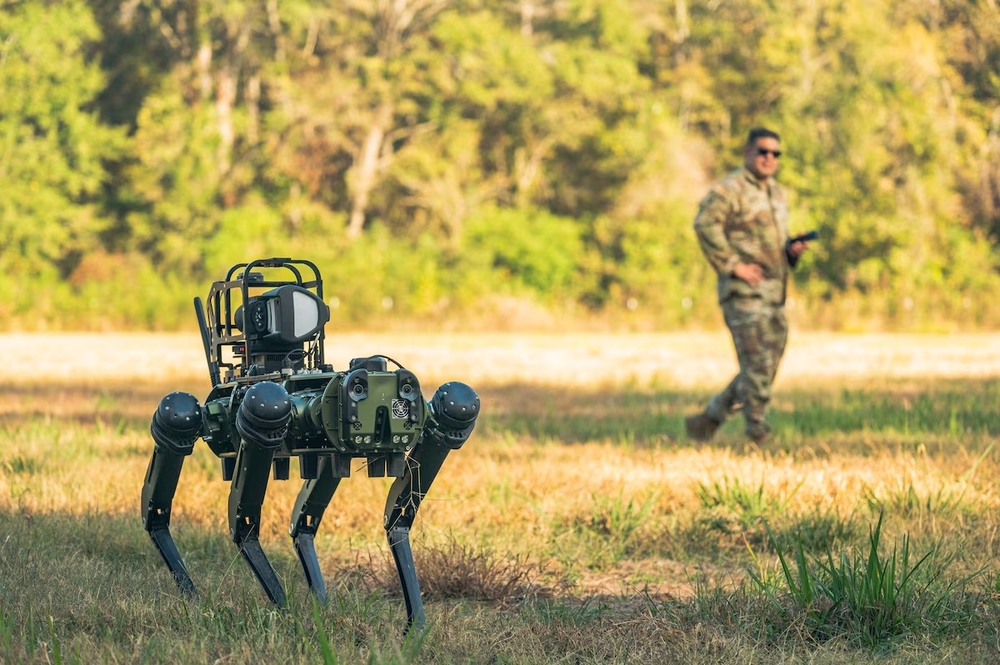
As AI, such as Cloud, has become increasingly used in battlefield intelligence and data processing, competition is also expanding in space-based security systems. According to The Strategist, both the US and China have accelerated the development of microwave weapons and lasers since the use of AI-based lasers, including those used to shoot down each other's satellites. Military planners claim that these systems provide the ability to defend against drones.
There are also widespread concerns that AI-based weapons could pose serious risks. At the recent summit on the 'Responsible Use of AI in Military Activities' (RIEM) held in A Coruña, Spain, defense experts, diplomats and technology experts from around the world expressed fears that 'the speed of AI could surpass human judgment.'
‘Countries should outlaw machines making life and death decisions,’ said Elizabeth Minor of the Stop Killer Robots campaign. ‘For AI, humans are just data points. If an AI algorithm is told to shoot something that is this tall, this tall, and this colored, it doesn’t care whether it’s a child or an old person. Any weapon that reduces a human to a data point is unacceptable.’ According to The Strategist, both the US and China have accelerated the development of microwave weapons and lasers since the use of AI-based lasers, including those used to shoot down each other's satellites.
Others in policymaking and technology have also pointed out the moral and strategic risks of the latest race. Steve Goose, an arms expert at Human Rights Watch, has warned that people’s concerns about autonomous weapons systems are at a critical juncture.
This sentiment is also echoed in international diplomacy. UN Secretary-General Antonio Guterres has said that giving a machine or algorithm the right to take life and conscience without human intervention is politically unacceptable and morally reprehensible.
Despite these warnings, there is no sign of stopping the AI arms race. Bloomberg predicts that the global market for autonomous or AI-based weapons will more than double to $33 billion by the end of this decade. Despite diplomatic efforts such as ‘RiEM’ to promote responsible AI use, competition between countries continues. Experts conclude that regulation of AI use in military and war operations has lagged far behind technological development. –With the help of the agency

