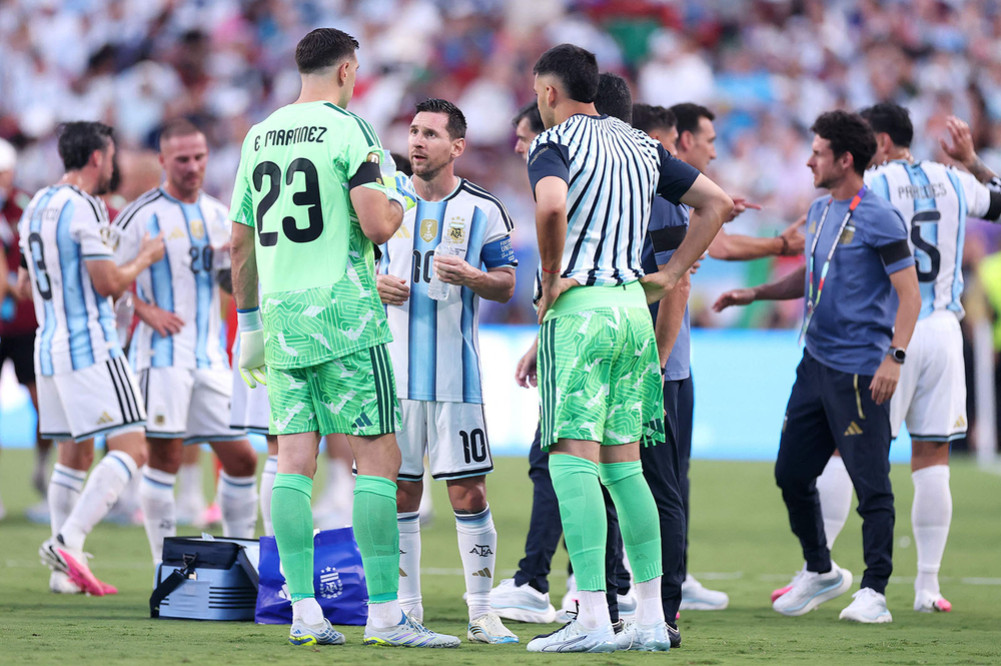
In this World Cup, FIFA imposed a mandatory three-minute hydration break in each half of each match.
We use Google Cloud Translation Services. Google requires we provide the following disclaimer relating to use of this service:
This service may contain translations powered by Google. Google disclaims all warranties related to the translations, expressed or implied, including any warranties of accuracy, reliability, and any implied warranties of merchantability, fitness for a particular purpose, and noninfringement.
Arsene Wenger, FIFA's head of global football development, claimed on Saturday that the hydration break rule used at the 2026 World Cup did not disrupt the game. Nor did it affect the outcome of the match. But whether the rule will remain in place is still undecided.
Former Arsenal coach Wenger said that this rule will be reconsidered. In this case, it is not certain whether this rule will be mandatory or not in the next major football tournament. In this World Cup, FIFA imposed a mandatory three-minute hydration break rule in each half of each match.
But not everyone had the same opinion on this. Some strongly opposed it, while others claimed that this rule was necessary. Critics of this rule claimed that after the hydration break was implemented, the game itself was divided into four parts and that it spoiled the rhythm of the game. Similarly, hydration breaks were also criticized for only helping to play advertisements on television. It was also said that it only benefited the television broadcasters financially.
During similar games, spectators were also seen opposing hydration breaks most of the time, especially in the league stage. But Wenger said, ‘The hydration break did not have a direct impact on the game, especially on the results. But some people did not like the rule. So we will analyze what the effect of this rule was and make a further decision on it.’
He added, ‘For me, this result has helped someone win and someone lose throughout the tournament. But what really matters is what our primary football is, what the players and spectators feel.’ During the tournament, Spanish coach Luis de la Fuente and Netherlands captain Virgil van Dijk supported this rule. They claimed that such a rule was needed in the scorching heat.
Coach Fuente supported this rule, saying that for him the health of the players is the most important thing, so we have to be serious about it. But England captain Thomas Tuchel opposed this rule, accusing it of spoiling the rhythm of the game.
Uruguayan coach Marcelo Bielsa also criticized the rule more. He said that the rule did not benefit football at all and that it actually damaged the very nature of the game. Some World Cup matches were played in the United States, Canada and Mexico in adverse weather conditions. Some of them were played in extreme heat. Some were played in cold weather. But hydration breaks were also taken after each match.
Wenger added, ‘In some matches, this rule was almost mandatory. But we did not want to remove this rule in some matches and there was confusion. So this rule was applied to every match. At the end of the tournament, we will definitely review it seriously. From a medical point of view, such a rule is also needed in some matches, but we have not decided that this is what we are going to do.’