What was Kathmandu's World Cup experience like in the 1980s and 1990s? 1986 was the first opportunity, when Kathmandu was first introduced to World Cup football.
We use Google Cloud Translation Services. Google requires we provide the following disclaimer relating to use of this service:
This service may contain translations powered by Google. Google disclaims all warranties related to the translations, expressed or implied, including any warranties of accuracy, reliability, and any implied warranties of merchantability, fitness for a particular purpose, and noninfringement.
‘Thank you for publishing the news about the preparations for the World Cup in Mexico’ This is part of a letter written to the editor by Lalit Shrestha of Kshetrapati Kathmandu. The title of this letter, published in The Rising Nepal on May 27, 1986, is ‘Mexico 86’. The letter further states, ‘Every day, some news is coming about the different teams, their objectives, strengths and weaknesses. All of them are informative. We are confident that similar news will come when the competition starts on May 31. We do not have a TV at home, so we will rely on the news that comes to The Rising Nepal.’
The 2026 World Cup is about to start. Supporters are buying the jersey they like. Some are copying the ‘hairstyle’ of their favorite players. Nowadays, fans watch the World Cup on big TVs, and that too in public places. And also in restaurants. Today's TVs are also 'smart'. You can even watch the World Cup on your 'smart phone'. The World Cup is all over Twitter, Facebook and TikTok. Even small details about each team are easily available. But what was Kathmandu's World Cup experience like in the eighties and nineties? 1986 was the first time Kathmandu had been involved in World Cup football for the first time.
TV had just entered Kathmandu and it was considered a luxury. In such a situation, newspapers used to be the main source of news for the World Cup. If you turn the pages of newspapers from 1982 to 1998 now, you will find 'letters to the editor' with similar content. And all those situations were not at all like they are now. These were all things before the internet and the digital age. There were only two dailies in Kathmandu, and they did not have much news about the World Cup. NTV had thrilled Kathmandu by broadcasting the World Cup matches. But the issues at that time were different, the broadcast of the matches was disrupted due to load shedding.
Maradona was under his own ban. This shocked football fans in Kathmandu, they did not believe the news. Some felt betrayed. Kathmandu was covered by the impact of the World Cup, but the women of Kathmandu were not very interested.
Football fans disappointed by the lack of news
Until 1982, Gorkhapatra and The Rising Nepal were the only sources of news, but the three did not give much news about the World Cup. For football lovers in Kathmandu, this was nothing but disappointment. Football had already entered Kathmandu in the 1920s, and Nepal's first and government-owned Gorkhapatra had even started publishing in 1901. However, there was no news about the first World Cup in 1930. A short news article about the 1958 World Cup may be the first historical occasion. Apart from that, there was either no news or very little news about the World Cup until 1982.
By 1982, interest in the World Cup had started to grow rapidly. But Gorkhapatra and The Rising Nepal did not cover it in a timely manner. The Rising Nepal itself started in 1965. JP Rauniyar of Indrachowk was a football fan, so he was disappointed with this trend. He also wrote a letter to the editor of The Rising Nepal, titled, ‘Football Fever’. The letter, published on July 2, 1982, states, ‘Football is the most popular sport in Nepal. There is extensive news about the World Cup in the international media.’ There is equal talk about live broadcasts and radio commentary. But The Rising Nepal is an exception, why?'
By 1986, many news about the World Cup started appearing in newspapers and magazines, and this was a joy for football fans in Kathmandu. At that time, there was not only special news about the World Cup, but a special place was set aside for the World Cup, and the World Cup also started attracting the attention of editors.
The joy brought by the World Cup broadcast
By 1986, TV was slowly entering every household in Kathmandu. This was a big turning point for us regarding the World Cup. Nepal Television had started broadcasting World Cup matches for the first time. This brought immense joy to the general football lovers. A letter from Sudhir Sigdel of Thamel has been published in The Rising Nepal on June 3, 1986. In it, he wrote, 'My heartfelt thanks to Nepal Television for deciding to broadcast the World Cup games.' Nepal Television and the games it broadcast dominated the atmosphere for the World Cup between 1994 and 1998.
A news item published in Gorkhapatra on June 8, 1998 was titled, 'Live Broadcast of the World Cup: Nepal Television Ahead in South Asia'. Nepal Television and the World Cup had established a culture of watching TV in Kathmandu. Sales of televisions also increased during the 1990s and subsequent World Cups.
The headline of a news item published in Gorkhapatra on June 5, 1998, was, 'Most football fans in the capital are eager to buy TVs to watch World Cup football'. This news item reads, 'In 1990 [...] at that time, not every person had a television in their home, people used to buy them, but this time everyone has a television in their home, so where will the sales and distribution increase?'
Newspapers were usually full of TV sales ads during the World Cup. On June 6, 1990, Ronisonic published an advertisement in Gorkhapatra, which said, ‘Ronisonic is bringing the 1990 World Cup to your doorstep.’ Ronisonic’s 14-inch TV’s sound and picture are not only clear, but also natural.’ Samsung had announced at the same time, ‘The 1994 World Cup on Samsung’s color screen.’ This advertisement, published on June 23, 1994, was about a 20-inch color and 14- and 17-inch black-and-white television. Two days later, Philips published another advertisement. It said, ‘Get ready to watch the FIFA World Cup on Philips’ PowerVision color television.’
Nepal was not limited to the excitement of the World Cup broadcast on television, all these events were also broadcast on television. The general audience was equally concerned about the timing of the games and the rebroadcasting of those games. Sudhir Sigdel wrote a letter on June 3, 1986. The gist of it is, ‘What I would like to suggest is that the games should be rebroadcast at 7 am. This will also be new for the audience. If the same game is repeated and broadcast in the evening, by then the audience will have known the result of the game on the radio.’
The time difference between the games was a problem for many. The games were broadcast live at midnight in Kathmandu. It was difficult for the general audience to balance the time of football and sleep. That is why on July 6, 1994, Sharad Pradhan of Ombahal wrote a letter to the editor of The Kathmandu Post. It said, ‘The problem of the general audience is that they do not sleep for the games. It is difficult to stay awake during the short gap between the first and second games. Therefore, it would be good if Nepal Television showed not only special programs of songs, dances, and comedy serials, but also entire TV movies at this time. If there is a gap of three hours between two games, Hindi or Nepali movies can be shown.’
Some fans also had objections to the way Nepal Television broadcast the game. In a letter to the editor published in Kantipur on July 9, 1998, Sanjay, Shri Kamal, Birendra and friends in Kathmandu wrote, ‘We are saddened that Nepal TV has shown advertisements at the peak of the game, depriving us of watching the most important moment of the game, despite the live broadcast of the semi-final match between Brazil and Holland under the World Cup on July 7, which most sports fans are watching with great interest after falling asleep. We are saddened by the fact that Nepal TV has shown a reckless tendency to show advertisements even during the broadcast of the last important match of this century. [...] We feel that our national broadcasting organization [...] has betrayed the trust we have placed in it.'
The impact of load shedding
By the time the 1998 World Cup was about to begin, load shedding had already begun to affect daily life in Kathmandu. Nepal Television had been disrupting the live broadcast of the World Cup matches. On June 9, 1998, a news article written by Suman Malla of the Kathmandu Post said, 'Nepali football fans are scared of a power outage. They are also praying that this will not happen. The fear is that half of Kathmandu's television sets will be off as the World Cup progresses in France.' And Wijesh Ghimire said in that news article, 'I am currently preparing for my final year medical examination and in the meantime, I have set aside some time for the World Cup.' I think this time will be wasted.’
How much load shedding made many people unhappy is evident from the letter to the editor. In a letter published in Kantipur on June 29, 1998, Upendra Lamichhane of Mulpani writes, ‘The World Cup 98, which is being watched live on television by about 4 billion people in the world, is not being watched by those interested in Nepal due to load shedding. That is why the Nepal Electricity Authority started load shedding from 5 pm. Now, almost all the matches start at 8:15 pm. The viewers would not have been deprived of watching the pre-quarter final final match.’
Shock, anger and protests over Maradona’s ban
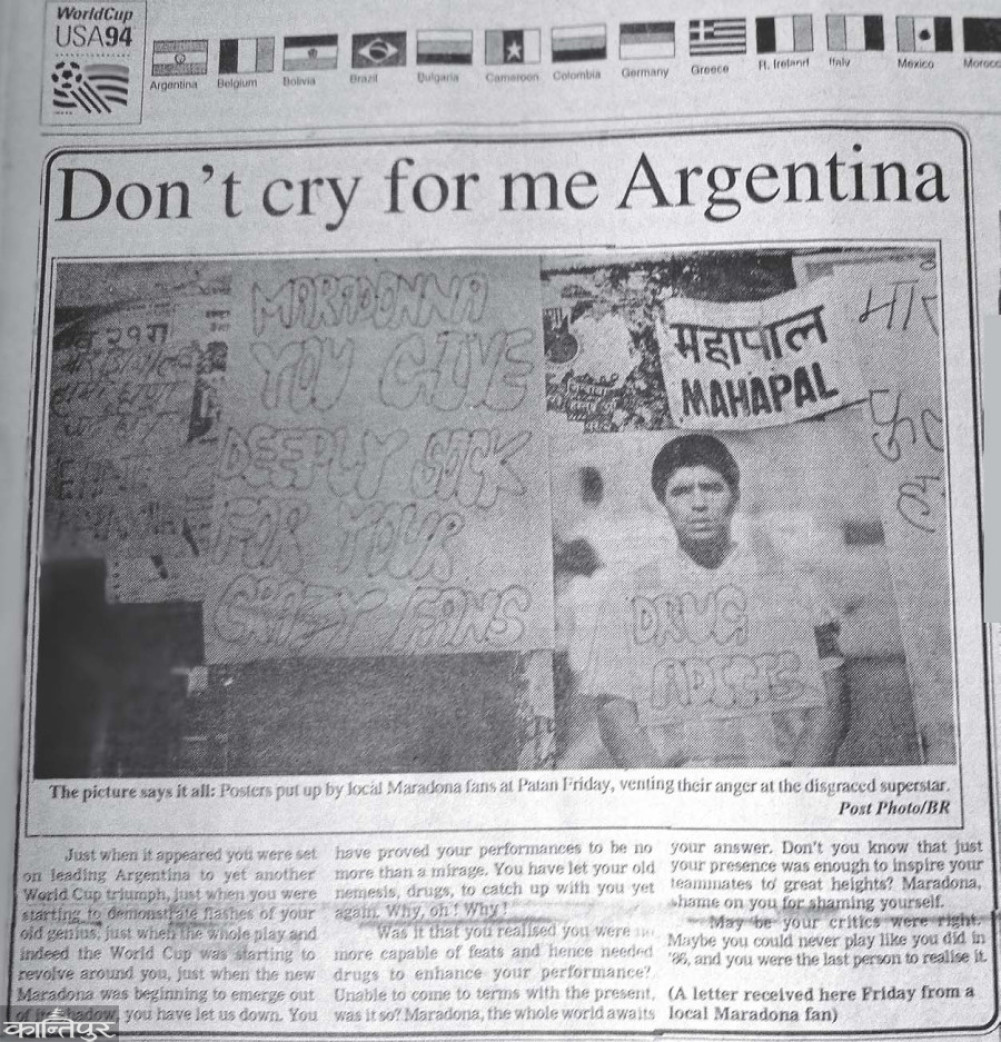
The 1986 to 1994 World Cups that Kathmandu saw were dominated by one player. Maradona’s performance in the 1986 World Cup was outstanding. That's why many Kathmanduites were moved by his game. Those who saw Maradona cry when Argentina was defeated by Germany in the 1990 World Cup final also cried. In the 1994 World Cup, the same Maradona failed a banned drug test and was banned. This was not acceptable to his supporters. The newspapers of that time tried to portray the anger and sadness shown by Nepali supporters.
The headline of the news that appeared in the Kathmandu Post on July 3, 1994 was, 'Nepali supporters shocked after Maradona was banned'. After Maradona was expelled from the World Cup, the whole world became emotional, Kathmandu was no exception. This incident saddened supporters of all age groups. Maradona was a familiar face to everyone by then. That's why the reaction of many was mixed, the news said. Buddhi Sagar, an employee of the National Sports Council, said, ‘The Maradona incident has shocked me. I became emotional, I could not hold back my tears. What I do not think is that Maradona used banned performance-enhancing drugs. I have decided not to watch the remaining matches of the World Cup from now on. For me, the World Cup without him is like tea without sugar.’
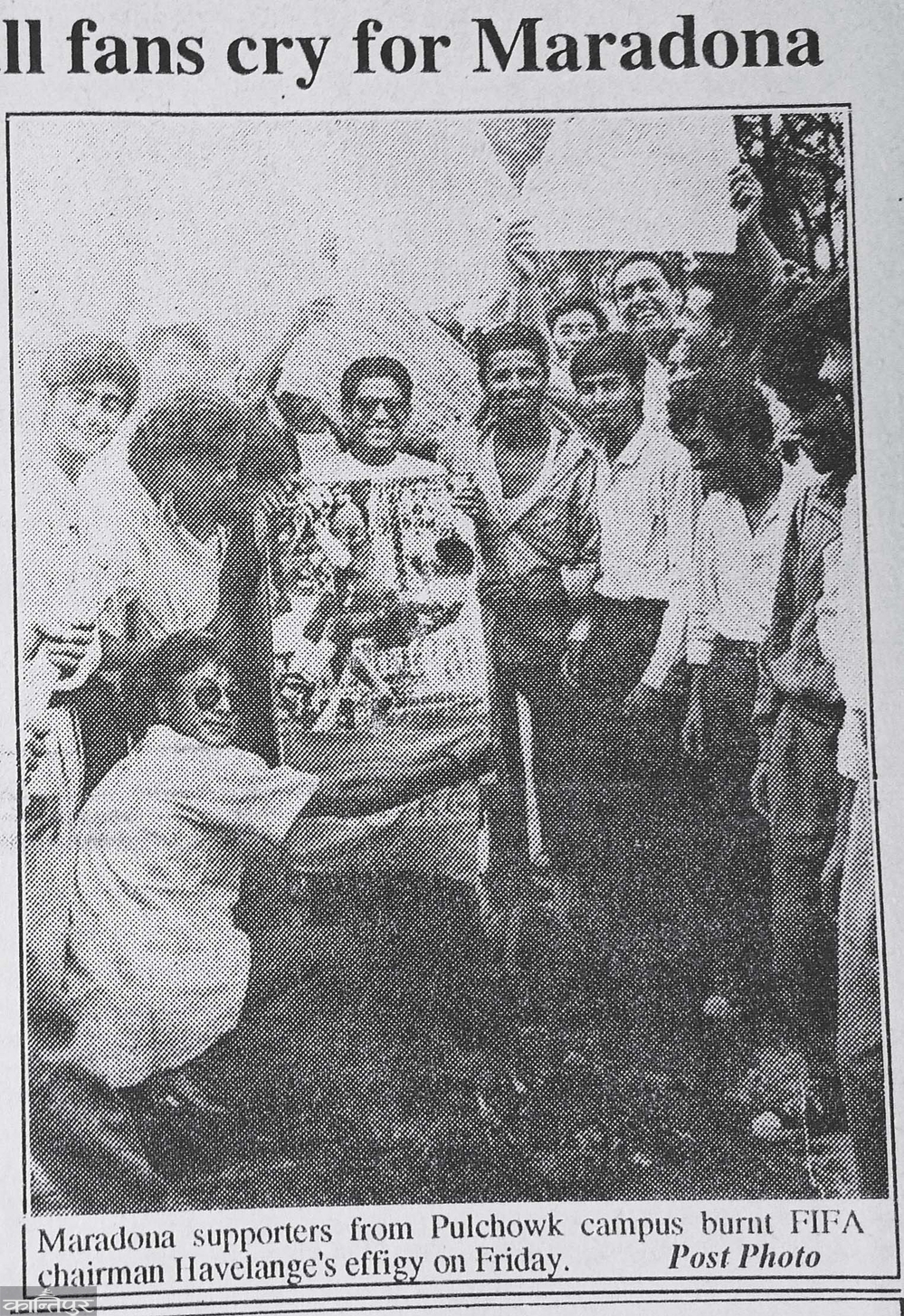
Sudha Lama, a big supporter of Maradona, also said, ‘I love him very much. He is a great player. I am disappointed that FIFA has treated him wrongly.’ Students of Pulchowk were equally emotional about the incident. The headline of a news published in the Kathmandu Post in 1994 was, ‘Football lovers of Pulchowk campus are crying for Maradona.’ It read, ‘Uncle Maradona, we are missing you.’ You are a victim of FIFA's conspiracy. If there is no Maradona, there is no World Cup. FIFA should be ashamed. FIFA should be dissolved, FIFA's president should be removed.'
The students also burned an effigy of FIFA president Joao Havelange. They also accused a star player as big as Maradona of being treated unfairly. And as part of the protest, they decided to boycott classes for eight days. But not everyone was in Maradona's favor. In a letter to the editor published on July 2, 1994, one person wrote, 'No one needs to cry for Argentina. Argentina has really disappointed us.' This incident has proven that Argentina's performance was just a mirage.' The Kathmandu Post also published a picture in which an Argentine fan from Patan expressed his anger towards Maradona through a poster. It read, 'Drug addict. Maradona has made us sad.'
Women's disinterest in the World Cup
The Maradona incident did not affect all Kathmanduites. What's more, the women of Kathmandu were not very interested in the entire World Cup. Sushil Thapa wrote in The Kathmandu Post on June 21, 1994, 'Football has never been a subject of interest for women.' The news said, 'The World Cup has attracted women from all over the world. This does not apply to Nepali women. काठमाडौं पोस्ट गरेको सामान्य सर्वेक्षणमा के देखिएको छ भने ९० प्रतिशत महिलालाई विश्वकपमा रुचि छैन र यो स्तब्धपूर्ण रहेको छ । अधिकांश महिलालाई फुटबल हेर्नेसम्ममा पनि रुचि रहेको छैन ।’ त्यस समाचारमा प्रतिमा प्रधान भन्छिन्, ‘टेलिभिजनमा ९० मिनेट फुटबल हेर्नु असाध्यै नरमाइलो लाग्छ ।’
फेरिएको स्थिति
१९९८ यता २००० र २०१० तिर इन्टरनेट र मोबाइल फोन अस्तित्वमा आइसकेका थिए । यसले काठमाडौंको विश्वकप अनुभवलाई पनि फेर्ने काम गरेको थियो । काठमाडौं पोस्टमा २०१० को जुन २० मा प्रकाशित दिनेश वाग्लेको समाचारको एउटा शीर्षक थियो, ‘ट्विटर विश्वकप’ । यसको अर्थ थियो, काठमाडौं डिजिटल विश्वकपतर्फ अग्रसर रहेको थियो । उनले लेखेका छन्, ‘२००२ मा मैले विश्वकप अनुभव इमेलबाट साटेको थिएँ । आफूलाई मन पर्ने केही खेलाडीको तस्बिर पनि डाउनलोड गरें । खेल तालिकाका लागि वेबसाइट हेरें । अनलाइनतिर आफ्ना विचार पनि पोखें । त्यसको चार वर्षपछि २००६ मा मैले विश्वकपबारे वेब साइटमा आफ्नो ब्लग लेखें ।’
अब पत्रपत्रिका र टेलिभिजन नै सबथोक रहेन । डिजिटल र सामाजिक सञ्जालमा सबै खाले समाचार उपलब्ध छन्, ती ‘टेक्स्ट’ का रूपमा मात्र होइन्, श्रव्यदृष्यमा पनि उपलब्ध छन् । यसले काठमाडौंको विश्वकप अनुभवलाई पक्कै फरक बनाएको छ । पत्रपत्रिका, रेडियो र टेलिभिजन सबै एउटै सानो यन्त्रमा समेटिएको छ, मोबाइल फोन र त्यसमा उपलब्धि इन्टरनेटका प्लेटफर्ममा । अब त विश्वकप हेर्न पनि पहिले जस्तो सबै एकै स्थानमा भेट्न आवश्यक छैन, जसरी सन् अस्सी र नब्बेको दशकमा हुने गर्थ्यो । अब त लोडसेडिङको मार पनि रहेन, न त दोहोर्याएर प्रशारण हुने खेलको रौनकता रह्यो । काठमाडौंलाई मन पर्ने कोही खेलाडी प्रतिबन्धमा पर्छ भने अब प्रदर्शनको पनि आवश्यकता छैन् ।
ट्विटर, फेसबुक र अन्य सामाजिक सञ्जालमा लेखे पुग्छ । अनि सबैको हात हातमै मोबाइल फोन भएको स्थितिमा कोही कसैले खेल तालिकाबारे कसैलाई सोधिरहन पनि आवश्यक छैन ।