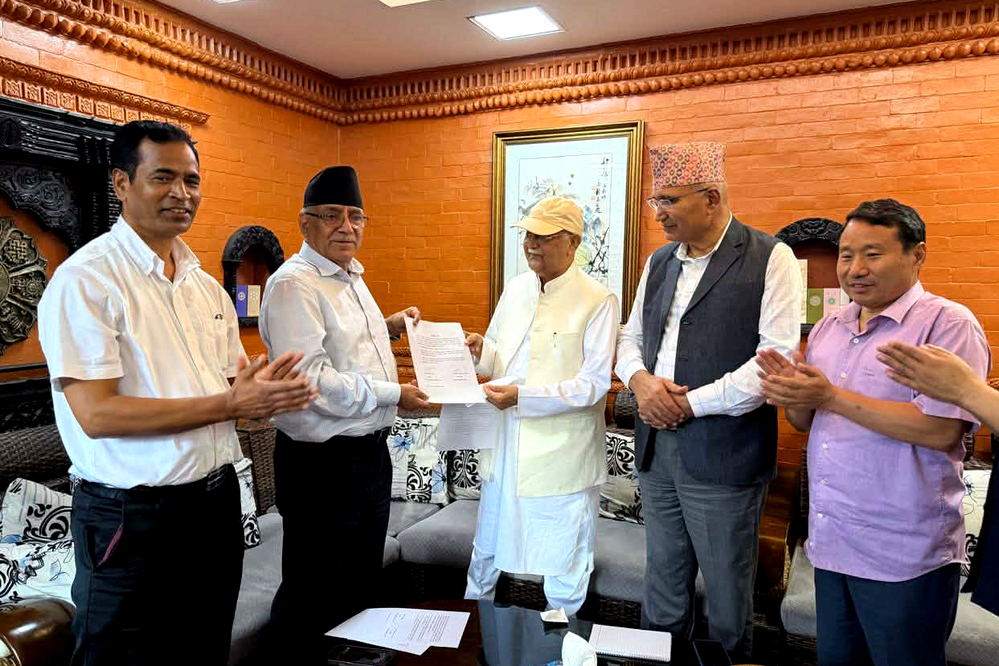
With an agreement to form a ruling coalition in the five provinces except Gandaki and Madhesh, Oli and Dahal have begun efforts to select chief ministers.
We use Google Cloud Translation Services. Google requires we provide the following disclaimer relating to use of this service:
This service may contain translations powered by Google. Google disclaims all warranties related to the translations, expressed or implied, including any warranties of accuracy, reliability, and any implied warranties of merchantability, fitness for a particular purpose, and noninfringement.
With an agreement reached between CPN-UML Chair KP Sharma Oli and CPN Coordinator Pushpa Kamal Dahal to form a power-sharing alliance after two years, the race among leaders for the post of Chief Minister has begun. With an agreement to form a coalition government in five provinces except Gandaki and Madhesh, Oli and Dahal have started working to select chief ministers.
UML Secretary Bhanu Bhakta Dhakal said the party has begun internal preparations to appoint chief ministers as per the agreement. “It won’t take long to form new provincial governments,” he said. CPN Spokesperson Prakash Jwala said that chief ministers would be finalized soon according to the agreement between the two parties. “Both parties are intensively preparing to select chief ministers. The decision will be made soon,” he said.
However, UML is facing difficulties in selecting chief ministers in Lumbini, Bagmati, and Koshi, which it has secured. UML Chair Oli is preparing to replace the current chief ministers in Koshi and Lumbini. Koshi Chief Minister Hikmat Karki, citing “no instructions or decisions from the center,” is adamant about not stepping down. “It’s not that I am resigning; the agreement is to move forward in coalition with the CPN,” he told Kantipur on Sunday. “We will discuss forming a new coalition government as per the central decision.”
Although Bagmati is currently led by the Congress, UML has secured the chief ministership there following the UML-CPN agreement. As the CPN is set to get the chief ministership in Sudurpaschim and Karnali, leaders are waiting for the central decision to finalize the chief ministers. Parliamentary party leaders from Sudurpaschim and Karnali have come to Kathmandu to discuss the selection of chief ministers. They held discussions with Coordinator Dahal on Sunday.
With an agreement between the CPN and UML in Sudurpaschim, it is almost certain that CPN leader Khagaraj Bhatt will become chief minister. A close source said Coordinator Dahal has already told Bhatt to prepare for the chief ministership.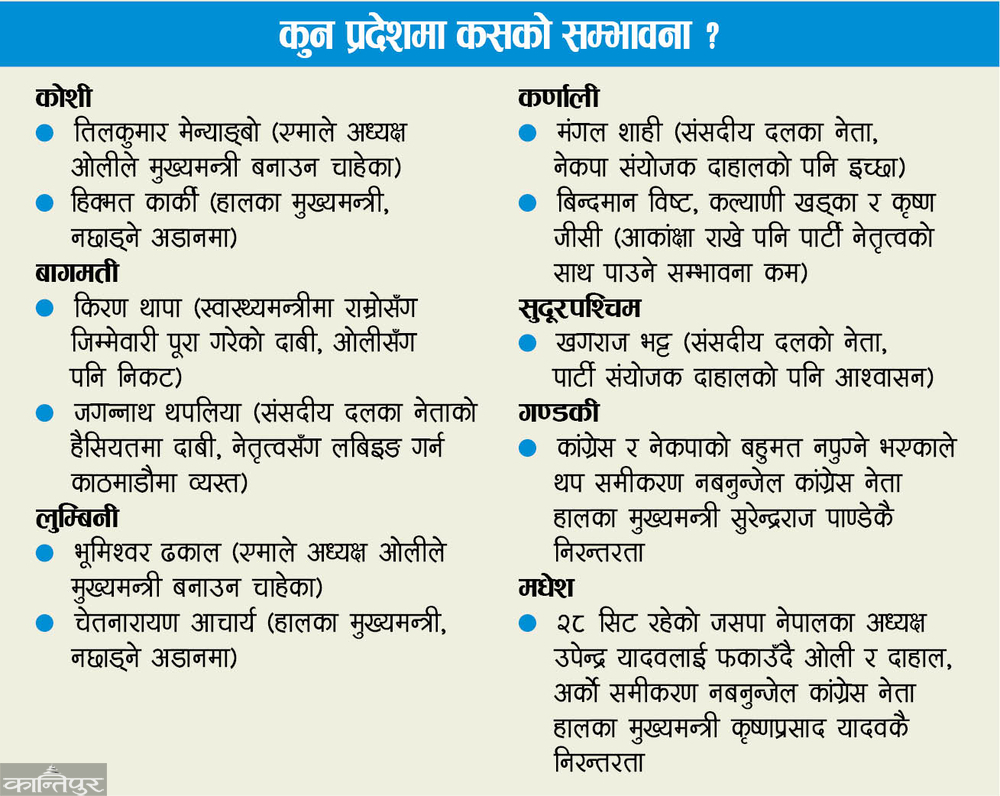
Leaders are waiting for Chief Minister Kamal Bahadur Shah’s resignation. Both parties have already called on Chief Minister Shah to pave the way. UML, which was a coalition partner in Shah’s government, withdrew its support on 31 Asar, and after the top-level understanding between UML and CPN on Saturday, the CPN also urged Shah to step aside. “As politics has taken a new course, we request the Chief Minister to pave the way,” said CPN parliamentary party leader Khagaraj Bhatt.
Chief Minister Shah is currently in Kathmandu for discussions with the party center. Shah has said he will make an appropriate decision after consulting with top party leaders. “I will act according to constitutional provisions; I will return to Dhangadhi and make an appropriate decision,” he said.
Meanwhile, as the Sudurpaschim provincial government is in a budget-less state, there is pressure to form a new government and bring the budget as soon as possible. The Congress-led coalition government, with UML as a partner, had presented the budget for fiscal year 2083/84 in the provincial assembly on 1 Asar with the agreement of ministers from both parties. However, after the budget was presented, UML rejected it and registered a proposal in the provincial assembly to cut the expenditure of all six ministries to just one rupee, leading to the breakdown of the UML-Congress partnership. In the 53-member Sudurpaschim Provincial Assembly, a majority requires 27 members. With 20 members (excluding the Speaker and one suspended member), the CPN is the largest party in the assembly. UML has 11 members. Together, the two parties will have 31 members.
The CPN was formed by merging the former CPN (Maoist), CPN (Unified Socialist), and NUPA. The Maoists had 11, CPN (Unified Socialist) 4, and NUPA 7 members. Even now, two groups each from the former Maoists and NUPA remain active, according to one assembly member. While it may not be difficult for the former Maoists to accept Bhatt as chief minister, there is competition for ministerial positions.
Meanwhile, of the seven former NUPA members, five are loyal to Resham Chaudhary and mobilized by him, while only two are said to support NUPA Chair Ranjita Shrestha, according to NUPA leaders.
The CPN has secured the chief ministership in Karnali. Mangal Shahi is the leader of the CPN parliamentary party. Coordinator Dahal has already said it would be appropriate to make the party leader the chief minister. However, CPN members Bindaman Bista, Kalyani Khadka, and Krishna GC are also aspirants, according to party leaders. The process to form a new government in Karnali has already begun. Karnali Province Chief Yagya Raj Joshi on Saturday called on provincial assembly members to submit claims for the chief ministership by 4 p.m. Tuesday.
Chief Minister Kandel was appointed on 27 Chaitra 2080 as chief minister from the UML and former CPN (Maoist) coalition. But after the partnership between the two parties broke down, Congress began supporting him from 21 Saun 2081. Since then, Congress and UML have run a joint government. However, on 31 Asar, four Congress ministers resigned collectively, and the next day a no-confidence motion was registered against the chief minister. The Congress and CPN parliamentary party meetings on Wednesday and Thursday decided to vote in favor of the no-confidence motion. Congress parliamentary party leader Jeevan Bahadur Shahi was proposed as chief minister in the no-confidence motion. However, a Congress assembly member said the possibility of him becoming chief minister has been averted for now.
No party has a clear majority in Karnali. UML and CPN together have a majority. In the 40-member Karnali Provincial Assembly, Congress has 15, CPN 13, UML (including the Speaker) 10, RPP 1, and one independent member. A majority requires 21 members. In Bagmati, there are two main aspirants for chief minister within UML. Provincial parliamentary party leader Jagannath Thapaliya from Chitwan and outgoing Health Minister Kiran Thapa from Bhaktapur are seen as the main contenders. Both leaders have been lobbying intensively with the party leadership to secure the decision in their favor. Thapaliya and Thapa have been in Kathmandu for two weeks lobbying.
Both leaders are waiting for the central decision. “Party leader Thapaliya is naturally a candidate for chief minister, but Kiran Thapa, who claims to have performed well as provincial health minister, has also staked his claim,” said a central UML official. “Both have legitimate claims to the chief ministership; the party will decide soon.”
Thapaliya, who has also served as provincial finance minister, was considered a future chief minister when the joint government with Congress was formed on 9 Saun 2080, based on an agreement to share the leadership for half the term each.
Under the new power equation, Lumbini Province has gone to UML. Currently, UML’s Chet Narayan Acharya is the chief minister in Lumbini. However, party chair Oli wants to replace him with another UML leader and central committee member, Bhumi Shwar Dhakal. Dhakal previously served as Minister for Physical Infrastructure Development in Acharya’s government. However, during the preparation of the current fiscal year’s budget, Chief Minister Acharya removed UML ministers and appointed new ones. Along with the ministers removed just before the budget, some other provincial assembly members are lobbying for Dhakal to become chief minister.
However, UML Vice Chair Bishnu Poudel supports Acharya’s continuation. Meanwhile, General Secretary Shankar Pokharel is backing Dhakal, whom Chair Oli also favors. At the UML’s party reorganization meeting in Lumbini Province, Chair Oli was dissatisfied with Acharya for not lobbying in his favor. Acharya was absent from the meeting. Dhakal, on the other hand, attended and argued that if the party is to be reorganized, it should be done at all levels and positions, otherwise removing Oli as chair alone would not suffice. That is why Oli is now pushing for Dhakal as chief minister. However, some UML leaders and provincial assembly members are also lobbying for Leela Giri, who previously served as chief minister for only three months, to be appointed if there is to be a change.
Current Chief Minister Acharya said the government would continue, and after Congress ministers resign on Monday, the process of government reformation would begin. “If the party decides, I will abide by that decision,” he said. “But until the party decides, this government will continue.” He said that since all members of the UML parliamentary party are eligible to claim the chief ministership, anyone can stake a claim, but the party’s decision is necessary to become chief minister or party leader.
When UML and CPN agreed on Saturday to form joint governments in the provinces, Gandaki’s Chief Minister Surendra Raj Pandey appeared “safe.” Oli and Dahal agreed that UML would lead Koshi, Bagmati, and Lumbini, while CPN would lead Karnali and Sudurpaschim. In Gandaki, the Congress-led government is stronger than in other provinces, so Chief Minister Pandey appears secure. In the 59-member provincial assembly, a majority requires 30 members. Congress has 27 members. RPP has 2, and NESP’s 1 member, Phanindra Devkota, has already pledged support to Pandey. As long as these three continue their support, Congress will have a majority. UML has 22 and CPN 7 members in Gandaki. Of the 7 CPN members, Speaker Krishna Prasad Dhital cannot vote.
In Koshi Province, UML parliamentary party deputy leader Tilak Kumar Menyangbo is almost certain to become chief minister. Oli is preparing to replace incumbent Chief Minister Hikmat Karki with Menyangbo, according to close leaders. Chief Minister Karki, however, says there has been no discussion about his resignation. In Madhesh, Congress’s Krishna Prasad Yadav is chief minister, with the support of Congress, UML, and CPN. All three parties are in government. Oli and Dahal are set to discuss leadership change in Madhesh with JSP Nepal Chair Upendra Yadav.