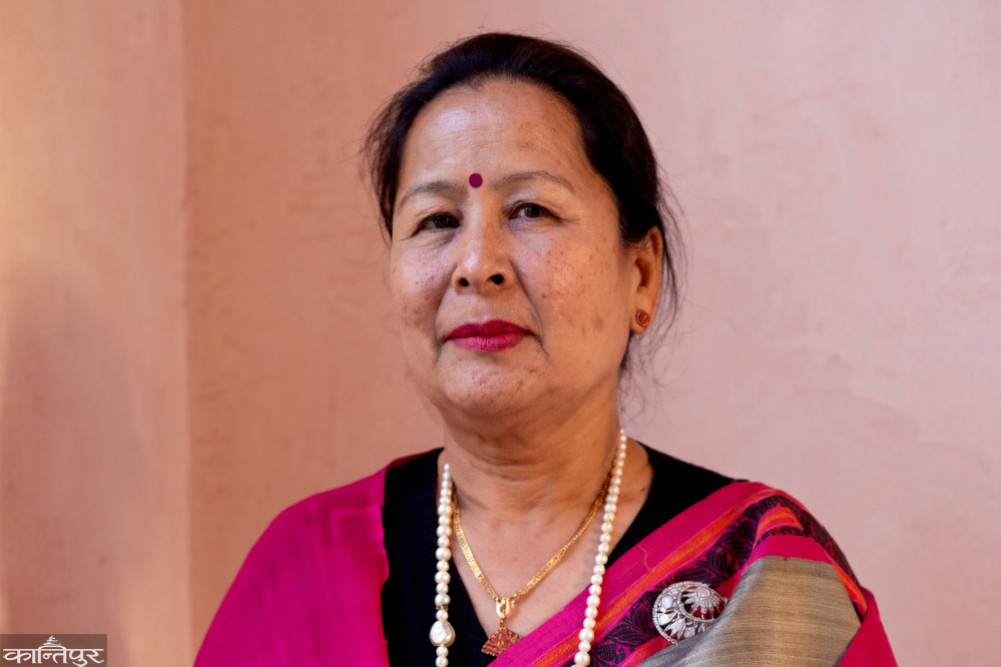
She, who has been facing criticism for getting the opportunity to be the wife of a leader, has resolved to establish herself as a responsible MP in Parliament.
We use Google Cloud Translation Services. Google requires we provide the following disclaimer relating to use of this service:
This service may contain translations powered by Google. Google disclaims all warranties related to the translations, expressed or implied, including any warranties of accuracy, reliability, and any implied warranties of merchantability, fitness for a particular purpose, and noninfringement.
The House of Representatives elections held on 21 Falgun established many new faces in national politics. One of them is Saraswati Lama.
The Rastriya Prajatantra Party (RPP) won only one seat directly, but after crossing the legal threshold, it won four seats through proportional representation. Among them, it was decided to make Lama an MP from the women's quota. With this decision, her name came to the center of both discussion and controversy.
I have never I did not think of asking for a position based on my husband's name, I believed that one day my contribution would be appreciated. Some praised the worker who has contributed to the party for a long time for getting the opportunity. Others accused her of getting the opportunity by identifying her as the wife of RPP senior leader Buddhiman Tamang. But Lama does not seem to be disturbed by these criticisms. Instead, she says, 'Criticism is an inspiration for me. Now I will respond by working actively in the House.'
Saraswati Lama's political journey began in 2047. After the restoration of multi-party democracy, she joined the RPP. Her ideal leaders were Surya Bahadur Thapa and Lokendra Bahadur Chand. Influenced by the political style and perspective of these leaders, she became active in politics. Initially, she started practicing politics from the student organization and gradually strengthened her presence in party activities.
During this period, she married Buddhiman Tamang. After that, home and politics began to move forward together in her life. She moved forward while balancing household responsibilities and political activism. However, for a few years, she could not be active in a formal position, but her relationship with the party never broke. 'I never thought of asking for a position based on my husband's name,' she says, 'I believed that one day one's contribution will definitely be appreciated.'
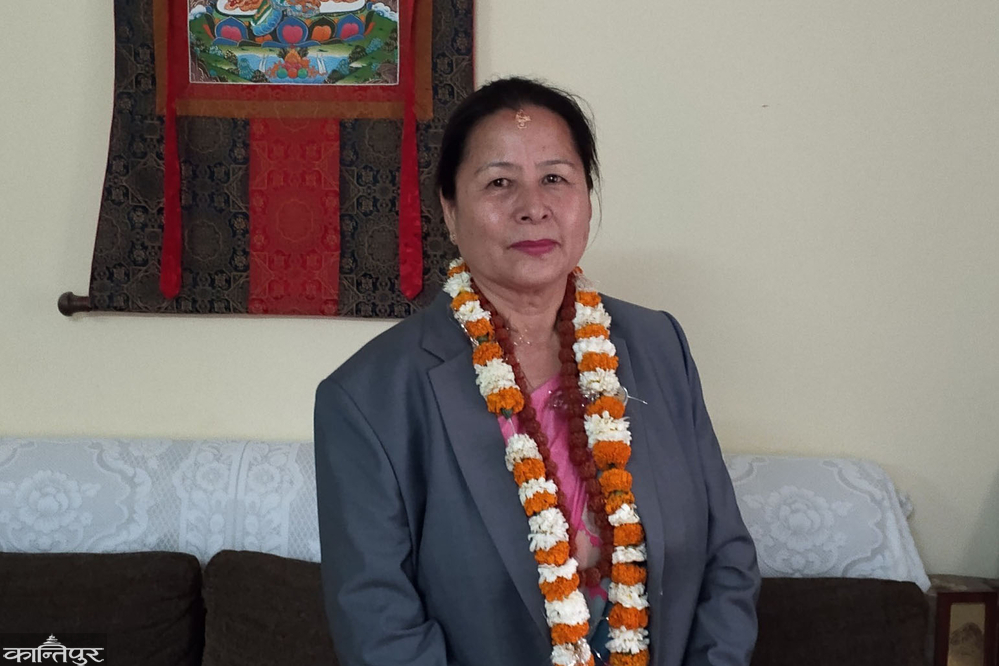
Although she had to stay away from active politics for some time due to family reasons, she became active again after Surya Bahadur Thapa left the RPP and formed the Rastriya Janshakti Party. She became a central member of the Janshakti Party. Later, after the RPP and Janshakti Party merged, she returned to mainstream politics. She continued her activism by becoming a general convention representative from Dhading.
She was arrested during a protest in front of the Indian Embassy after India published a new map including Lipulekh. After her husband became active within the party, she gave up some opportunities after receiving suggestions that it would not be appropriate for both of them to compete for the same position. After that, she focused on women's organizations. She contributed to strengthening the organization by assuming the responsibility of the vice-president of the women's department. This role made her known among the top leadership. Later, she became an invited central member and then an elected central member.
Lama, who became an elected central member from the general convention led by Rajendra Lingden, had wanted to become the chairperson of the women's department. But in accordance with the policy of 'one person, one post', she withdrew her claim.
She has gone through many stages of struggle in her political journey of about 35 years. She had to endure beatings during the movement, and sometimes had to be in police custody. She was arrested while participating in a protest in front of the Indian Embassy after India published a new map including Lipulekh. 'At that time, I was not arrested as someone's wife, but as a worker,' she recalls.
Today, when she became a member of the federal parliament, questions are still raised on her. But she considers such comments natural. 'Only those who do not understand my contribution say this,' she says, 'Those who have seen my journey, they consider it justice.'
Lama, who had the opportunity to study only up to SLC, has now decided to reach the place where the country's laws are made and raise the voice of the people. She is confident, 'Now I will establish my identity as a responsible MP, not someone's wife.'